
Installation of a GREE FreeMatch R32 two-head wall-mounted heat pump in Saint-Damase, MRC des Maskoutains
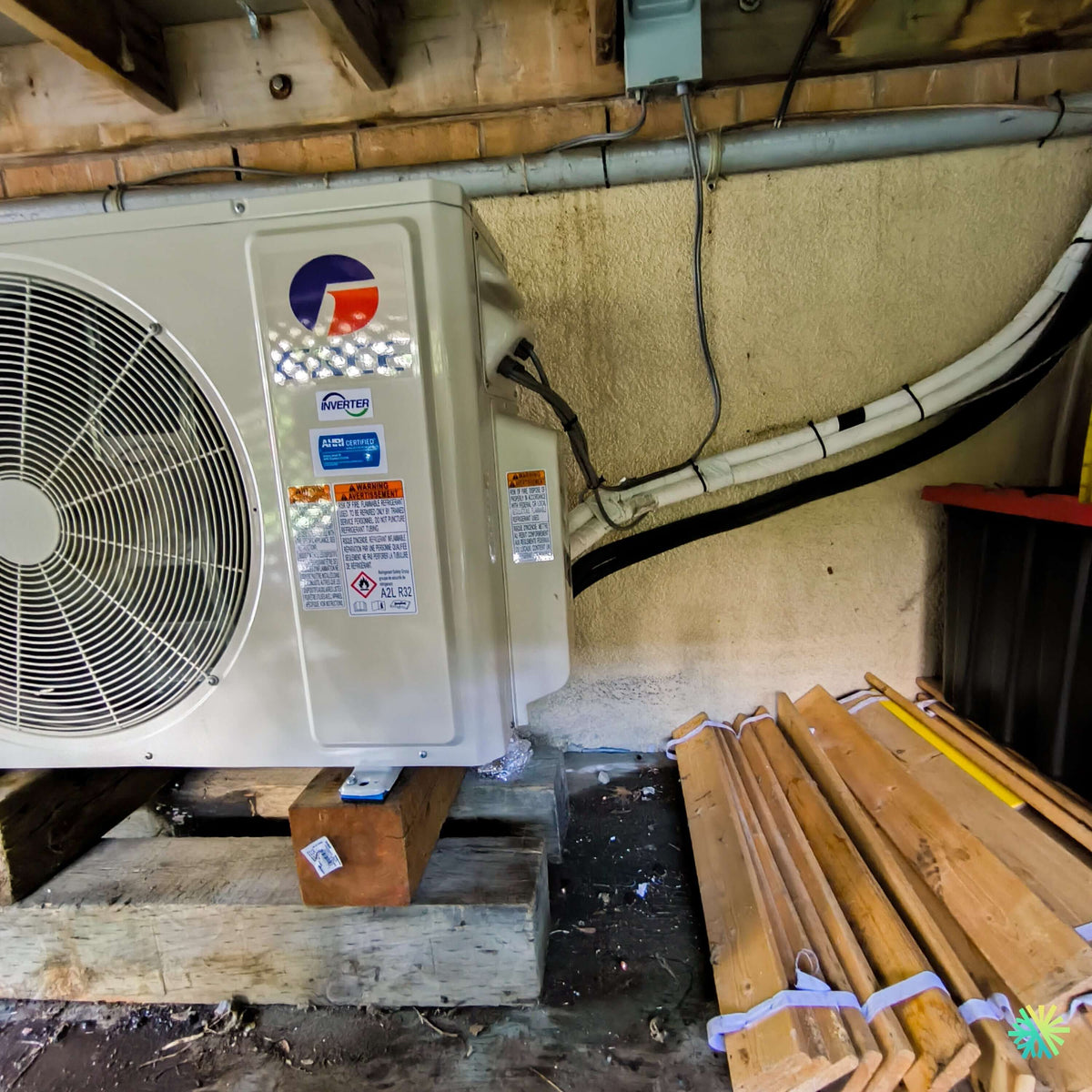
Beneath a Saint-Damase row house, the outdoor unit sits in an enclosed space with an earth floor, beneath the joists of the occupied floor above. Where does the defrost water go, what does livestock air do to the copper, and why did the available space lead to choosing the GREE FreeMatch R32 model?
- City
- Region
- Equipment
- Brand
- Challenges
- Published
The job on one screen
The article, chapter by chapter
An outdoor unit beneath an occupied floor: what the water does to the wood above it
An outdoor unit from a heat pump rarely ends up where the drawing placed it. At Saint-Damase, it ended up in the enclosed space beneath the main body of the house: exposed floor joists a few dozen centimeters above the top of the cabinet, stuccoed foundation walls on two sides, an earthen floor, a disconnect switch screwed directly into a joist, and a stack of lumber leaning against the adjacent wall.
This is not an installation beneath a deck. We have already written twice about that situation—the horizontal surface above a unit, the boards that let water through, and snow pushed off the deck floor—and none of that applies here. Beneath a deck, the unit remains outdoors: there is wind, soil that drains, possible evaporation, and sunlight that sometimes reaches it. In the crawl space beneath a house, none of that exists. It is an enclosed space, without light or significant air movement, with an earthen floor below and a wooden structure occupied above.
The technical question on this page can be summed up in one sentence: a heat pump produces water, and you need to know where that water goes.
What the photo shows—and what it does not say
It shows a GREE condenser using R32, with its A2L labels clearly visible, resting on two pieces of wood directly on the ground. It shows the line set running up to the right beneath white insulation, a rigid conduit running along the sill plate, and a disconnect switch mounted on the wooden structure. It does not say whether this space is ventilated on one side, whether the ground has already been covered with a vapor barrier, or what was there before. These are exactly the three things a technical inspection will verify before anything is secured in place.
Defrost water is winter water, and here it has nowhere to go
The least intuitive point about a heat pump for a homeowner is that the outdoor unit produces water in winter, not in summer. In cooling mode, the water is produced indoors and exits through the head unit’s drain. In heating mode, the opposite happens: the outdoor coil drops below the dew point, becomes covered in frost, and the unit reverses its cycle to melt it. That water falls beneath the unit several times a day, from November to April.
On ordinary ground, it falls into a bed of stone and disappears. In an enclosed space beneath a house, three things hold it back:
- There is no thaw cycle. A shaded cavity that stays shaded year-round never experiences the warm spell that, outdoors, resets the balance. What freezes stays frozen and adds to the deposit from the previous day.
- There is no wind. Evaporation, which makes much of the water from a unit disappear in the open air, does not occur here.
- The bare earth floor is itself a source. Bare ground beneath a building continuously releases vapor. We add several liters of liquid water per day of heating to this already-humid space.
The result is never an error code. It is a space whose relative humidity rises all winter, without anyone going downstairs to check.
The cold side of the floor
This is where the problem stops being an HVAC problem and becomes a building problem.
The floor above is heated on one side and cold on the other. When the air in an enclosed space becomes humid, the first surface on which that moisture settles is the coldest one it encounters: the underside of the subfloor, the sides of the joists, and the ends resting on the sill plate. The wood absorbs moisture and does not dry—since there is neither air movement nor sunlight—and wood that remains above roughly twenty percent moisture content for months is wood in which rot can begin.
We published a related version of this mechanism on our Brossard page: a unit installed on a deck, whose runoff always falls in the same place, with the joist beneath that runoff line becoming a starting point for rot. The Saint-Damase case is the exact inversion. There, the unit was above and the water fell into an open space that no one watches. Here, the unit is below, the water remains in an enclosed space, and what the moisture attacks is not a deck structure but the load-bearing structure of a floor over an occupied space.
What we do with this interpretation, concretely:
- The ground must be addressed before the unit. A continuous vapor barrier on the ground, brought up and sealed, is not HVAC work—it is building work, and it must be done before our visit or the location will change.
- Defrost water must be directed out of the space, beyond the perimeter, and never against a foundation wall or beneath the sill plate. That point belongs on our Cèdres and Saint-Eustache pages, and we will not reargue it here.
- Ventilation of the space is a requirement, not an upgrade. An enclosed space that receives liquid water all winter must have an airflow path. If it does not, the unit cannot go there.
- The structure’s wood must be measured, not judged by appearance. A pin-type moisture meter costs a few dozen dollars, and a reading taken at installation creates a baseline for comparison the following year.
Is a covered outdoor space a room?
R32 belongs to the A2L category: mildly flammable and denser than air. That is why installation manuals require a minimum room area, calculated from the system’s total charge, and why our Dundee and Sainte-Martine pages established that this check must be repeated after the final line lengths are known, never at the quotation stage.
The question raised by this photo has never been settled on our pages, and we will not settle it here either: is a covered outdoor space, enclosed on three sides and at a low point, to be treated as open air or as a room? Physically, a fluid denser than air that leaks into an enclosed depression does not behave as it would in a yard. From a regulatory standpoint, the answer belongs to the equipment’s supplied manual and the applicable regulations, not to an installer’s intuition or a quote.
Our position is methodological: when an outdoor location is confined and below grade, we put the question in writing in the file, have it decided before drilling, and publish no numerical threshold. A contractor who replies, “It’s outside, so it doesn’t apply,” is answering too quickly.
Lumber stored against the wall raises the same issue. A stack of boards in a low space, against equipment containing a mildly flammable refrigerant, is not merely a construction-site aesthetics problem. It also occupies the intake clearance, shelters rodents that eventually end up in the control box, and shifts board by board—that is, by rubbing against the fins. The general rule, “nothing stored around or beneath the equipment,” belongs to our Ahuntsic-Cartierville page; here we are only adding the further reason.
What we have not argued again
Three topics prompted by this photo that the series has already addressed elsewhere, cited rather than repeated:
- Wooden sleepers. Two pieces of wood placed directly on the ground as a base, they are the subject of our Sainte-Christine pages (“a plank is not a shim”—one foot sinks and the bin stops draining) and of Saint-Théodore-d'Acton (same wood species, same treatment, same age, replaced as a complete set). In a damp space, the deadline is simply shorter.
- Vibration toward the occupied floor above. A floor-mounted appliance transfers its vibration to the floor; a wooden structure conducts it. This mechanism is discussed in Saint-Eustache and Saint-Chrysostome, and the practical conclusion is the same: read the layout of the rooms above before choosing the location, and do not install it beneath a bedroom.
- The disconnect switch. It remains visible, accessible, and never behind something that must be moved — that is the rule from our Côte Saint-Luc page. Mounted on a floor joist, it also raises a support question for the electrician, not for us.
The task that cannot be performed
One final point, and it is the one that costs the most in the long term. An appliance is maintained and repaired where it was installed. In a low-ceilinged space, a series of routine tasks become difficult or impossible: lifting the top panel when a joist is directly above it, setting up a manifold, removing a 35 kg cabinet from its location, pulling a hose to the coil, or simply working in any position other than crouched on an earthen floor.
Service ergonomics as a siting criterion belongs to our Villeray and Sainte-Christine pages, whose principle still holds: an appliance that is difficult to service is an appliance that is serviced less effectively. At Saint-Damase, this meant measuring the clearance above the cabinet and the actual front clearance before securing the supports — and recording in writing in the handover file what will have to be moved when the appliance eventually needs to be removed.
The air a condenser breathes in livestock country
Saint-Damase is located in the Maskoutains RCM, an area of 1,312 km² with seventeen municipalities, recognized as Quebec's agri-food capital — Saint-Hyacinthe, which borders the territory, was the first Canadian city to obtain technopole status, in 1993. The municipality itself, with approximately 2,447 residents in the 2021 census across nearly 80 km², is agricultural from end to end: concession roads, field crops, and a significant poultry industry. The village's poultry slaughtering and processing plant received an investment of more than $30 million, completed in 2021, bringing its area to 150,000 sq. ft., its workforce to approximately 500 employees, and its capacity to nearly one million chickens per week.
This has a direct consequence for an outdoor coil, and it is not the one people usually think of.
Fouling and Corrosion Are Two Different Problems
Fouling is mechanical: field dust, pollen, harvest residue, a film that forms between the fins and causes heat transfer to drop. The series has covered it several times—Saint-Télesphore for field and gravel-road dust, Havelock for pollen, and Pierrefonds-Roxboro for the cleaning method, in the opposite direction, with what works and what damages a coil.
Corrosion is chemical, and it is an installation problem, not a repair problem. Our Montréal-Est page established the framework for industrial and saline atmospheres: acidic compounds that attack copper, deposits that permanently retain moisture against the metal, and above all the fact that corrosion triggers no error code.
What Saint-Damase adds is a type of chemistry we had not yet named: that of livestock facilities and spreading operations. Ammonia compounds are well documented as aggressive toward copper and its alloys, and a unit that breathes, for several months a year, the air of a row where manure is spread and transported does not operate in the same atmosphere as a suburban unit. We will publish no rates, estimated service lives, or promises: that would be invention. We are stating what can be verified—that the mechanism exists, that it is silent, and that it should be addressed at the time of purchase rather than after a breakdown.
The Agricultural Calendar Is the Air-Conditioning Calendar
The detail that makes this concrete: the times when the air in the row is most heavily laden—spring and autumn spreading, ploughing, harvesting, and heavy traffic on the roads—largely overlap with the months when the unit runs the most. Unlike the indoor coil, the outdoor coil has no filter. Whatever is carried in the air passes through the fins.
A condenser does not breathe the air from the weather station; it breathes the air of its own square metre. On this job, that translated into two simple decisions: do not orient the intake side toward the row, and choose a location sheltered from the direct movement of dust. The rest—the cleaning frequency determined by the environment rather than the calendar—is already covered in our previous pages, and we refer you to them rather than turning it into another rule.
Three Questions to Ask Your Contractor
They come from our Montréal-Est page and apply in full to agricultural environments:
- Does this model's coil receive a factory treatment against corrosion, and if so, which one?
- Does this treatment, or the lack thereof, change anything about the warranty in an aggressive environment?
- What cleaning frequency does the manufacturer require for the warranty to remain valid in this type of environment?
A contractor who has never asked these questions of their distributor will sell you the same equipment at the same price for a farm road in Saint-Damase and for a street in Longueuil. It is not the same contract.
The selected configuration
| Item | Value |
|---|---|
| Outdoor unit | GWHD(18)ND6MO — AHRI 214931586 / 591 / 592 |
| Nominal capacity | 18,000 BTU/h in cooling and heating |
| Modulated range | 7,300 to 19,800 BTU/h in cooling · 7,300 to 18,100 BTU/h in heating |
| Heads | wall-mounted 9,000 BTU/h + wall-mounted 9,000 BTU/h = 18,000 BTU/h (100% of nominal) |
| Efficiency | SEER2 21 · HSPF2 10 · EER2 12.5 · COP 3.9 — ENERGY STAR certified |
| Operating ranges | −30 to 48 °C in cooling · −30 to 24 °C in heating |
| Electrical | MCA 14.5 A · maximum overcurrent protection 20 A |
| Cabinet | 822 × 550 × 352 mm · 35.5 kg · 54 dB(A) |
| Refrigerant | R32, factory charge 900 g, 10 m factory charge |
| Lines | 6 m + 11 m = 17 m developed length → 140 g of R32 weighed and added, final charge 1,040 g |
| Leak detection | Integrated A2L sensor, standard |
| Warranty | 10 years, with a 2-year extension upon registration |
Two comments that matter more than the figures themselves.
It was not the heat load that determined the model; it was the available volume. The argument is the one from our Charlemagne page, applied to a different constraint: the GWHD(18) is the smallest cabinet in the FreeMatch range — 822 mm wide, 352 mm deep, 35.5 kg — and it was the only one that left acceptable service clearance and headroom in this crawl space. A larger compressor would have fit in it; it would not have been serviced there.
The additional 140 g is not an administrative detail. At 17 metres of developed length, we exceed the 10-metre factory charge, and the top-up is calculated and then weighed — it is not estimated. Above all, the final 1,040 g charge becomes the value against which the A2L-required minimum room area verification must be redone, head by head, after the lines are installed and not at the quotation stage.
Mistakes we see in this type of location
- Treat a crawl space like the outdoors. It has no wind, sunlight, drainage, or freeze-thaw cycle.
- Letting defrost water drain onto a dirt floor and assuming the ground will absorb it. In January, the ground is frozen.
- Installing the unit before the floor is treated. The floor vapour barrier cannot be installed around an appliance that has already been installed.
- Storing wood, tires, or tools in the same space. It is a service area, not storage.
- Choosing the model based solely on the load when the ceiling height determines everything.
- Never go back down there. This space is not inspected by chance: two minutes in November and two minutes in April, with a moisture meter in hand, are worth more than any diagnostic.
Grants and eligibility
GREE FreeMatch R32 systems certified by ENERGY STAR are generally among the equipment eligible for assistance programs in effect in Quebec. The criteria, amounts, and documentation requirements change from year to year and depend on the building's existing heating system. At AirGreen, we verify eligibility for the project before ordering, and we provide the AHRI numbers along with the efficiency documentation required to prepare the application. We do not promise any amount before this verification.
AirGreen in the Les Maskoutains RCM
Let us clarify this, because the confusion is constant: this is Saint-Damase des Maskoutains in Montérégie, not Saint-Damase in Matapédia or Saint-Damase-de-L'Islet. The village was given its name on December 11, 1820, by Bishop Joseph-Octave Plessis in honour of Saint Damasus I — and not, contrary to what is often written, in tribute to Father Damase Ricard, who was only twenty years old at the time. The current municipality was created by merging the village and parish on October 5, 2001.
We regularly work in the Saint-Hyacinthe area — La Présentation, Saint-Liboire, Sainte-Madeleine — as well as throughout Montérégie, in addition to our regular volume in Montréal, Laval, Longueuil, on the North Shore, and on the South Shore. Installing a wall-mounted heat pump or wall-mounted air conditioner in an agricultural setting is particular because it must be assessed based on two things that no one includes in a quote: where the water will go and the air the unit breathes.
For an assessment in Saint-Damase, whether in the rural areas or the village, our team comes to the site, measures the ceiling height as well as the house, and provides a quote indicating where the water will go.
The job tools
Two quick checks with real numbers: what heat costs, and what your current heaters add up to in BTU/h.
Conversion: 1 W = 3.412 BTU/h. An indication, not a load calculation: baseboards and furnaces are often stronger than the real need, and they can stay as backup. AirGreen confirms the capacity on site.
How the job unfolds
The main steps of this kind of job at AirGreen. Every house has its quirks: the estimate brings them out.
We look at the room, the outside wall, the line route and where the outdoor unit will go. That is where the capacity gets chosen.
Model, capacity and price, in writing. We also check whether the model qualifies for assistance programs.
Floors and furniture protected, wall plate position marked level, wall opening located.
A single opening, with the slope the drain needs to flow outside.
Set on a stand raised above the snow, with the clearances the manufacturer requires.
Connected, insulated and protected. The opening is then sealed against water, cold air and insects.
A dedicated circuit and an accessible disconnect near the outdoor unit.
Leak test, vacuum, then start-up and a check of heating and cooling.
Remote, modes, filters: we show you the essentials before we leave.
- The on-site estimateWe look at the room, the outside wall, the line route and where the outdoor unit will go. That is where the capacity gets chosen.
- The quoteModel, capacity and price, in writing. We also check whether the model qualifies for assistance programs.
- Getting readyFloors and furniture protected, wall plate position marked level, wall opening located.
- The wall openingA single opening, with the slope the drain needs to flow outside.
- The outdoor unitSet on a stand raised above the snow, with the clearances the manufacturer requires.
- Lines, cable and drainConnected, insulated and protected. The opening is then sealed against water, cold air and insects.
- The electrical workA dedicated circuit and an accessible disconnect near the outdoor unit.
- Tests and start-upLeak test, vacuum, then start-up and a check of heating and cooling.
- The walkthroughRemote, modes, filters: we show you the essentials before we leave.
What we check on a job like this one
Each number is a point we check on site. Switch between summer and winter to watch air and heat move.
In summer, the outdoor unit rejects the house's heat outside.
Generic illustration of this type of installation, not a survey of this job site. Tap a number.
Mounted level on a wall plate, high enough for the air to reach the whole room, with enough space around it to slide the filters out easily.
The refrigerant lines, the communication cable and the drain go through the wall in a single opening, sealed against water, cold air and insects.
Two insulated copper pipes connect the two units. Outside, a line cover can protect them from sun, knocks and weather.
A shut-off switch near the outdoor unit isolates it safely for service. It must stay accessible at all times.
The compressor and the fan. In heating mode it captures heat from the outdoor air, even in winter, and moves it inside.
On the ground or on the wall, it keeps the unit above accumulated snow. The unit stays clear and defrost water can drain away.
The fan needs to blow freely. Storage, a fence or a wall too close, and efficiency drops while noise goes up.
Is your home ready?
Check what applies at your place. A "no" is not a refusal: it is what we sort out during the estimate.
Good habits, once the unit is in place
Six simple habits that keep the unit going. Your list stays on this device.
What to do, season by season
Three habits per season for this unit. They take a few minutes and prevent many calls.
- Clean the indoor unit's filters.
- Clear leaves and debris left on the outdoor unit by winter.
- Test cooling before the first hot days.
- Clean the filters more often when the unit runs a lot.
- Keep plants away from the outdoor unit.
- Check that no water drips from the indoor unit.
- Rake the leaves around the outdoor unit.
- Test heating before the first cold days.
- Book periodic maintenance before winter.
- Keep snow away from the stand and the front of the unit.
- Let the unit defrost: it is normal.
- Never hit the ice on the fins; call us if the unit stays iced up.
The right pages, at the right time
Four statements: true or false?
It all comes down to details you have just seen.
1. In heating mode, the outdoor unit can produce water.
During defrost cycles. That water must drain away without forming ice.
2. You pick the capacity with a simple square-footage rule.
Windows, insulation, orientation and how the room is used all count. Capacity is chosen on site.
3. A multi-zone connects several indoor heads to a single condenser.
One head per room, all on the same condenser. Each room keeps its own temperature.
4. The disconnect can sit behind the patio furniture.
It must stay accessible: it is what shuts the unit off for service.
0 / 4 right answers
What people ask us about this kind of work
Does a wall-mounted heat pump heat in winter?
Wall-mounted or multi-zone: how do I choose?
Where does the outdoor unit go?
Are there grants?
Do I need a permit?
How cold can it heat?
How much can I save?
How is the LogisVert assistance calculated?
Is it noisy?
The outdoor unit is covered in ice: is that normal?
Does AirGreen hold the required licences?
Is the estimate free?
No question matches. Write to us: we answer.
More jobs to see, near you
By town, by equipment or by region: browse more than 4,700 published projects.
Each dot: a town where AirGreen has published projects. The glowing dot: this job.
An on-site estimate, the right capacity, the right equipment.
The on-site estimate is free and the quote follows within 24 hours.
Text and photo: a real AirGreen Climatisation & Chauffage job. The diagrams are generic illustrations of the type of installation, not a survey of this job site. Sources of the added figures: airgreen.ca product pages (NEEP / AHRI performance), Hydro-Québec (Heat pumps page, LogisVert, read on 13 October 2026), Régie de l’énergie (rate D as of 1 April 2026).