
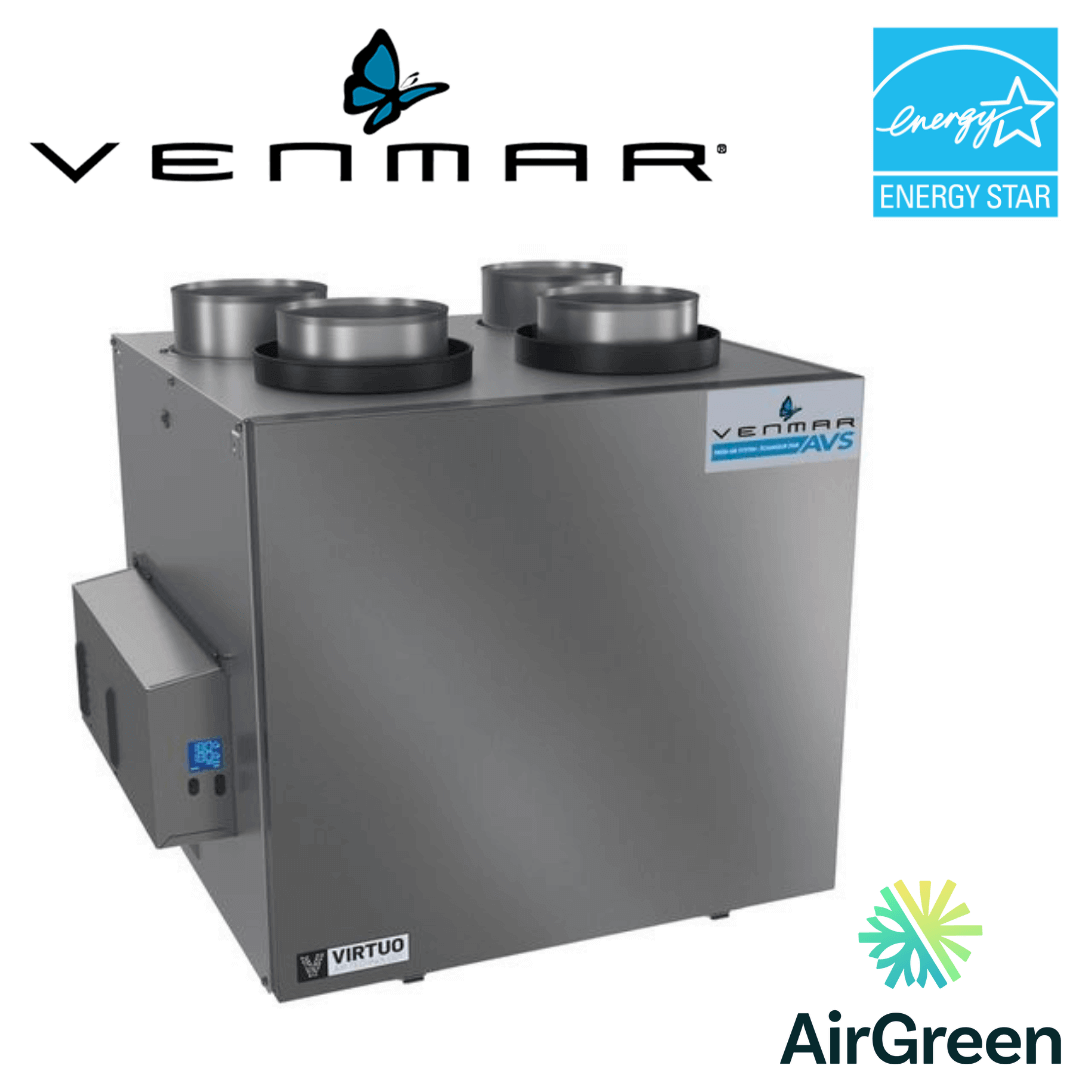
Air Exchanger VENMAR AVS® AI2 SERIES A180E75RT Greater Montreal
Is it the right size for your home?
It delivers 182 cfm net, enough to ventilate 2,100 to 3,400 sq ft. Choose your home's living area.
It's the right size.
For a 2,500 to 3,200 sq ft home, about 150 cfm of air needs to be renewed continuously. This unit delivers 182 cfm net — enough for the house, with extra capacity to boost ventilation for the bathroom and kitchen.
Calculation: 0.35 air changes per hour over the living volume, with 9 ft ceilings. We set the exact airflow during our on-site assessment.
What it does, in numbers
$22.45
Electricity per year
Less than a 60 W light bulb
Bulbs left on day and night. Same calculation for every line: wattage × 8,760 h × 11.142 ¢/kWh.
Meets both thresholds of the Québec Construction Code (art. 9.36.3.9). At −25 °C and at least 22 L/s, the Code (art. 9.36.3.9, in force since April 17, 2025) requires 55% where there are fewer than 6,000 heating degree-days and 60% elsewhere. This unit is rated at 64% at 83 cfm (HVI).
Airflow and efficiency: manufacturer's data; airflow at 0.4 in and power draw from the V180E75RT spec sheet. Cost: 23 W over 8,760 h at Hydro-Québec's Rate D second tier (11.142 ¢/kWh).
What you should know about this one
Published, verifiable facts, not brochure claims.
Top onlyThe 180 cfm size comes with top ports only
The platform comes with top or side ports, but Venmar notes the 180 cfm models are only available with top ports. The 210 and 230 cfm models also come in a side-port (RS) version.
−30 cfmProtects its core membrane when ducts are too restrictive
If the maximum airflow reached during auto-balancing is 130 cfm or less, the unit takes 30 cfm off to keep the ERV core membrane from deforming under very high static pressure (over 1.3 in w.g.).
64%What it still recovers at −25 °C
The only efficiency figure that matters for a Québec winter, and the one the Code uses. An efficiency quoted without its temperature means nothing; this one is measured at a test airflow of 83 cfm.
DamperIt defrosts with indoor air
In cold weather, a motorized damper closes the outdoor air intake and recirculates indoor air through the core to thaw it. During the cycle, no outdoor air comes in through the unit.
ERVIt moves moisture too, not just heat
An ERV transfers some moisture between the two airstreams. Useful in a house that gets too dry in winter or takes on a lot of humidity in summer. The trade-off: it generally recovers less heat than a comparable HRV.
−7 cfmWhat the ducts cost it
Between a nearly unrestricted test bench (0.2 in) and a real duct system (0.4 in), it drops from 189 to 182 cfm. Most spec sheets show only the first number, precisely because it looks better.
23 WMeasured at the airflow it actually runs at
Its 81% at 0 °C is measured at 66 cfm, the continuous airflow of a typical home. At that setting it draws 23 W, or about 201 kWh a year.
5 yearsThe core warranty
The core does the work and is the most expensive part to replace. Motors and parts: 5 years.
6 inWhat it needs on site
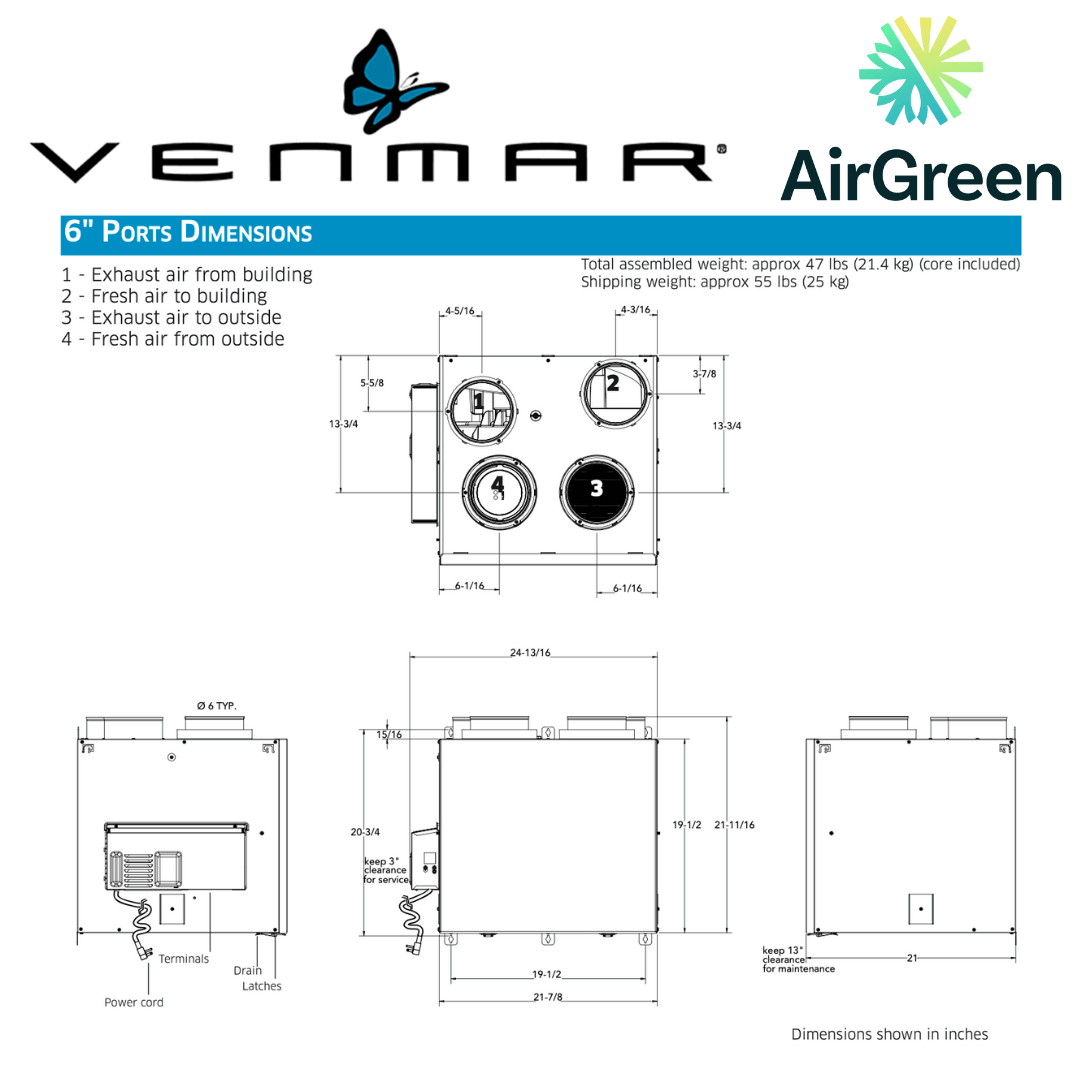
6 in ducts, top connection. It weighs 47 lb, and it needs enough clearance to slide the core out for cleaning.
What it needs on site
In a condo with no floor drain, or with little ceiling clearance, we usually look at a side-port model instead. Our estimator checks the location, the drain and the duct route before ordering.
Complete spec sheetData and cited sources
- Net airflow at 0.2 in. w.g.
- 189 cfm
- Net airflow at 0.4 in. w.g.
- 182 cfm
- SRE at 0 °C (66 cfm)
- 81%
- SRE at −25 °C (83 cfm)
- 64%
- ASE at 0 °C
- 84%
- Power draw
- 23 W
- Efficacy
- 2.9 cfm/W
- Type
- ERV
- Connection
- Top ports
- Duct collars
- 6 in
- Defrost cycle
- Recirculation (motorized damper)
- Filters
- Washable MERV 8 filter and washable exhaust filter included
- Dimensions (L × D × H)
- 24.81 × 21 × 21.69 in
- Weight
- 47 lb
- Power supply
- 120 V
- Warranty — core
- 5 years
- Warranty — motors
- 5 years
- Warranty — parts
- 5 years
Manufacturer's published data for this model; airflow at 0.4 in and power draw from the V180E75RT spec sheet, a model with identical published ratings. Annual consumption calculated at 23 W running continuously for 8,760 h, at Hydro-Québec's Rate D second tier (11.142 ¢/kWh), in effect since April 1, 2026.
The next model down and up

Talk to an HVAC technician before you choose
We assess your needs on site, check the location and the drain, and give you an installed price. Balancing is measured at commissioning, not estimated.
The A180E75RT never drops below 65 cfm, and needs no drain
With its 6 in. collars on top, the Ai2 Series A180E75RT runs continuously anywhere from 65 to 189 cfm. The bottom of that range matters as much as the top: the N Series ERVs we carry, such as the A160E75RT, go down to 35 cfm. If the house needs only a little continuous air, we check this during the on-site assessment before settling on the Ai2 Series.
Next to the A180H75RT, the HRV built in the same cabinet, this model has a placement advantage. Guide 23831 asks for a nearby drain only on HRVs, so the A180E75RT can go in a room with no floor drain, which widens the choice of location. And in the fall its core stays dry: a pass with the vacuum does it, no soaking.
Sources: manufacturer's pages for the A180E75RT and the A160E75RT (viewed Nov. 23, 2026); installation guide 23831.
Sold and installed by AirGreen