
Service Call for a Central Heat Pump in Îles-Laval
- Service
- Service call
- Unit
- Central heat pump
- Area
- Laval
- Published
- Reading
- 10 min

A central heat pump that started but no longer delivered its full power
In Îles-Laval, our AirGreen team was called for a common problem with ducted residential systems: a central heat pump that seemed to be working but could no longer maintain a comfortable temperature in the house. The client reported irregular behavior: the outdoor unit would start, the fan would run, but heating became unstable during colder periods and cooling lost efficiency during warmer days.
This type of HVAC service call requires a precise analysis, because a central heat pump does not operate alone. It is part of a complete system: outdoor unit, indoor coil, furnace or central blower, ducts, thermostat, condensate drain, control wiring, power supply, and refrigerant circuit. A failure in a single component can give the impression that the entire machine is at fault.
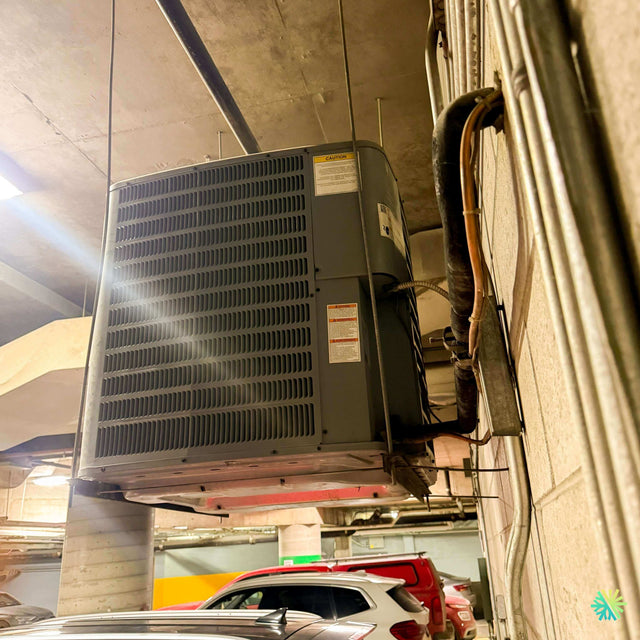
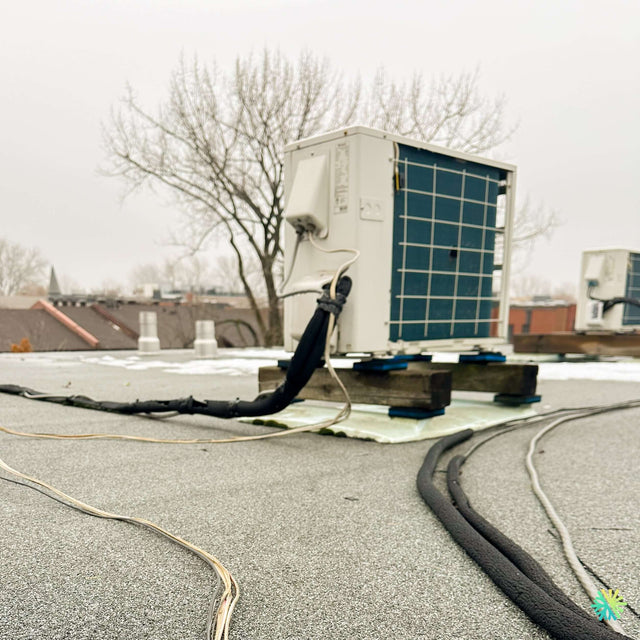
On site, the outdoor unit was installed near a brick wall, with the electrical disconnect nearby, the refrigerant lines clearly visible, and an accumulation of dead leaves at the base of the unit. The installation was typical of a Laval residence, where central heat pumps are often placed along a side wall, near the basement or mechanical room. The visual context already gave us several clues: airflow to check, clearance around the unit, condition of the outdoor coil, line insulation, drainage, vibration, and exposure to seasonal debris.
A central residential system of about 2.5 to 3 tons
The inspected device was a residential central heat pump, with an estimated capacity of around 30,000 to 36,000 BTU, or about 2.5 to 3 tons, depending on the size of the outdoor unit and the type of installation. The exact brand was not clearly identifiable from the outside at the time of the visual inspection, but the format matched a standard central system connected to a duct network.
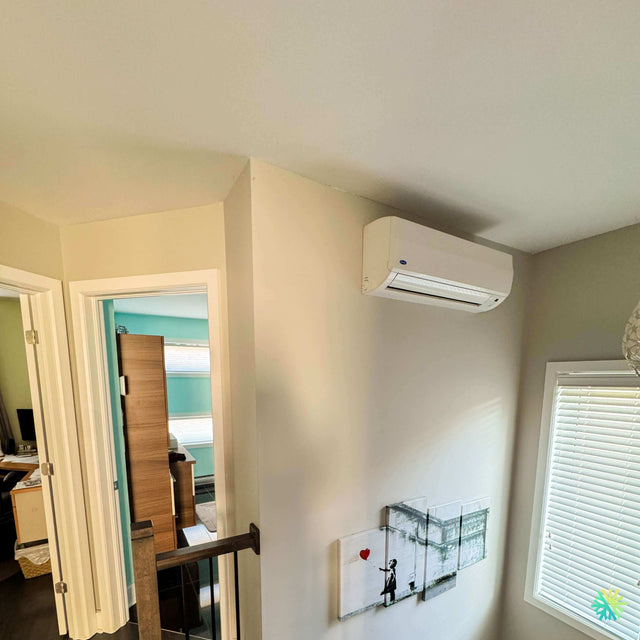
This type of system is very common in homes in Montreal, Laval, Longueuil, on the North Shore and the South Shore, especially in properties equipped with an electric furnace or a central air handler. Unlike a wall-mounted heat pump, the central heat pump distributes air to several rooms through a duct network. This allows for uniform comfort but also makes diagnosis more complex: the problem could come from the outdoor unit, the indoor blower, the thermostat, the indoor coil, the filter, the ducts, or a combination of factors.
Symptoms observed by the client
Before our intervention, the client had noticed several concerning signs:
- The temperature rose slowly in heating mode.
- The system ran longer than before.
- The air blowing from the vents seemed less warm.
- The outdoor unit made a slightly different noise at startup.
- The thermostat struggled to reach the setpoint.
- The system seemed to switch to auxiliary heating more often.
- Cooling performance had also decreased during the previous season.
These symptoms could be related to several possible causes: clogged outdoor coil, weakened condenser, worn contactor, tired outdoor fan motor, low refrigerant charge, air restriction in the system, overly dirty indoor filter, thermostat problem, faulty sensor, or even intermittent control board.
At AirGreen, our priority is to avoid quick diagnoses that lead to unnecessary replacements. An effective HVAC repair starts with validating every critical element.
Initial inspection: clearance, dead leaves, and air circulation
The first step was inspecting the outdoor environment. The unit was installed very close to a wooded area, with dead leaves accumulated at the base of the machine. This situation is common in Îles-Laval, where many houses are surrounded by mature trees. In autumn and spring, debris can quickly build up around the base of the outdoor unit.
Even though the grille seemed relatively clean at first glance, we observed that leaves and fine particles limited airflow at the lower level. A central heat pump heavily depends on good heat exchange. In heating, the outdoor unit must capture energy from the outside air. In cooling, it must reject the heat extracted from the house. If the outdoor coil is blocked, the system loses efficiency in both modes.
We also checked the clearance between the unit and the brick wall. A central unit must breathe freely. When hot or cold air recirculates too close to the wall, the machine works harder, pressures become less stable, and cycles can lengthen.
Electrical diagnosis: disconnect, contactor, and capacitor
After securing the electrical supply, our technician opened the service panel. The goal was to check the condition of the most stressed electrical components:
- outdoor disconnect;
- power connections;
- contactor;
- capacitor;
- low voltage wiring;
- control terminals;
- signs of overheating;
- fan motor starting values;
- compressor response during thermostat demand.
The contactor showed signs of wear on the contact points. It was not completely faulty, but its condition explained part of the irregular starting reported by the customer. A worn contactor can cause hesitant starts, intermittent shutdowns, or less stable power supply to the compressor and fan.
The capacitor was then tested. Its value was weakened compared to the expected tolerance. This type of degradation is common after several seasons of operation. The system can continue to start, but with less power, more noise, and increased stress on the motors.
In this case, we had two electrical components to fix: a weakened capacitor and a worn contactor.
Refrigeration circuit check
Once the electrical components were evaluated, we proceeded with the refrigeration readings. A drop in performance on a central heat pump is often too quickly attributed to a refrigerant leak. However, a dirty coil or an air problem can mimic the symptoms of an incorrect charge.
We checked:
- operating pressures;
- line temperatures;
- temperature differential;
- compressor behavior;
- cycle stability;
- the condition of insulation on refrigerant lines;
- the presence of oil traces around visible fittings.
The readings did not suggest a major leak. Pressures were influenced by reduced heat exchange and unstable electrical operation. It was therefore better to first correct confirmed causes before considering any intervention on the refrigerant charge.
This step is essential. Adding refrigerant without clear evidence can unbalance the system, increase operating pressure, and reduce the compressor's lifespan.
Indoor inspection: filter, blower, and air distribution
A central heat pump must always be evaluated with its indoor unit. Inside, we checked the filter, blower, air return, main grilles, and thermostat response.
The filter was clogged and partially restricted airflow. This was not the only cause of the problem, but it contributed to the loss of performance. An overly dirty filter forces the blower motor to work harder, reduces the volume of air distributed throughout the house, and can affect the operating temperature of the indoor coil.
We recommended immediate filter replacement and explained to the client the importance of using a filter compatible with their system. An overly restrictive filter, even if new, can cause airflow problems. In many homes in Montreal, Laval, Longueuil, the North Shore, and the South Shore, we see very high-density filters installed on systems not designed to support them. The result: less air, more noise, less comfort.
Repair performed on site
After the diagnosis, our team made the necessary repairs. The weakened capacitor was replaced with a part compatible with the device's specifications. The worn contactor was also replaced to ensure a more reliable power supply to the compressor and the outdoor fan.
We then cleaned the base of the outdoor unit, removed the accumulated leaves, and cleared the area around the machine. The outdoor coil was carefully cleaned to improve heat transfer without damaging the fins.
The intervention therefore included:
- replacement of the capacitor;
- replacement of the contactor;
- cleaning of the unit base;
- removal of leaves and debris;
- inspection of the outdoor coil;
- verification of indoor airflow;
- recommendation to replace the filter;
- full test in heating mode;
- validation of startup and operating cycle.
Performance tests after repair
Once the work was completed, we restarted the system and observed its behavior over a full cycle. The start was more decisive, the outdoor noise more stable, and the fan operated without hesitation. The compressor responded correctly to the thermostat's demand.
Inside, the air distributed to the vents was more consistent. The system better reached the setpoint without switching to auxiliary heating as quickly. This point is important because auxiliary heating generally consumes more energy. When the heat pump works properly, it should cover a large part of the heating needs before electric backup is required.
The client also noticed that the system seemed to work less hard. The house regained more uniform comfort, especially in rooms far from the indoor unit.
What this case shows about central heat pumps
This intervention in Îles-Laval demonstrates an important reality: a central heat pump can lose performance without being completely broken. In many cases, the device continues to start, but it operates with weakened components, reduced airflow, or compromised heat exchange.
A central system is particularly sensitive to the balance between air, electricity, and refrigerant. If any one of these three elements is disrupted, the entire system's performance decreases.
The role of outdoor cleaning
Dead leaves, dust, tree seeds, and debris may seem harmless. However, when they accumulate around an outdoor unit, they reduce the system's ability to exchange heat. This leads to longer cycles and increased consumption.
The role of the capacitor
A weakened capacitor doesn’t always stop the system immediately. It can simply make starts more difficult and increase motor wear. Replacing it at the right time can prevent more costly failures.
The role of the contactor
The contactor is a discreet but essential component. When worn, it can cause intermittent interruptions or irregular starts. On a central heat pump, this part should always be tested during a service call.
The role of the indoor filter
A dirty or overly restrictive filter can mimic a major failure. Before concluding there is a refrigerant or compressor problem, always check the airflow.
Mistakes to avoid with a central heat pump
During our HVAC repair calls, some mistakes often recur:
- Letting leaves accumulate around the outdoor unit.
- Installing a filter that is too restrictive.
- Waiting until the system stops working completely.
- Ignoring startup noises.
- Adding refrigerant without a complete diagnosis.
- Neglecting maintenance of the outdoor coil.
- Forgetting that frequent auxiliary heating can indicate a loss of performance.
- Confusing a thermostat problem with a compressor failure.
These mistakes can increase repair costs and reduce the system’s lifespan.
Why AirGreen acts differently
At AirGreen, we treat every service call as a technical investigation. For a central heat pump, we don’t just look at the outdoor unit. We analyze the entire system: power supply, starting components, heat transfer, airflow, controls, thermostat, and actual behavior inside the home.
This approach allows for a precise solution without unnecessarily replacing expensive parts. In this case in Îles-Laval, targeted replacement of the capacitor and contactor, combined with cleaning the unit and checking the airflow, restored performance without recommending a full system replacement.
An HVAC service tailored to the realities of Laval and Greater Montreal
Homes in Laval, Montreal, Longueuil, the North Shore, and the South Shore each have their particularities: limited outdoor access, units near walls, dense vegetation, mechanical basements, old ducts, hybrid systems, existing electric furnaces, and sometimes poorly configured thermostats.
Our field experience allows us to tailor our diagnostics to these realities. A successful HVAC installation or HVAC repair depends not only on the machine. It also depends on the environment, maintenance, quality of connections, and how the system is used daily.
Final result: a more stable, more efficient central heat pump and a reassured client
At the end of the intervention, the central heat pump operated with a more stable start-up, better heat transfer, and more consistent air distribution. The client regained reliable comfort in the home, with a better understanding of the actual condition of their system.
This repair in Îles-Laval perfectly illustrates the importance of a complete diagnosis. The problem was not a single dramatic failure, but a combination of factors: weakened electrical components, debris buildup, airflow optimization needed, and maintenance to be resumed. By addressing these elements, we extended the machine’s lifespan and improved its performance.
For a service call on a heat pump, a central heat pump, a central air conditioner, an electric furnace, or any other HVAC system, AirGreen supports homeowners in Montreal, Laval, Longueuil, the North Shore, and the South Shore with a technical, thorough, and solution-oriented approach focused on sustainability.
The same service at your place?
Cleaning, repair or maintenance: tell us about your unit and we schedule the visit.
- RBQ licence 5645-9605-01Subclasses 15.8, 15.10 and 16
- $5M liability insuranceOn every job
- 15+ yearsFamily-owned, based in Montréal