
Service Call for a Carrier Wall-Mounted Heat Pump in Montreal

What we checked
Items tick as you read the diagnosis.
A Carrier unit installed upstairs, in an open space, that was no longer delivering the expected comfort
In this Montreal residence, our AirGreen team responded to a service call on a Carrier wall-mounted heat pump installed high up, in a passage area between several rooms. The indoor unit, placed near the ceiling above a landing, had to ensure stable air distribution to adjacent spaces: corridor, bedrooms, circulation area, and neighboring rooms. This type of location is common in multi-level homes but requires precise operation of the device, as even a minor ventilation, drainage, or temperature reading issue can affect several zones at once.
The client had contacted us because the wall-mounted heat pump was no longer delivering the same performance as before. The unit would start, but the comfort was no longer consistent. At times, the air seemed less cool in air conditioning, less warm in heating, and the unit produced a more pronounced flow noise than usual. The client also noticed slight moisture under the unit, without major leaks, but enough to raise concern: when water appears near an indoor wall unit, action must be taken quickly before the problem affects the wall, paint, moldings, or electronic components.
From the moment we arrived, the installation gave us several clues. The Carrier unit was positioned high on the wall, near the ceiling, in a space where air circulation could be influenced by the stairwell, open doors, the nearby window, and temperature differences between rooms. The device appeared clean, but a full HVAC diagnosis was needed to confirm what was happening inside: filter condition, ventilation fan, coil, condensate pan, drain, temperature sensor, and the system’s overall behavior.
A Carrier wall-mounted heat pump in a sensitive indoor setup
A Carrier wall-mounted mini-split heat pump is designed to provide efficient, discreet, and adjustable comfort. In an upstairs installation, its performance strongly depends on three elements: proper air circulation, the accuracy of the indoor sensor, and adequate condensate drainage.
In this house, the indoor unit was installed above a passageway, not directly in a closed room. This choice can be relevant when the goal is to distribute air to several zones, but it requires the device to operate without restriction. If the turbine is dirty, if the filters are clogged, if the coil is partially blocked, or if the drain slows water flow, the impact is quickly felt in several rooms.
The client explained to us that the device had worked well before, but its performance had gradually declined. This detail is important: a sudden failure often points to an electrical or electronic component, while a gradual performance drop frequently indicates insufficient maintenance, partial blockage, a condensate problem, or dust buildup inside the unit.
Symptoms observed before the intervention
The reported symptoms matched a situation we often encounter in Montreal, Laval, Longueuil, on the North Shore and the South Shore:
- airflow weaker than before;
- less stable blowing temperature;
- persistent humidity near the indoor unit;
- water or gurgling noise at certain times;
- longer operating cycles;
- uneven comfort feeling between rooms;
- fear of a leak coming from the condensate tray.
This type of problem may seem minor at first, but it can turn into interior damage if water accumulates in the tray or if the drain becomes completely blocked. On a wall unit installed high up, water can flow behind the plastic, follow the wall, penetrate paint joints, and leave marks that are difficult to fix.
Initial diagnosis: do not confuse air conditioning failure with drainage problem
When a wall-mounted heat pump no longer cools as well, many customers immediately think of a refrigerant leak or a compressor failure. These possibilities exist, but they are not always the cause. In this case, our first goal was to check whether the device was actually losing its cooling capacity or if the problem was rather due to a lack of air circulation and slowed condensate drainage.
Our technician started by inspecting the Carrier indoor unit:
- removal and inspection of filters;
- visual inspection of the evaporator coil;
- ventilation turbine verification;
- condensate tray check;
- drain flow test;
- motorized flap observation;
- blowing temperature measurement;
- comparison between ambient temperature and setpoint;
- listening to internal noises during operation.
The first observation was clear: the device was running, but the air was not circulating with its normal efficiency. A buildup of fine dust inside the unit, combined with a partially blocked drain, created a situation where moisture was less effectively removed and overall performance was affected.
The role of the condensate drain in a wall unit
In cooling mode, a wall heat pump removes moisture from indoor air. This moisture turns into water on the cold coil, then drains into a condensate pan before being directed to a drain. If this drain is partially clogged by dust, deposits, biofilms, or small particles, the water no longer drains quickly enough.
The customer may then notice:
- a musty smell;
- water noise;
- an occasional drip;
- moisture under the unit;
- a drop in performance;
- an intermittent shutdown if the device protects itself.
In this intervention, the drain was not completely blocked, but its flow was insufficient. This is often the most deceptive scenario because the device continues to operate. The customer believes the system is still usable, while water is already starting to accumulate inside the unit.
Targeted cleaning of the pan, drain, and internal components
After confirming the slowed flow, we proceeded with targeted cleaning of the Carrier indoor unit. The goal was not just to unblock the drain but to address the root cause of the problem.
We cleaned the condensate pan, checked the drainage path, cleared the deposits present, and tested the flow with water. Then, we inspected the ventilation fan, because a dirty fan reduces airflow and promotes excessive condensation on certain areas of the coil. A wall unit may look clean on the outside while being dust-laden inside.
This step is essential in a well-executed HVAC repair. Unblocking the drain without cleaning the pan and without checking the ventilation may only fix the symptom for a few days. At AirGreen, we aim to avoid unnecessary returns by fixing the problem at its source.
Checking the blowing temperature and performance
Once the cleaning was completed, we restarted the device to observe its behavior. The airflow was more stable, the flow noise had decreased, and the water drained properly during the test. We then checked the blowing temperature to confirm that the Carrier system was producing the expected effect.
This check helps distinguish a drainage problem from a true loss of refrigeration capacity. In this case, the measurements and device behavior indicated that the heat pump did not need a major component replacement. The compressor responded correctly, the indoor unit ventilated better after cleaning, and drainage was restored.
Why the unit’s location influences comfort
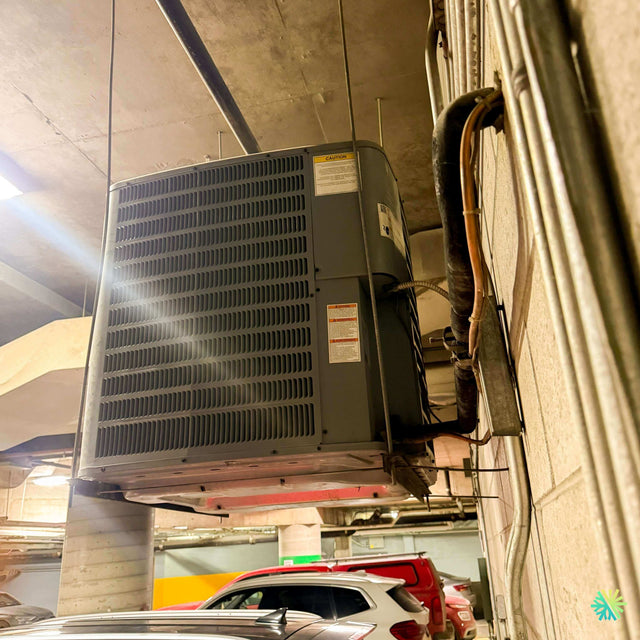
The installation visible in the photo shows a unit placed in an open area, near a window and a staircase. This type of location can be very effective, but it also creates particular challenges.
Cold air naturally sinks, while warm air rises. In cooling mode, the unit can cool the landing and allow diffusion to neighboring rooms, especially if doors remain open. In heating mode, however, air stratification can make some areas less comfortable if airflow is reduced. That’s why a clean turbine, clear filters, and correct orientation of the louvers are even more important in this kind of setup.
We explained to the client that the performance of a Carrier wall heat pump does not depend solely on the brand or BTU power. It also depends on maintenance, air circulation, installation height, obstacles, doors, windows, and daily use.
Mistakes to avoid with an indoor wall heat pump
During this service call, we also took the time to share practical advice with the client. Several simple actions help prevent the problem from returning too quickly.
The most common mistakes are:
- waiting for a leak to become visible before requesting service;
- cleaning only the filters without having the inside of the unit inspected;
- using the device in cooling mode for several seasons without thorough cleaning;
- closing all doors hoping to cool several rooms from a single point;
- setting the temperature too low, which increases condensation;
- ignoring water noises or damp smells;
- trying to insert objects into the drain or air outlet.
A wall-mounted unit installed high must be carefully maintained. Even if the filters are accessible, internal components like the turbine, condensate tray, and coil require a professional method to avoid damaging the device.
An intervention without unnecessary replacement
In this specific case, no electronic board, fan motor, or major refrigeration component needed to be replaced. The intervention focused on diagnosis, cleaning, drainage, and validating operation. This is a good example of a service call where expertise helps avoid unnecessary costs.
Replacing a part without a full diagnosis would have been a mistake. The client could have paid for a component that wasn’t the cause, while still having the same drainage problem. Our approach restored the unit to normal operation, reduced the risk of indoor leaks, and improved air distribution in the space.
Result: comfort restored and quieter operation
After the intervention, the Carrier wall-mounted heat pump regained a more consistent airflow and proper condensate drainage. The client noticed improved comfort, especially in the landing area and adjacent rooms. Operation was also quieter, as the water noises caused by slow drainage had disappeared.
We recommended monitoring over the following days, especially during periods of high humidity, as well as periodic maintenance to maintain system performance. For a unit installed in such a central area of the home, preventive maintenance has a direct impact on daily comfort.
A successful Carrier wall-mounted heat pump repair thanks to an accurate diagnosis
This service call in Montreal shows that a wall-mounted heat pump repair is not just about checking if the unit starts or not. A Carrier unit can operate while its efficiency is reduced due to a partially clogged drain, a dirty turbine, a full condensate pan, or weakened air circulation.
At AirGreen, we service residential systems throughout Greater Montreal, including Laval, Longueuil, the North Shore, and the South Shore. Every service call is handled with the same thoroughness: understanding the symptoms, inspecting the installation, testing components, fixing the root cause, and clearly explaining to the client how to prevent the problem from recurring.
A well-maintained Carrier wall-mounted heat pump can provide reliable comfort for many years. But when a sign appears — water noise, humidity, reduced flow, odor, irregular performance — it’s best to act quickly. In this home, the intervention helped protect the wall, stabilize the unit’s operation, and give the client lasting peace of mind.
The same service at your place?
Cleaning, repair or maintenance: tell us about your unit and we schedule the visit.
- RBQ licence 5645-9605-01Subclasses 15.8, 15.10 and 16
- $5M liability insuranceOn every job
- 15+ yearsFamily-owned, based in Montréal