
AirGreen job in
Central Heat Pump Repair in Îles-Laval
Stylised map, not to scale.
- Montréal
- Laval
- Longueuil
- South Shore
- North Shore
An HVAC service call in an indoor parking lot where performance depended as much on diagnosis as on mechanical access
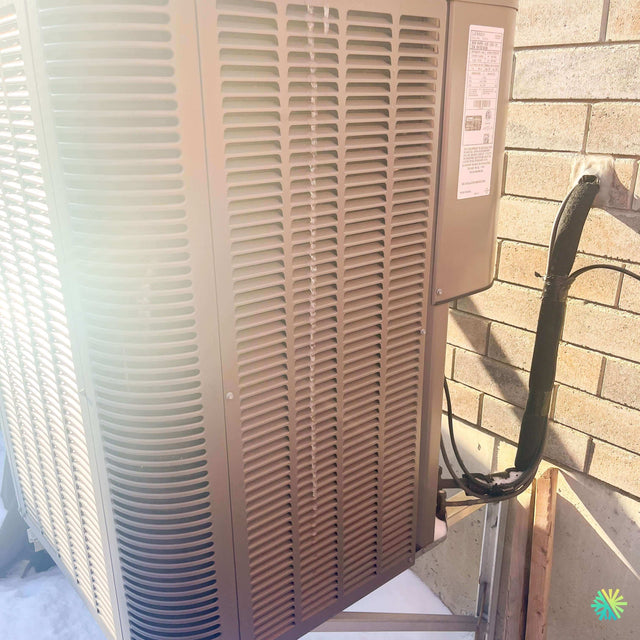
In Îles-Laval, our AirGreen team was called for a central heat pump repair installed in a particular mechanical environment: an indoor parking lot with a suspended outdoor unit, exposed refrigeration piping, surface electrical supply, and connections passing through a concrete wall. This type of installation requires expertise quite different from a simple unit placed on the ground outside. Here, the HVAC system had to operate in a space where air circulation, vibrations, dust, ambient heat, and technical accessibility directly influence performance.
The client contacted us after noticing a gradual decrease in comfort in the home. The central heat pump still seemed to start, but the air distributed through the ducts was no longer as cool as before. On hotter days, the system took much longer to reach the requested temperature. At times, the unit also produced a dull noise, like a resonance transmitted to the structure. The client wanted to avoid a complete breakdown during a peak demand period and sought a serious diagnosis before authorizing an expensive replacement.
A central heat pump installed in a demanding mechanical context
The machine observed on site was a residential central heat pump, connected to a duct network and an indoor ventilation unit. Unlike a wall-mounted heat pump, which serves an area with an indoor wall head, this system works with an indoor exchanger, a central fan, and air distribution to multiple rooms. The unit visible in the parking lot served as the outdoor condensation and heat exchange module, even though it was installed in a covered space.
This setup is sometimes found in residential buildings, condominiums, or buildings where installation on the facade or in an outdoor courtyard is impossible. In Îles-Laval, as in several areas of Montreal, Laval, Longueuil, the North Shore, and the South Shore, some HVAC units are installed in indoor parking lots, semi-open technical spaces, or shared mechanical areas. This can be perfectly functional, provided the installation meets air, clearance, heat evacuation, and maintenance requirements.
In this specific case, several visual clues deserved our attention: the unit was suspended near a wall, the refrigerant lines ran along a vertical surface, the connections seemed exposed to vibrations, and the exchange grille was positioned in an area where parking dust can accumulate quickly. Indoor parking lots often generate fine particles from tires, concrete, salt, dust, and air movement. These particles settle on the coils and can reduce system efficiency.
Symptoms reported before our intervention
The client described three main signs. First, a loss of cooling efficiency. The house or condo would eventually cool down, but much more slowly. Then, the system tended to run for longer periods, creating an impression of mechanical fatigue. Finally, a vibration noise became noticeable during certain startups.
These symptoms can indicate several possible problems:
- dirty outdoor coil;
- air restriction around the unit;
- weakened outdoor fan;
- electrical capacitor out of tolerance;
- worn or marked contactor;
- abnormal refrigerant pressure;
- beginning of refrigerant leak;
- unstable sensor or control board;
- vibration transmitted by suspended supports;
- deteriorated ducts or refrigeration insulation.
The challenge in this type of service call is to avoid jumping to conclusions too quickly. A central heat pump may show a loss of performance for a simple reason, such as a dirty coil, but also for a more serious cause, like a compression problem or a refrigerant leak. At AirGreen, we always proceed step by step: inspection, measurements, validation, correction, then final testing.
Initial inspection: access, safety, and general condition of the device
Before touching the equipment, our technician checked the work environment. In an indoor parking lot, safety is essential: presence of vehicles, unit height, circulation around the area, exposed cables, metal supports, clearances, and access to service panels. The goal was to work cleanly without damaging the existing installation or compromising occupant safety.
The visual inspection showed that the device was securely installed but vibrated slightly at startup. The panels were in place, the main grille showed dust accumulation, and the refrigerant lines had aging insulation in some spots. No major leaks were visible, but we still looked for oil traces around the fittings, as a refrigerant leak often leaves a greasy deposit near a joint or brazing.
We also inspected the pipe passage area through the wall. Mechanical penetrations in concrete must be well protected, especially when copper lines and communication wires run through them. Constant vibration or direct contact with a sharp edge can, over time, weaken a refrigerant line.
HVAC diagnosis: understanding why the central heat pump was losing efficiency
Once the inspection was completed, we put the system in cooling demand mode to observe its actual behavior. The diagnosis included checking the startup, the fan, the compressor response, the air temperature at the network, electrical stability, and thermal exchange at the unit.
We noted irregular operation linked to two main factors. The first was a loss of thermal exchange efficiency caused by coil fouling and less optimal air circulation around the unit. The second was mechanical vibration amplified by the suspended support and certain contact points of the refrigerant lines.
The system was not completely stopped. It was rather in a problematic zone: functional enough not to immediately trigger a clear failure, but degraded enough to reduce comfort, increase cycles, and impose an unnecessary load on the compressor. This kind of situation is common in central heat pumps that have not been regularly maintained or that operate in dusty environments.
Verification of electrical components
We then proceeded with electrical checks. On a central heat pump, a poor electrical contact can cause difficult starts, intermittent stops, or reduced performance. The components most often affected are the contactor, capacitor, low voltage connections, high voltage connections, and internal protections.
During this intervention, the contactor showed signs of visual wear and the fan capacitor needed precise testing. A weakened capacitor may allow the fan to run, but not always at optimal performance. The result is often misleading: the device seems to operate, but the heat exchange is insufficient. In an indoor parking area, this ventilation drop becomes even more significant because the air around the unit is already less favorable than free outdoor air.
After measurements, we replaced the capacitor when the measured tolerance no longer guaranteed stable operation. We also cleaned accessible connections and tightened necessary electrical points. These actions may seem simple, but they prevent many repetitive service calls.
Technical coil cleaning and airflow improvement
Cleaning the coil was an essential step. A dusty grille or a partially clogged coil limits the heat pump’s ability to reject or absorb heat. In a central system, this directly affects the blowing temperature, operating pressures, and cycle duration.
We performed cleaning adapted to the environment, without using excessive pressure that could damage the fins. The goal was to clear air passages, remove accumulated deposits, and restore the fan’s ability to properly circulate air through the exchanger. We also checked that nothing was blocking the air discharge around the unit.
In buildings where several mechanical systems are located in the same parking area, air can recirculate from one zone to another. A central heat pump that reuses already warmed air works harder. This explains why simple cleaning is not always enough: it is also necessary to understand how air moves around the device.
Vibration correction and protection of refrigerant lines
The noise reported by the customer partly came from a vibration transmitted by the support and certain contact points near the pipes. We stabilized the unit, checked the anchors, and repositioned elements that could amplify resonance. The refrigerant lines were inspected to ensure they were not under mechanical stress.
This part of the repair is particularly important. An uncorrected vibration can become a long-term cause of leaks. Copper pipes are sturdy, but they are not designed to absorb constant stress at the same point for years. On a suspended installation, a small vibration can turn into structural noise, especially in a concrete building.
We added protection points and adjusted the support of visible elements to reduce mechanical transmission. The system was then restarted to confirm the noise reduction.
Final result: comfort restored and more stable operation
After cleaning, replacing the weakened electrical component, checking connections, and correcting vibrations, the central heat pump regained much more stable operation. The system started normally, the fan worked more regularly, and the air distributed through the ducts showed a noticeable improvement.
The client noticed that the machine no longer struggled the same way. The cycles were more consistent, the noise had decreased, and the air conditioning responded better to demand. We also explained the points to watch for: sudden performance drop, starting noise, frequent shutdowns, tripped breaker, lukewarm air at registers, or presence of ice on a line.
What this repair in Îles-Laval reveals about central heat pump maintenance
A central heat pump cannot be diagnosed solely from the visible unit
The photographed unit is only part of the system. A central heat pump also includes an indoor unit, a fan, an indoor coil, a duct network, a thermostat control, electrical protections, and a complete refrigerant circuit. A drop in performance can come from the suspended unit, but also from a clogged indoor filter, insufficient airflow, a duct problem, or incorrect thermostat settings.
That’s why our HVAC service calls are structured. We don’t just look at the most accessible unit. We seek to understand the behavior of the entire system.
Indoor parking requires more rigorous maintenance
Indoor parking may seem protected from the weather, but it is not necessarily an easier environment for a heat pump. Dust is constant, ventilation can vary, heat can build up, and building vibrations may be more noticeable. Devices installed in these areas must be inspected regularly.
For owners in Îles-Laval, Laval, Montreal, Longueuil, on the North Shore or the South Shore, it is important not to wait until a central heat pump completely stops working before requesting a check. A loss of performance is often the first sign of a problem that can be fixed before it becomes costly.
Mistakes to avoid when comfort decreases
The first mistake is constantly lowering the thermostat thinking the system will eventually compensate. If the heat pump lacks airflow or the coil is clogged, asking for a lower temperature doesn’t solve anything. It simply prolongs cycles and increases the load on the compressor.
The second mistake is replacing parts without a full diagnosis. A capacitor may be weak, but if the coil remains dirty, the performance problem will return. Conversely, cleaning may improve things but won’t fix an electrical component that is out of tolerance.
The third mistake is ignoring vibrations. Mechanical noise is often an early warning signal from the system. The sooner it is fixed, the less likely it is to damage ducts, supports, or internal components.
Why choose AirGreen for central heat pump repair
At AirGreen, we work on central heat pumps, wall-mounted heat pumps, MultiZone systems, wall air conditioners, electric furnaces, and many other residential HVAC equipment. Our experience in Greater Montreal allows us to handle everything from traditional backyard installations to more complex setups in parking lots, rooftops, mechanical rooms, or multi-unit buildings.
This service in Îles-Laval illustrates our method: comprehensive analysis, precise diagnosis, targeted repair, result validation, and practical advice for the client. Our goal is not just to get the device running again, but to restore lasting comfort and protect the owner's investment.
The same service at your place?
Cleaning, repair or maintenance: tell us about your unit and we schedule the visit.
- RBQ licence 5645-9605-01Subclasses 15.8, 15.10 and 16
- $5M liability insuranceOn every job
- 15+ yearsFamily-owned, based in Montréal