
Central heat pump repair in the Old Port
Beforewhat the article reports

Afterresults described
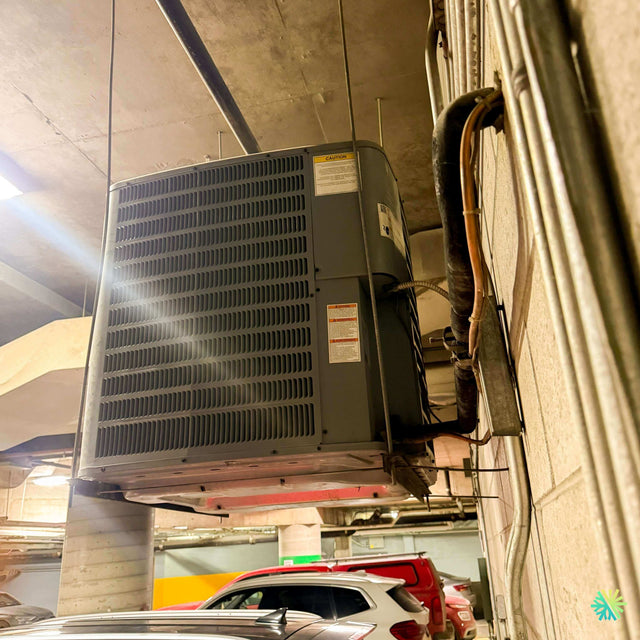
An outdoor central heat pump losing efficiency despite apparent operation
In the Old Port, where several residential buildings combine old masonry, limited mechanical spaces, and high comfort requirements, a service call for a central heat pump rarely requires a superficial approach. For this intervention, our AirGreen team was called to evaluate an outdoor unit installed near a brick wall, connected to a central indoor system distributing air throughout the property.
At first glance, the machine seemed to be working: the fan started, the compressor attempted its cycles, and no dramatic anomalies were visible such as major casing damage or an obvious significant leak. Yet, the client noticed a clear drop in performance. The system heated less efficiently, cycles became longer, and the indoor temperature took much longer to reach the setpoint. This type of situation is common with a central heat pump: the device may appear to be working while producing reduced capacity, which increases electrical consumption, unnecessarily stresses components, and decreases comfort.
Our goal was not simply to "get the machine running again," but to understand why this central heat pump in the Old Port was no longer delivering the expected performance. A lasting HVAC repair always begins with a methodical diagnosis.
An outdoor installation exposed to leaves, moisture, and space constraints
The outdoor unit observed on site was installed very close to a brick wall, with a vegetated area and dead leaves accumulated on the ground. This detail may seem trivial, but it plays an important role in the performance of a central heat pump. Leaves, dust, seeds, organic debris, and seasonal deposits can be drawn toward the outdoor coil, reducing airflow and impairing heat exchange.
In the case of a central heat pump, the outdoor condenser is a key component of the system. In heating mode, it captures outdoor heat to transfer it inside. In cooling mode, it releases the home's heat to the outside. As soon as the coil is even partially blocked, operating pressures change, the compressor works harder, cycles lengthen, and actual capacity decreases.
In this intervention, the immediate environment gave us several important clues:
- Presence of dead leaves near the base of the unit;
- Side clearance to monitor to ensure good airflow;
- Proximity to a brick wall that could affect ventilation around the condenser;
- Visible refrigeration connections, requiring inspection of insulation and sealing;
- Outdoor electrical box to check to confirm connection quality and power supply safety.
These elements alone do not allow a conclusion of failure, but they guide the diagnosis. An effective repair never focuses only on the visible symptom: it takes the entire installation into account.
Symptoms reported by the customer
The customer described a gradual problem rather than a sudden failure. The central heat pump would start, but comfort was no longer stable. Some parts seemed to receive less warm air, cycles appeared longer, and the system seemed to have to work harder to maintain the requested temperature.
This kind of complaint can come from several causes:
A dirty outdoor coil
A coil covered with dust, pollen, or debris reduces heat exchange. The heat pump may still operate, but it loses some of its capacity.
An inadequate refrigerant charge
A slight leak, a poorly balanced previous repair, or a pressure issue can cause reduced efficiency. In this case, simply adding refrigerant is not enough: the cause must be understood.
A defrosting problem
In heating mode, a central heat pump must manage defrost cycles. If the sensor, control board, or defrost logic is not working properly, the outdoor unit can accumulate too much frost or defrost at the wrong time.
An unstable power supply
A worn contactor, a weak capacitor, or aging electrical connections can cause irregular starts or power loss.
A lack of indoor airflow
Even though the photo shows the outdoor unit, the central system also includes an indoor part: blower, indoor coil, filter, ducts, thermostat, and sometimes auxiliary electric heating. A saturated filter or insufficient airflow can create symptoms similar to an outdoor unit failure.
Our on-site HVAC diagnosis
We started with a complete visual inspection of the outdoor unit. The protective grille, top panel, condenser sides, refrigerant connections, and the base of the unit were examined. The goal was to identify signs of air restriction, vibration, wear, oil around connections, or traces that could indicate a refrigerant leak.
Next, we checked the overall operation of the unit in heating mode. When servicing a central heat pump, we always observe several parameters together, because a single indicator can be misleading. A pressure may seem acceptable, but if airflow, outdoor temperature, or coil condition are not considered, the diagnosis can be incomplete.
So we checked:
- the startup sequence;
- the noise of the compressor;
- the operation of the outdoor fan;
- the condition of the contactor;
- the stability of the electrical supply;
- the visual condition of wires and connections;
- the temperature of the air blown inside;
- the temperature difference between return and supply;
- the condition of the outdoor coil;
- possible signs of restriction or overload;
- the consistency of operation with the thermostat demand.
One important finding was that the outdoor unit needed serious technical maintenance before making a definitive diagnosis on the refrigerant charge. When a coil is dirty or air circulation is poor, pressure readings can be misleading. At AirGreen, we avoid jumping to conclusions about refrigerant shortage if test conditions are not clean and controlled.
Technical cleaning and reconditioning of the outdoor unit
After securing the intervention, we proceeded with a targeted cleaning of the outdoor condenser. Debris accumulated around the base was cleared, then the coil was inspected more closely. In this type of setup, you must work carefully to avoid damaging the coil fins or pushing debris deeper into the unit.
Cleaning a central heat pump is not just about spraying the outdoor grille. You need to follow the direction of the coil, avoid excessive pressure, protect electrical components, and ensure the water does not cause secondary problems. A poor method can bend the fins, compromise airflow, and worsen the issue.
Once the condenser was cleaned, we restarted the system to compare behavior before and after the intervention. This step is essential: a serious HVAC repair must be validated by observable results.
Electrical check: a point often underestimated
The outdoor electrical box visible near the unit also led us to carefully check the power supply. On central heat pumps, electrical problems don’t always cause a complete failure. They can create intermittent symptoms: difficult starts, shutdowns, reduced performance, unusual noise, or accelerated compressor wear.
We checked the quality of connections, the condition of accessible conductors, signs of overheating, and the operation of control components. A worn contactor may allow current to pass but with poor contact quality. A weakened capacitor may let the motor start but with reduced efficiency. These details often make the difference between a temporary fix and a lasting repair.
In this specific case, refurbishing the outdoor unit and performing electrical checks stabilized the system’s operation. The cycles became more consistent, and the heat pump responded more normally to the thermostat’s demand.
A repair that restores comfort and prevents a more costly breakdown
Once the checks were completed, we confirmed that the central heat pump was operating more stably. The client noticed improved comfort and better consistency in heat distribution. The intervention also helped prevent more serious deterioration, as a condenser constantly working under poor conditions can eventually cause premature wear of the compressor, fan motor, or electrical components.
Why this type of problem often occurs in the Old Port
The Old Port of Montreal has characteristics that directly influence HVAC installations. Many properties have brick walls, narrow courtyards, shared outdoor areas, mature trees, and limited mechanical spaces. A central heat pump can be properly installed there, but it must be closely monitored.
Dead leaves, urban dust, moisture near foundations, and clearance constraints around the outdoor unit can gradually reduce performance. That’s why preventive maintenance is especially important in areas like the Old Port, but also in many neighborhoods of Montreal, Laval, Longueuil, on the North Shore, and on the South Shore.
Mistakes to avoid with a central heat pump
During our service calls, we often observe the same mistakes. Some seem minor, but they can be costly in the long run.
Letting leaves accumulate around the unit
A central heat pump needs to breathe. Even if the grille seems clear, debris on the ground can be sucked into the coil or retain moisture near the base.
Ignoring a gradual drop in performance
When a system heats less effectively, consumes more, or runs longer than before, it’s best to act quickly. Waiting for a complete breakdown can turn a simple service call into a major repair.
Adding refrigerant without a complete diagnosis
A sealed refrigeration system should not lose refrigerant without reason. Adding gas without looking for a leak or checking operating conditions can mask the real problem.
Neglecting the indoor filter
Even if the failure seems to come from the outdoor unit, a clogged indoor filter can reduce airflow and cause complex symptoms.
Installing too close to an obstacle
Clearing around an outdoor unit directly affects performance. A wall, fence, dense vegetation, or a space that is too confined can hinder heat exchange.
What we recommended to the client
At the end of the service, we explained to the client the points to watch to maintain the performance of their central heat pump. We recommended regularly clearing leaves around the unit, seasonal inspections, proper replacement of indoor filters, and professional checks if the cycles become abnormally long again.
We also emphasized the importance of maintenance before periods of high demand. In Quebec, a central heat pump is used as much for summer air conditioning as for fall and winter heating. A minor issue in the spring can become much more problematic during a heatwave in Montreal or a cold spell on the North Shore.
An AirGreen approach focused on true diagnosis
At AirGreen, we approach every HVAC service call with a simple logic: find the real cause, fix what needs to be fixed, then validate the result. This method is essential for central heat pumps, as they bring together several interdependent elements: outdoor unit, indoor coil, blower, ducts, thermostat, electrical supply, refrigerant, and auxiliary heating.
In this intervention in the Old Port, the work was not limited to checking if the unit started. We took the time to analyze the environment, the condition of the condenser, the system’s behavior, the electrical components, and overall performance. It is this thoroughness that restores the client’s confidence and prevents repeated repairs.
Final result: a more stable, cleaner, and better-protected central heat pump
After restoring the outdoor unit, performing technical checks, and running operational tests, the central heat pump regained much more consistent behavior. The system responded better to demand, cycles were more regular, and the client received clear explanations about the probable cause of the problem and the steps to take to prevent recurrence.
This type of service call shows that a successful repair is not always spectacular. Sometimes, the real work consists of spotting the small anomalies that, together, reduce the performance of a central system. An outdoor unit exposed to leaves, a less efficient coil, compromised air circulation, or an electrical component to monitor can be enough to create real discomfort.
AirGreen provides repair services for central heat pumps in the Old Port, throughout Montreal, as well as in Laval, Longueuil, on the North Shore and the South Shore. Our priority remains the same: to offer an accurate diagnosis, a clean intervention, a clear explanation, and a lasting result.

The same service at your place?
Cleaning, repair or maintenance: tell us about your unit and we schedule the visit.
- RBQ licence 5645-9605-01Subclasses 15.8, 15.10 and 16
- $5M liability insuranceOn every job
- 15+ yearsFamily-owned, based in Montréal