
Repair of a wall-mounted heat pump in Ahuntsic-Cartierville
Beforewhat the article reports

Afterresults described
When an outwardly “normal” wall-mounted heat pump hides a real performance problem
In the Ahuntsic-Cartierville neighborhood of Montreal, our AirGreen team was recently called for a service call on a residential wall-mounted heat pump installed on the side of a vinyl-sided house. At first glance, the outdoor unit appeared to be in good condition: the compressor was well secured on its wall mount, the refrigerant lines were protected, the electrical supply was present, and no major damage was visible on the casing. Yet, the client reported a very concrete problem: the heat pump was working, but the indoor comfort was no longer stable.
The main symptom was typical of a system losing efficiency: the unit would start, ventilate, but not always maintain the requested temperature. Some days, the heat seemed adequate; other times, the blown air was less warm, the cycle became longer, and the outdoor unit produced a slightly different noise than its usual operation. This kind of situation requires a structured diagnosis, as a mini-split wall-mounted heat pump can show the same symptoms for several different causes: refrigerant shortage, defrosting problem, air obstruction, faulty sensor, unstable electronic board, poorly controlled drainage, vibration transmitted to the wall, or restriction in the refrigerant lines.
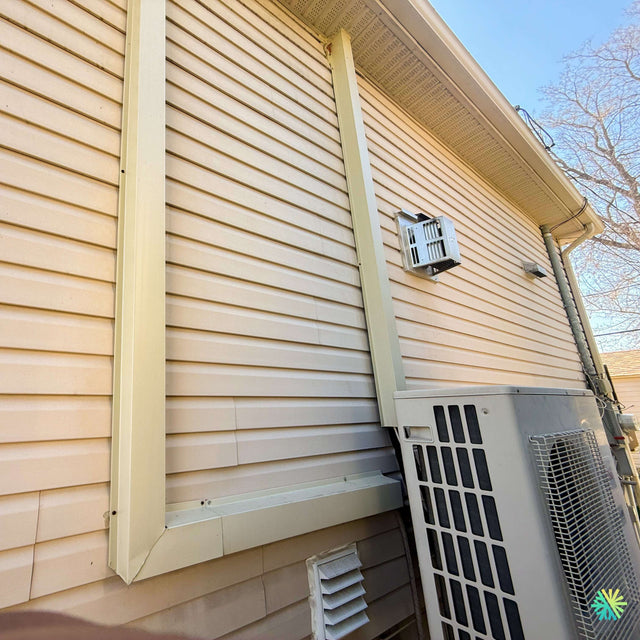
On site, the installation environment immediately caught our attention. The outdoor unit was installed on a side facade, near meters and vertical ducts, in an area where the ground space is partially occupied by decorative stones, dead leaves, and dry vegetation. This type of location is common in Montreal, Laval, Longueuil, on the North Shore and the South Shore, especially in narrow side yards. It can be perfectly acceptable, provided that air circulation, defrost water drainage, and service access remain adequate.
In this specific case, the goal was not just to “restart” the machine. Our mandate was to understand why this wall-mounted heat pump was losing efficiency, identify short-term risks, and then restore the system to a reliable and safe condition.
Visual inspection: a good diagnosis always starts outside
Even before connecting the instruments, we conducted a complete inspection of the outdoor unit. Several elements were checked:
- the condition of the wall mount and anchors;
- the stability of the outdoor unit;
- the presence of abnormal vibrations;
- the apparent condition of the refrigerant lines;
- the protection of insulation on the pipes;
- the drainage of condensate and defrost water;
- the cleanliness of the outdoor heat exchanger;
- the clearance around the fan;
- the condition of visible wiring;
- the proximity of meters and surrounding obstacles.
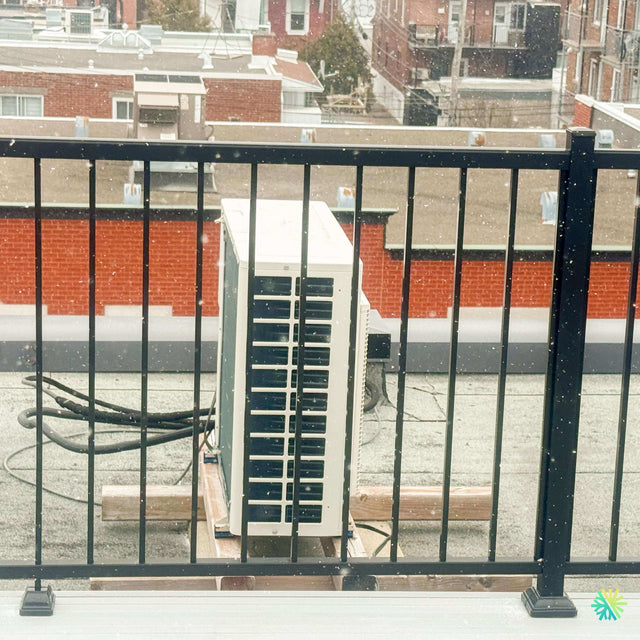
The site photo shows a typical installation of a residential wall-mounted heat pump: compact compressor fixed to the wall, pipes running inside, dedicated electrical supply, and limited outdoor space. Nothing indicated a catastrophic failure, but several small details could contribute to reduced performance.
One of the key points was the area under the unit. In heating mode, a heat pump naturally produces water during defrost cycles. When this water accumulates near the base, it can form ice in winter, reduce clearance under the unit, partially block drainage, and create more frequent defrost cycles. Even when the unit is wall-mounted, poor water management on the ground can eventually affect operation.
We also paid attention to the refrigerant lines. Damaged, crushed, or poorly protected insulation can cause heat loss, condensation, and sometimes inaccurate readings of the actual performance of the unit. In outdoor installations exposed to sun, frost, rodents, or accidental handling, this element becomes particularly important.
Symptoms reported by the customer: irregular heat and longer cycles
The customer explained to us that the device had been more efficient before. The heat pump was still heating, but the time needed to reach the requested temperature had increased. In the evening or during temperature drops, the system seemed to work harder. Inside, the temperature varied more than before, creating a feeling of discomfort despite a still functional device.
This type of complaint is very common during an HVAC service call. A system can start, ventilate, and seem operational while having a reduced performance of 20%, 30%, or more. For an owner, the problem shows as unstable comfort. For a technician, it is necessary to determine whether the cause comes from the refrigerant circuit, heat exchange, electronic control, maintenance, or installation.
At AirGreen, we avoid quick conclusions. A heat pump that heats less is not automatically “to be replaced.” In many cases, a targeted intervention is enough to restore performance.
Complete HVAC diagnosis and restoration of the wall heat pump
Our technician started by running the heat pump in heating mode, with a high setpoint, to observe the behavior of the compressor, the outdoor fan, and the indoor unit. We then compared the supply and return temperatures, observed the cycles, checked operational stability, and inspected accessible components.
Checking airflow and heat exchange
A lack of airflow is one of the most underestimated causes of wall heat pump problems. Even if the outdoor unit appears clear, the exchanger can be partially blocked by dust, pollen, fine leaves, plant debris, or dirt accumulated between the fins.
In this case, the outdoor environment had several possible sources of clogging: dry vegetation, leaves on the ground, dust on decorative stones, and a side space exposed to the wind. We therefore inspected the outdoor heat exchanger and carried out appropriate cleaning of accessible areas, taking care not to damage the fins.
Inside, the customer had already cleaned the filters, but we still checked the condition of the wall unit, the tangential fan, the louvers, the temperature sensor, and the quality of the airflow. A clean filter does not always guarantee a clean indoor heat exchanger. Over time, a thin buildup can reduce heat exchange efficiency and create a sensation of less warm air.
Refrigeration circuit control: pressures, temperatures, and operational consistency
The next step was to check the system’s refrigeration behavior. On a wall-mounted heat pump, the compressor, electronic expansion valve, sensors, and refrigerant must work precisely together. A small deviation can affect overall performance.
We evaluated operating temperatures, the outdoor unit’s heating response, cycle stability, and indicators that could suggest refrigerant shortage or restriction. A refrigerant shortage is not confirmed solely by a feeling of lukewarm air. Several data points must be analyzed together: outdoor temperature, indoor demand, operating pressure, pipe temperatures, compressor behavior, exchanger condition, and cycle duration.
In this intervention in Ahuntsic-Cartierville, the findings mainly indicated a combination of efficiency loss related to air exchange and an outdoor configuration to monitor, rather than a major compressor failure. This conclusion was important for the client because it avoided premature replacement of the unit.
Drainage management and ice prevention under the outdoor unit
The area under the unit was also carefully examined. In winter, water from defrosting must be able to drain freely. If it falls into a poorly drained area, filled with leaves, or too close to obstacles, it can form an ice buildup. This ice can then rise toward the unit or create an unfavorable environment around the support.
We recommended a cleaner clearance under the heat pump, notably by removing dead leaves and plant debris near the base. This is not just an aesthetic detail: it is a preventive measure to maintain performance and reduce the risks of noise, vibration, or partial blockage during freezing periods.
In several boroughs of Montreal, including Ahuntsic-Cartierville, the side spaces are often narrow. Owners sometimes add fences, planters, solar lights, storage boxes, or landscaping around the outdoor unit. These elements may seem unrelated to HVAC mechanics, but they directly influence airflow and access for maintenance.
Correction of minor anomalies and stabilization of operation
After the checks, we performed targeted restoration: cleaning critical areas, checking pipe passage, inspecting visible wiring, validating cycles, and recommending maintenance adapted to the location.
The operation was then tested again. The outdoor unit resumed a more stable cycle, the indoor airflow became more consistent, and the client noticed an improvement in comfort. The goal was clear: restore reliable performance without unnecessarily replacing a still functional heat pump.
What this service reveals: a wall heat pump must be evaluated as a complete system
This intervention illustrates an important reality: a wall heat pump repair is not just about replacing a part. In many cases, the problem comes from a combination of factors. A slightly dirty outdoor unit, imperfect drainage, limited service space, piping protection to monitor, and longer heating cycles can together create a noticeable loss of comfort.
Our HVAC technicians always evaluate the entire system:
- the outdoor unit;
- the indoor unit;
- the communication between the two;
- the sensors;
- the refrigerant circuit;
- the drainage;
- the installation environment;
- the client’s usage habits;
- symptoms observed over several days.
This approach helps distinguish a real breakdown from a maintenance issue, an installation constraint, or an improper setting.
Common mistakes to avoid with a wall heat pump
During this service call in Ahuntsic-Cartierville, we also took the time to explain to the client some common mistakes that reduce the lifespan of a wall system:
Waiting for the device to stop working completely
A heat pump often gives warning signs: longer cycles, different noise, less consistent heating, more frequent defrosting, increased consumption. Acting early often prevents a more costly breakdown.
Neglecting the space around the outdoor unit
Even a small wall unit needs good clearance. Leaves, branches, bins, fences, decorations, and snow buildup can impair performance.
Believing a clean filter is enough
Cleaning filters is essential, but it doesn’t replace a full inspection. The indoor fan, heat exchanger, sensors, and outdoor unit must also be monitored.
Ignoring defrost water
In heating mode, defrost water is part of normal operation. What’s not normal is when it accumulates in the wrong place and creates ice around the unit.
Local expertise for Montreal, Laval, Longueuil, the North Shore, and the South Shore
AirGreen works every week on wall-mounted heat pumps in a wide variety of settings: duplexes in Montreal, single-family homes in Laval, condominiums in Longueuil, residences on the North Shore, and family properties on the South Shore. Each building presents its own challenges: limited space, fragile exterior cladding, difficult access, close neighbors, electrical constraints, humidity, wind exposure, or snow accumulation.
In this case in Ahuntsic-Cartierville, the intervention reassured the customer, improved performance, and extended the lifespan of the unit. The system did not need to be replaced. It needed a thorough diagnosis, targeted maintenance, and recommendations suited to its actual environment.
Final result: comfort restored and customer better informed
At the end of the service call, the wall-mounted heat pump was running more steadily. The customer knew what to watch for in the following weeks: blowing temperature, frequency of defrost cycles, water or ice buildup under the unit, outside noise, and how quickly the room reached the set temperature.
We also recommended regular maintenance to prevent the problem from recurring, especially before periods of high heating or cooling demand. A well-maintained heat pump uses less energy, heats better, cools more efficiently, and reduces the risk of breakdowns at inconvenient times.
At AirGreen, our priority is to provide accurate, honest, and sustainable HVAC service. A good repair is not just a technical fix: it’s a solution that gives the customer back control of their comfort.

The same service at your place?
Cleaning, repair or maintenance: tell us about your unit and we schedule the visit.
- RBQ licence 5645-9605-01Subclasses 15.8, 15.10 and 16
- $5M liability insuranceOn every job
- 15+ yearsFamily-owned, based in Montréal