
Repair of a wall-mounted heat pump in Montreal East
Beforewhat the article reports

Afterresults described
A high-up service call for a wall-mounted heat pump that vibrated, cooled less effectively, and worried the owner
In East Montreal, our AirGreen team was called for a wall-mounted heat pump installed high on an outdoor wall bracket, just under the roof overhang of a residence. The client contacted us because the outdoor unit was making an abnormal noise during startups, with vibrations felt inside the house and less consistent cooling performance. The system was not completely broken, but its behavior had changed: rougher startups, longer cycles, slower cooling, and a general impression of a unit working harder than before.
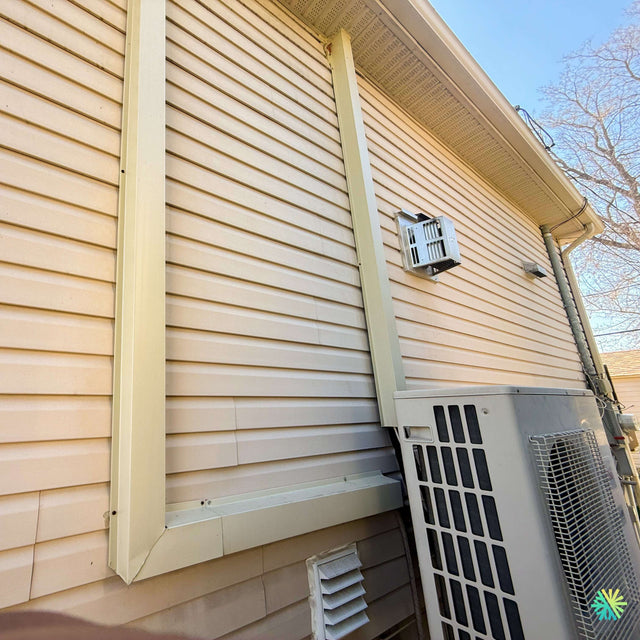
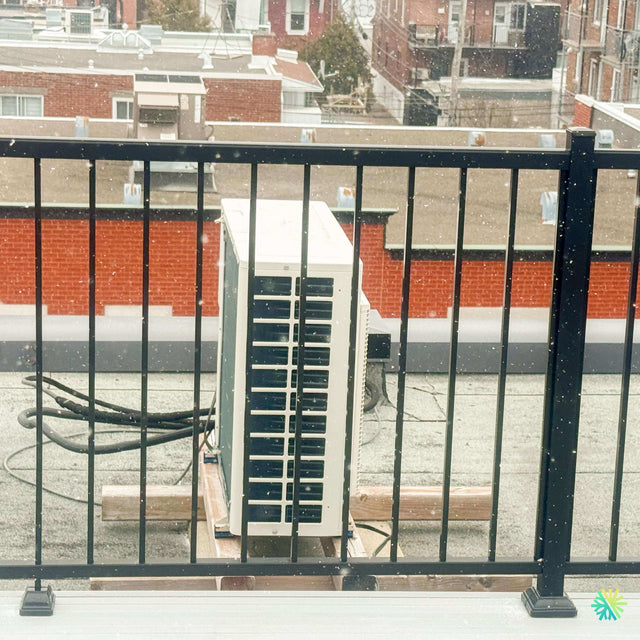
The installation photo immediately reveals an important point: the outdoor unit is mounted on an aluminum wall structure, above ground level, with refrigerant pipes and wiring passing through the exterior cladding. This type of installation is common when ground space is limited or when the owner wants to clear the yard, but it requires special attention during an HVAC service call. Access is more complex, vibrations transmit more easily to the building structure, and clearances around the machine must be checked precisely.
At AirGreen, we approached this intervention as a full diagnosis, not just a simple visual inspection. A wall-mounted heat pump that vibrates can have several causes: weakened support, worn silent blocks, poorly fixed panel, unbalanced fan, compressor strain, dirty coil, stressed piping, poorly protected cable, or pressure issues related to the refrigerant circuit. Our role was therefore to determine what was actually causing the symptoms, then fix the problem without unnecessarily replacing the unit.
A compact wall installation with limited technical access
The observed machine corresponds to a residential wall-mounted heat pump, also called a mini-split, with a compact outdoor unit installed on a wall bracket. The exact brand and model were not readable in the image, but the configuration indicated a wall system with residential capacity, probably in a common range of 9,000 to 18,000 BTU depending on the connected indoor unit and the home's needs.
This type of system is very popular in Montreal, Laval, Longueuil, on the North Shore and the South Shore, because it allows adding heating and cooling without ducts. However, when an outdoor unit is installed at height, certain elements become critical:
- strength of the wall mount;
- condition of the anchors in the structure;
- presence of anti-vibration silent blocks;
- distance between the unit and the wall;
- clearance under the soffit;
- protection of the refrigerant pipes;
- condition of the exterior wiring;
- unit stability during startups;
- water drainage and protection against ice;
- accessibility for HVAC maintenance.
In this specific case, the unit was mounted near the exterior siding, with exposed piping and a visible section of insulating protection. The installation was not unusual, but it showed clear signs of aging: exposed insulation, vibration transmitted to the structure, and a mount that needed thorough inspection.
Symptoms reported by the client
The client described three main symptoms. First, a louder noise when the heat pump starts. Then, a noticeable vibration in the room near the exterior wall. Finally, a drop in cooling performance, especially on hotter days.
This mix of symptoms guided our diagnosis toward two categories of problems: mechanical and performance. The noise and vibrations could come from the mount, the fan, the panels, the mounting brackets, or the piping. The drop in efficiency could be caused by a partially clogged outdoor coil, a fan that doesn’t move enough air, a restriction, lack of maintenance, or a refrigeration issue.
It was important not to confuse effects with causes. An outdoor unit that vibrates can produce a worrying noise without a major malfunction. Conversely, a vibration can be the first sign of a compressor starting under poor conditions or an unbalanced fan. That’s why we proceeded step by step.
Securing access before diagnosis
Before any handling, our technician assessed access to the unit. A HVAC installation at height requires more caution than a ground unit. The wall mount, working height, proximity to the soffit, and space around the machine influence how to proceed.
We secured the area, then checked the overall stability of the unit before opening it. This step is essential: when a machine is mounted on the wall, a loose support or weakened attachment can make the intervention riskier. You should never start by removing panels without confirming the device is properly supported.
Inspection of the wall support and vibrations
The aluminum wall support was still in place, but some fastening points showed slight play. The vibrations did not come only from the compressor: they were amplified by the support structure and transmitted to the exterior wall. This is a common phenomenon when anti-vibration silent blocks are crushed, missing, poorly positioned, or have become too rigid over time.
We inspected:
The support brackets
The metal arms needed to be stable and well aligned. A slightly misaligned support can create constant tension on the unit and increase noise.
The anchor points
The wall fastenings were checked to confirm they had not loosened due to cycles, wind, and vibrations.
The silent blocks
The anti-vibration pads were worn out. We replaced them with suitable elements to reduce vibration transmission to the structure.
The contact between the unit and the support
A unit poorly seated on its supports can vibrate irregularly. We corrected the seating and tightened the necessary points.
This part of the intervention immediately reduced some of the mechanical noise. However, we still needed to check why the system seemed less efficient.
Cleaning the outdoor condenser
Even though the outdoor unit was not covered in visible dirt like some units installed near the ground, its coil had an accumulation of fine dust, pollen, and particles trapped in the fins. On a wall-mounted heat pump, a partially clogged outdoor coil can increase operating pressure and reduce cooling efficiency.
We carried out a controlled cleaning of the condenser, taking care not to damage the fins. The cleaning improved air circulation through the machine and reduced the effort required by the outdoor fan. In a compact wall unit, even the slightest air restriction can quickly impact performance.
A simple misdirected water jet is not always enough and can even damage certain components if cleaning is done without a method. Our intervention aimed to clear the heat exchanger, check the condition of the fins, remove accumulated deposits, and confirm that the fan could properly draw in and expel air.
Fan and panel inspection
The outdoor fan was then inspected. We checked rotation, presence of friction, visual blade balance, and noise during operation. A slightly unbalanced fan can cause vibrations that resonate throughout the wall support. In this case, the motor was functional and did not require replacement, but cleaning and tightening the panels helped eliminate some of the unwanted noise.
The outdoor panels were also checked. On a unit exposed to wind and installed at height, some screws can loosen over time. A vibrating panel can give the impression of a compressor problem when it is simply body noise amplified by the support. We tightened accessible panels and properly repositioned the vibrating elements.
Inspection of refrigerant piping and insulation
The visible piping near the wall required special attention. In the photo, you can see pipes coming out of the wall and connecting to the outdoor unit. When these pipes are stretched, poorly insulated, or exposed to UV rays, they can cause vibrations, lose efficiency, or deteriorate prematurely.
We inspected the insulation, pipe protection, and how the pipes were positioned. A section of outdoor insulation was worn and was repaired. We added appropriate protection on exposed segments to limit degradation caused by sun, rain, frost, and system movements.
This correction is more important than it may seem. Damaged insulation can reduce system efficiency, cause unwanted condensation, and expose the pipes to premature wear. In a climate like Montreal, with cycles of freezing, thawing, humidity, and heat, protecting the pipes is an essential part of good HVAC service.
Electrical inspection and restart
After mechanical corrections, we checked the accessible electrical connections, the condition of the outdoor wiring, and the unit's response during a call for operation. No major electronic board replacements were necessary. The system responded correctly to the command, but the startup noise was amplified by vibrations from the support and the general condition of the outdoor unit.
We performed several start and stop cycles to confirm operational stability. The system was then tested in air conditioning mode, with verification of the indoor unit's response, airflow, and outdoor behavior.
A repair that restored stability, silence, and efficiency to the wall system
After our intervention, the wall heat pump operated much more stably. Replacing the silent blocks, tightening the support, cleaning the condenser, correcting the pipe insulation, and a complete unit check significantly reduced vibrations and improved overall performance.
The client noticed an immediate difference in the noise transmitted inside. The system started more smoothly, vibrations were better absorbed, and the air conditioning became more effective again. The machine did not need to be replaced: it needed targeted service, performed with a clear understanding of its installation at height.
Why wall units installed at height require more attention
An outdoor ground unit generally transmits fewer vibrations to the house, especially when installed on a stable base. A wall unit, however, is directly attached to the building. Even normal vibration can become disturbing if the supports are rigid or if the silent blocks are worn.
In Montréal-Est, this installation precisely faced this challenge. The problem was not only in the machine but in the relationship between the machine, the support, and the building structure. That is why an effective repair had to include both the mounting mechanics and the HVAC operation.
Mistakes to avoid with a noisy wall heat pump
When a wall heat pump becomes noisy, several mistakes can worsen the situation:
Ignoring vibrations
Noise that increases over time is not normal. Even if the system still heats or cools, vibration can damage supports, pipes, or panels.
Replacing the machine too quickly
A noisy device is not always at the end of its life. In many cases, a corrected support, replaced silent blocks, and a thorough cleaning are enough to restore acceptable operation.
Neglecting pipe insulation
Exposed or damaged insulation can reduce efficiency and cause condensation. It must be properly protected.
Cleaning only the indoor unit
Maintenance of a wall heat pump is not limited to the indoor filters. The outdoor unit must also be inspected, especially when it is installed at height.
Allowing vegetation, ice, or debris to accumulate
Even a wall unit can be affected by pollen, dust, leaves, blown snow, and frost.
Our AirGreen approach to this type of service call
At AirGreen, we believe a good HVAC diagnosis must consider the entire installation. For this intervention in Montreal East, we analyzed the machine, the support, the lines, the wiring, the noise, the airflow, and the behavior during actual operation.
This approach allows us to offer more precise service in Greater Montreal, including Montreal, Laval, Longueuil, the North Shore, and the South Shore. A wall-mounted heat pump may seem simple, but it depends on a combination of elements: indoor unit, outdoor unit, piping, drainage, power supply, support, clearances, and maintenance.
A useful intervention to extend the unit's lifespan
The repair carried out in Montreal East prevented progressive deterioration. An uncorrected vibration can eventually loosen fasteners, fatigue refrigerant lines, or accelerate wear on certain components. A dirty condenser can cause the compressor to work under more difficult conditions. Damaged insulation can reduce system efficiency.
By correcting these elements before a major breakdown, we extended the machine's useful life and restored better indoor comfort. This is exactly the goal of a well-executed HVAC service: to fix the current problem, prevent complications, and give the owner a clear view of the system's condition.
Final result: a quieter and higher-performing wall-mounted heat pump
At the end of the intervention, the wall-mounted heat pump was better stabilized, better protected, and more efficient. The abnormal noise had decreased, the vibrations transmitted to the wall were reduced, and the system responded properly to cooling demands. The client regained more reliable comfort without having to replace the unit.
This repair demonstrates the importance of a diagnosis adapted to the reality of the installation. In Montreal East, the challenge was not only to repair a machine but to correct the effects of a wall-mounted installation at height subjected to vibrations, weather, and aging support components. Thanks to a precise intervention, the wall-mounted heat pump regained a more stable, quieter, and more reassuring operation.

The same service at your place?
Cleaning, repair or maintenance: tell us about your unit and we schedule the visit.
- RBQ licence 5645-9605-01Subclasses 15.8, 15.10 and 16
- $5M liability insuranceOn every job
- 15+ yearsFamily-owned, based in Montréal