
Repair of a wall-mounted heat pump in Mercier–Hochelaga-Maisonneuve

What we checked
Items tick as you read the diagnosis.
When a wall unit loses its efficiency: a revealing service call in Montreal
In the Mercier–Hochelaga-Maisonneuve neighborhood, in Montreal, our AirGreen team was called for a wall-mounted heat pump repair in a residence where indoor comfort was no longer consistent. The wall unit, installed high near the ceiling, showed typical signs of a system that still works but can no longer deliver the expected performance: weakened airflow, less stable temperature, louder noise at startup, and the general impression that the machine "works harder" than before.
At first glance, the indoor unit looked like a compact residential wall-mounted heat pump, probably with a common capacity of about 9,000 to 12,000 BTU, used to heat and cool a main area of the home. The exact brand and model were not visible in the photo, but the format, front grille, wall position, and lower flap clearly indicated a mini-split wall system. This type of equipment is very common in the east of Montreal, especially in condos, plexes, renovated apartments, and houses where people want to add efficient heating and cooling without installing a full duct network.
The client contacted us because the device was no longer responding as before. In cooling mode, the air was less cold. In heating mode, the temperature rise was slower. The client also noticed that the lower flap sometimes seemed to hesitate slightly, that the air was poorly distributed in the room, and that a slight vibration noise was heard when the unit started. No permanent error code was displayed, which made the diagnosis more subtle: the machine was not completely broken, but its behavior clearly indicated a performance problem.
Symptoms observed before our arrival
During the call, several clues helped us guide our intervention. The client did not describe a total breakdown, but rather a gradual decline in comfort. It is often in this type of situation that a professional diagnosis becomes essential, because a wall-mounted heat pump can continue to blow air even if an important component is dirty, weakened, or poorly controlled.
The reported symptoms were as follows:
- Weaker airflow than before.
- Uneven cooling during hotter days.
- Slower heating in the main room.
- Light noise coming from the flap or the indoor turbine.
- Feeling of humid or less fresh air after several minutes of operation.
- Need to lower or raise the setpoint more on the wall thermostat or remote control.
- Longer operation to achieve the same result.
These signs can have several causes: clogged filters, dirty indoor turbine, heat exchanger blocked by dust, temperature sensor problem, weakened ventilation motor, misaligned air flap, partially clogged condensate drain, refrigerant shortage, or unstable communication between the indoor unit and the outdoor condenser.
A complete internal inspection of the wall unit
The first step was to inspect the indoor unit. Since the device was installed high on the wall, near a ceiling molding, access had to be done carefully to avoid damaging the wall, the plastic casing, or the lower flap. On older wall units, the front clips sometimes become fragile over time. A sudden opening can crack the panel or misalign the motorized flap.
We removed the filters and inspected the inside of the unit. As is often the case in HVAC repair calls in Montreal, the problem was not limited to a single defective part. The machine showed dust buildup on the filters, on the indoor heat exchanger, and around the turbine. This buildup reduced airflow and forced the fan to work harder. A dirty heat exchanger can also distort the temperature sensor reading, since air circulates less effectively around the heat transfer surfaces.
The indoor turbine was also checked. A dirty turbine can cause three problems at once: reduced airflow, vibration at startup, and uneven distribution in the room. In this case, the noise reported by the customer matched a combination of accumulated dust and slight mechanical resistance in the air movement.
Diagnosis of the flap, sensor, and control
The lower flap, visible in the photo, plays an important role in air distribution. When it is poorly positioned, stuck, or out of sync, air can be directed toward the ceiling or a too limited area, giving the impression that the device no longer heats or cools properly. We therefore tested its movement at different speeds and modes.
The flap was still responsive, but its movement was not perfectly smooth. No immediate replacement of the flap motor was necessary, but cleaning the pivot area and precise repositioning improved its operation. We also checked the indoor unit’s temperature sensor. A displaced or dust-covered sensor can send incorrect readings to the electronic board, causing cycles that are too short or too long.
In a wall-mounted HVAC installation, it is common for a comfort issue to be mistaken for a refrigerant leak when the cause lies inside: insufficient air circulation, neglected filters, dust-loaded turbine, or a flap that no longer directs air properly. That is why our diagnosis never starts with a gas recharge. We first seek to confirm the real cause.
Technical cleaning, checks, and performance restoration
Exchanger cleaning and airflow improvement
After the inspection, we proceeded with targeted cleaning of the indoor unit. The goal was to restore normal air circulation through the exchanger and reduce the load on the fan. The filters were cleaned, the exchanger was carefully cleared, and the turbine was treated to remove deposits causing noise and irregular airflow.
This type of cleaning is more than just an aesthetic operation. A wall-mounted heat pump directly depends on the quality of its heat exchange. If air does not pass properly through the exchanger, the machine consumes more energy, heats or cools less effectively, and may eventually trigger internal protections. In air conditioning, a clogged exchanger can promote residual humidity and odors. In heating, it can slow down the diffusion of warm air and create discomfort despite a high setpoint.
In Laval, Longueuil, on the North Shore and the South Shore, we often observe the same phenomenon: owners think their unit has lost power with age, while a technical cleaning and a complete diagnosis can sometimes recover much of the original performance.
Condensate drain inspection
Even though the client did not report a significant water leak, we checked the condensate drain. On a wall unit, a partially clogged drain can produce subtle symptoms before becoming an emergency: musty odor, water stagnating in the tray, dripping noise, moisture near the wall, or sudden drainage during an extended cooling cycle.
The condensation tray was inspected, then the drain passage was checked. We confirmed that water could drain, but preventive maintenance was necessary to avoid future blockage. This point is especially important in homes where the heat pump runs for long periods during the summer, as condensate production can be significant during humid periods in Montreal.
Inspection of the outdoor condenser and refrigerant cycle
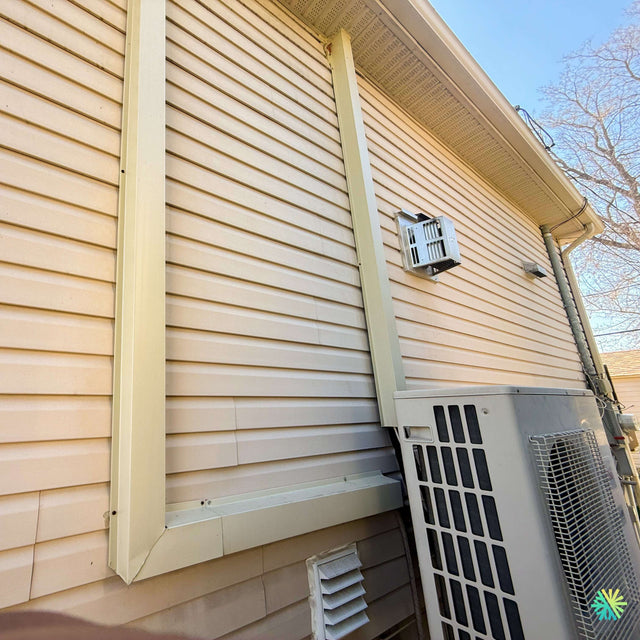
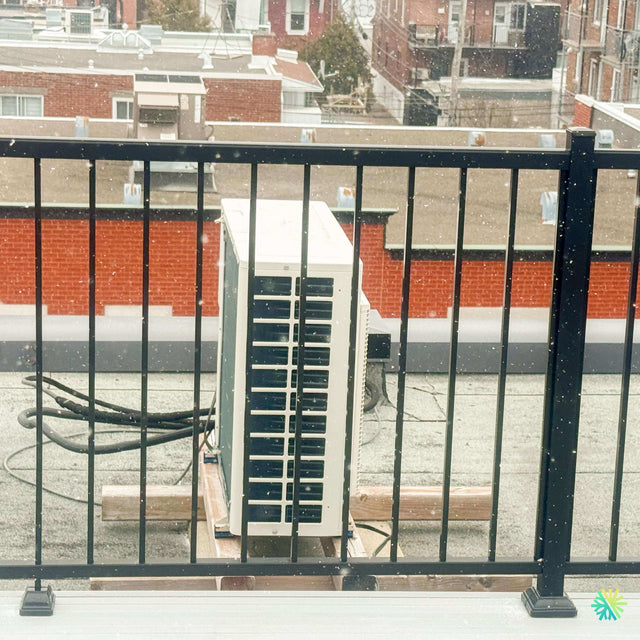
A serious repair of a wall-mounted heat pump cannot be limited to the indoor unit. Even though the photo shows the wall unit, the complete system also includes an outdoor condenser, refrigerant lines, communication wiring, and power supply. We therefore validated the overall system behavior after cleaning.
The outdoor condenser was tested to confirm that the compressor started correctly, the outdoor fan operated normally, and the machine responded well to mode changes. We also observed the temperature difference between the return air and the supply air inside. After cleaning and repositioning the flap, the difference was more consistent, and the airflow was noticeably more stable.
No refrigerant was added without clear signs of a leak or lack of charge. This is a crucial point: adding refrigerant to a system without an accurate diagnosis can worsen a problem, increase pressures, and damage the compressor. At AirGreen, we prioritize a measurable approach: symptoms, inspection, tests, correction, then validation of the result.
Noise correction and operation stabilization
The noise reported by the client mainly came from disturbed air circulation and slight vibration due to internal dirt buildup. After cleaning the turbine, checking the flap, and putting the front elements back in place, the operation became quieter. The client immediately noticed a difference in the airflow power and air distribution in the room.
We then tested several modes: air conditioning, ventilation only, heating, and flap oscillation. This sequence confirms that the electronic board correctly sends commands, that the ventilation motor responds to the requested speeds, and that the unit does not show intermittent behavior.
What this intervention reveals about the maintenance of wall-mounted heat pumps
A wall-mounted heat pump may seem simple to use, but it requires regular maintenance. The visible filters are only part of the problem. Even when cleaned by the owner, dust can accumulate deeper in the turbine, on the heat exchanger, in the condensation tray, and around the flap.
The most common mistakes we encounter are the following:
- Cleaning only the filters without having the inside of the unit inspected.
- Ignoring a gradual decrease in airflow.
- Using the device despite new vibrations.
- Believing that a musty smell will disappear on its own.
- Manually closing the flap and forcing the mechanism.
- Requesting a refrigerant recharge before a proper diagnosis.
- Waiting for a water leak before checking the drain.
- Installing furniture or curtains too close to the unit, which hinders air circulation.
Professional maintenance not only improves comfort but also protects costly parts: ventilation motor, electronic board, compressor, and sensors. In many cases, early intervention prevents a more significant breakdown a few months later.
Final result for the client in Mercier–Hochelaga-Maisonneuve
At the end of the service call, the wall heat pump was blowing stronger, the noise had decreased, the flap responded better, and the output temperature was more stable. The client regained more consistent comfort in the main room, without unnecessary replacement of the device.
We also provided clear recommendations: clean the filters regularly, watch for any water traces under the unit, avoid manually handling the flap, and schedule a full maintenance if a performance drop returns. For a wall unit used for both heating and cooling, periodic maintenance is a direct investment in system reliability.
Local expertise for wall systems in Montreal and surrounding areas
AirGreen works every week on wall-mounted heat pumps, wall air conditioners, multi-zone systems, central heat pumps, and residential HVAC equipment throughout Greater Montreal. Whether the call comes from Montreal, Laval, Longueuil, the North Shore, or the South Shore, our approach remains the same: understand the symptoms, inspect the entire equipment, explain the real causes, and restore the system to reliable operation.
In the case of this repair in Mercier–Hochelaga-Maisonneuve, the intervention showed that a machine that simply seems "less powerful" can hide several small accumulated problems. By fixing them at the right time, we helped the client avoid premature replacement and extend the lifespan of their wall system.

The same service at your place?
Cleaning, repair or maintenance: tell us about your unit and we schedule the visit.
- RBQ licence 5645-9605-01Subclasses 15.8, 15.10 and 16
- $5M liability insuranceOn every job
- 15+ yearsFamily-owned, based in Montréal