Repair of a wall-mounted heat pump in Duvernay
| Service | Repair | Unit | Wall-mounted heat pump |
|---|---|---|---|
| Area | Duvernay (Laval) | Published | October 23, 2026 |
| Reading | 10 min | ||
Attachment 1 · job photo

An outdoor wall-mounted heat pump on a roof that required more than a simple restart
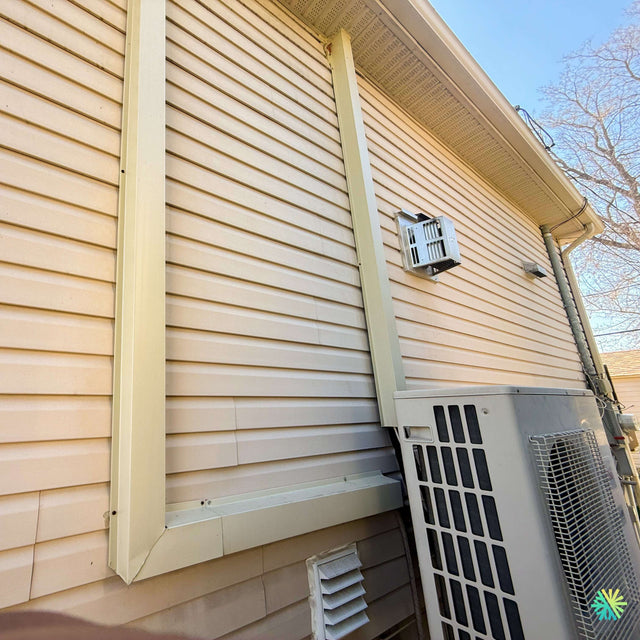
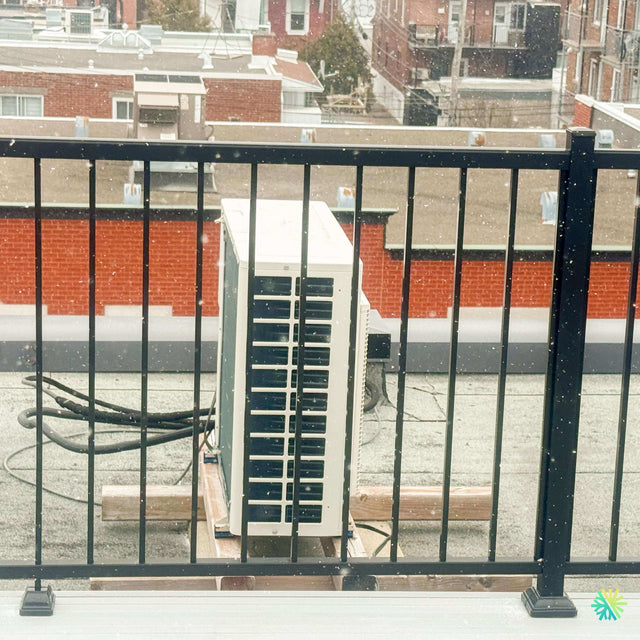
In Duvernay, in the Laval area, our AirGreen team responded to a service call on a wall-mounted heat pump installed high up, on a low roof section along the back facade of a residence. Upon arrival, the visual configuration of the installation already gave us several clues: compact outdoor mini-split unit, aging casing, oxidation marks on some screws, visible connections near the wall, refrigerant line protected by a metal cover, and a tight workspace between the window, the exterior siding, and the railing.
The client contacted us because the machine was no longer delivering the expected performance. The system would start, but the comfort was no longer stable: the room served took too long to reach the requested temperature, the operation seemed irregular, and the outdoor unit produced a noise different from what the client was used to. In this type of situation, it is essential not to jump to conclusions about a major breakdown too quickly. A serious HVAC repair always begins with a methodical check: electrical supply, communication between the indoor and outdoor units, coil condition, refrigerant pressure, blowing temperature, drainage, general cleanliness, and compressor behavior.
In this specific case, the wall-mounted heat pump was a residential mini-split unit, with an exact model that had become difficult to read on the nameplate due to age, outdoor exposure, and wear. For our diagnosis, the brand matters less than the technical logic of the system: a wall-mounted heat pump operates according to a precise balance between the compressor, the outdoor fan, the indoor coil, the electronic board, the temperature sensor, the valves, the refrigerant connections, and the condensate drainage. A weakness in any one of these elements can affect the entire comfort of the home.
A special access: working neatly on a residential roof
One of the first challenges of this service call in Duvernay was access to the outdoor unit. It was installed on a low roof surface covered with black shingles, with little clearance around the casing. This type of installation requires a careful approach, both to protect the roofing and to allow the technician to work efficiently.
Before any handling, we secured the work area, checked the stability of the unit, then inspected the mounting brackets. The outdoor unit’s feet still seemed well in place, but some signs of wear were visible: dirt buildup on top of the casing, early oxidation on several screws, moisture marks near the base, and worn insulation around the pipes. These elements do not automatically mean the machine is beyond repair, but they indicate that insufficient maintenance or prolonged exposure can lead to performance issues.
On wall-mounted heat pumps installed near a wall, window, or railing, the space around the condenser is particularly important. A unit lacking clearance can recycle its own hot air in cooling mode or poorly evacuate cold air in heating mode. Result: reduced efficiency, longer cycles, increased noise, abnormal operating pressure, and premature compressor wear.
Symptoms observed before the diagnosis
The client described three main symptoms:
- reduced heating and cooling performance;
- more noticeable outdoor noise than before;
- irregular operation, with stops and restarts that seemed less smooth.
These symptoms can stem from several causes: clogged outdoor coil, weakened fan, lack of refrigerant, faulty sensor, communication problem, unstable electronic board, partially leaking refrigerant connection, or inadequate power supply. At AirGreen, we avoid approximate diagnoses. A wall-mounted heat pump repair must be based on measurements, not just on sound or visual impressions.
We therefore started with a complete inspection of the outdoor unit, followed by an electrical check. The circuit breaker, power supply voltage, main connections, and communication cables were checked. The visible wires near the wall were also examined for any signs of deterioration, overheating, poor connection, or moisture.
Condenser inspection: dirt, ventilation, and aging
The outdoor unit showed an accumulation of dust, debris, and fine dirt in certain areas of the casing and coil. Even when the front grille seems relatively clear, a coil can lose a lot of efficiency if the fins are partially blocked. A thin layer of dirt is sometimes enough to reduce heat exchange, especially on humid or very hot days in Montreal, Laval, Longueuil, on the North Shore or the South Shore.
We carried out a targeted cleaning of the condenser, taking care not to damage the fins. The outdoor fan was inspected to confirm that the rotation was stable, without excessive vibration or rubbing. The blades were checked, as well as the motor and mounting points. In this case, the fan was working, but the coil's dirt buildup contributed to less favorable operating pressure, which partly explained the reduced efficiency.
Refrigeration check: understanding if the machine is low on refrigerant
After the electrical and mechanical inspection, we performed a check of the refrigeration parameters. When a wall-mounted heat pump loses performance, many customers immediately think they need to "add gas." This is a common mistake. A closed refrigeration system should not lose refrigerant. If there is a shortage, the cause must be investigated.
In this case, the temperature readings and the machine's behavior indicated reduced performance, but not a complete compressor failure. We checked the accessible fittings, the pipes near the wall, the visible connections, and possible traces of refrigerant oil. Special attention was given to the area where the pipes exit the metal cover, as vibrations, sun exposure, ice, wind, and temperature variations can wear down the insulation or stress the fittings over the years.
We also checked the condition of the insulation around the pipes. Damaged insulation can lead to efficiency losses, unwanted condensation, and faster degradation of components around the wall penetration. On an aging installation, this detail can make a big difference.
AirGreen Diagnosis: a combination of factors, not a single isolated failure
The diagnosis revealed that the performance drop was not caused by a single spectacular failure, but rather by a combination of factors:
- dirty condenser reducing heat exchange;
- limited outdoor clearance around the unit;
- aging insulation on the pipes;
- visible oxidation on some fasteners;
- refrigeration behavior to monitor;
- insufficient preventive maintenance over time.
This type of conclusion is very common in residential HVAC service calls. A wall-mounted heat pump can continue to operate for years while gradually losing efficiency. The client does not always notice the degradation at first, until cycles become longer, noise increases, or indoor temperature becomes unstable.
A comprehensive intervention to restore comfort and prevent a more costly breakdown
Our intervention was not limited to simply restarting the device. The goal was to restore more stable operation, improve heat exchange, secure visible components, and provide the client with a clear understanding of the actual condition of their heat pump.
Technical cleaning of the outdoor unit
We cleaned the outdoor unit, paying particular attention to the coil, grille, fan, and areas where dirt usually accumulates. On a rooftop, debris can come from several sources: dust, pollen, leaves, shingle particles, stagnant moisture, moss, or dirt blown by the wind. Unlike a ground-installed unit, a rooftop machine may seem less exposed, but it often endures greater temperature fluctuations and fine accumulations.
After cleaning, the airflow was freer and the fan operated with less resistance. This simple element can reduce the load on the compressor and improve efficiency in both cooling and heating modes.
Fixing weak points around the ducts
We then checked the duct passage and the condition of the external protection. The metal cover visible in the photo protects part of the refrigerant line, but some areas near the unit remained more vulnerable. We recommended fixing the worn insulation and better protecting the exposed sections to prevent condensation, loss of efficiency, and progressive material deterioration.
In a residential HVAC installation, small insulation details are often underestimated. Yet, a poorly protected duct can harm efficiency, especially during rapid temperature changes between summer and winter. In Duvernay as elsewhere in Laval, HVAC systems must cope with significant variations: high humidity in summer, intense cold in winter, freeze-thaw cycles, and extended heating periods.
Function check after intervention
Once the corrections were made, we restarted the system and observed its behavior. We checked:
- the startup stability;
- the response of the outdoor unit;
- the indoor blowing temperature;
- the outdoor ventilation;
- the abnormal noises;
- the operating cycles;
- the communication between the two units.
The result was positive: the wall-mounted heat pump resumed more stable operation, with better response and more efficient outdoor ventilation. The client also received clear explanations about the condition of the device, the limitations related to its age, and the signs to watch for in the coming weeks.
What the client needed to monitor after our departure
Even when a repair significantly improves the situation, an aging device must be closely monitored. We therefore recommended that the client watch for certain signs:
- return of a metallic noise or an unusual vibration;
- excessive ice formation on the outdoor unit;
- rapid performance drop;
- unusual odor;
- frequent shutdowns;
- water or condensation in an unusual place;
- sudden increase in electrical consumption.
These signs don’t always mean the machine needs immediate replacement. However, they indicate that a new diagnosis may be necessary before the compressor or electronic board is further stressed.
Mistakes to avoid with a rooftop wall-mounted heat pump
This project in Duvernay illustrates several common mistakes we observe in the field.
Waiting for the machine to stop completely
A malfunctioning heat pump often sends signals before breaking down. Noise, long cycles, lack of power, odors, unusual frost, or weak airflow: these symptoms should be taken seriously. The sooner the intervention, the better the chances of an economical repair.
Neglecting condenser cleaning
The outdoor condenser is at the heart of performance. When it is dirty, the compressor works harder. Over time, this can reduce the system’s lifespan.
Ignoring line insulation
Damaged insulation around refrigerant lines may seem minor, but it directly affects performance and can cause condensation or damage around the wall penetration.
Installing too close to obstacles
An outdoor unit needs to breathe. When it is too close to a wall, window, railing, or enclosed space, performance can drop. Every installation must be planned according to service access, ventilation, safety, and future maintenance.
Why call AirGreen for HVAC repair in Duvernay
At AirGreen, we regularly work on wall-mounted heat pump systems, wall air conditioners, MultiZone heat pumps, central heat pumps, electric furnaces, air exchangers, and other residential and commercial equipment in Greater Montreal. Our approach is based on a complete assessment of the installation, not just a quick part replacement.
For this service call in Duvernay, the value of our intervention came from our ability to connect the client’s symptoms to visible signs on the unit: exterior aging, condenser dirt buildup, restricted access, worn insulation, ventilation to optimize, and refrigeration parameters to check. This is exactly what distinguishes a true HVAC repair from a simple temporary restart.
We serve Montreal, Laval, Longueuil, the North Shore, and the South Shore, with expertise tailored to local realities: harsh winters, summer humidity, older buildings, condominiums, homes with difficult access, high-rise units, aging wall systems, and installations requiring special attention.
Final result: a stabilized system and a better-informed client
At the end of the intervention, the wall-mounted heat pump was running more consistently. Cleaning the condenser, electrical and refrigeration checks, as well as analyzing the lines, helped restore better performance and reduce the risk of immediate failure. Most importantly, the client received a clear answer: the machine could still operate, but it needed to be monitored and maintained more seriously to avoid accelerated deterioration.
This type of service call highlights the importance of a professional, structured, and transparent intervention. A wall-mounted heat pump installed on the roof can provide excellent comfort, but it must be carefully inspected, especially as it ages or shows signs of wear.
For a wall-mounted heat pump repair in Duvernay, a HVAC service call in Laval, a diagnosis of a wall air conditioner, a performance check, or an intervention on a residential system in Greater Montreal, AirGreen supports each client with a technical, honest, and results-oriented approach focused on long-term solutions.