
Repair of a wall-mounted heat pump in Montreal

What we checked
Items tick as you read the diagnosis.
A wall heat pump stuck in a corner: a service call where every detail mattered
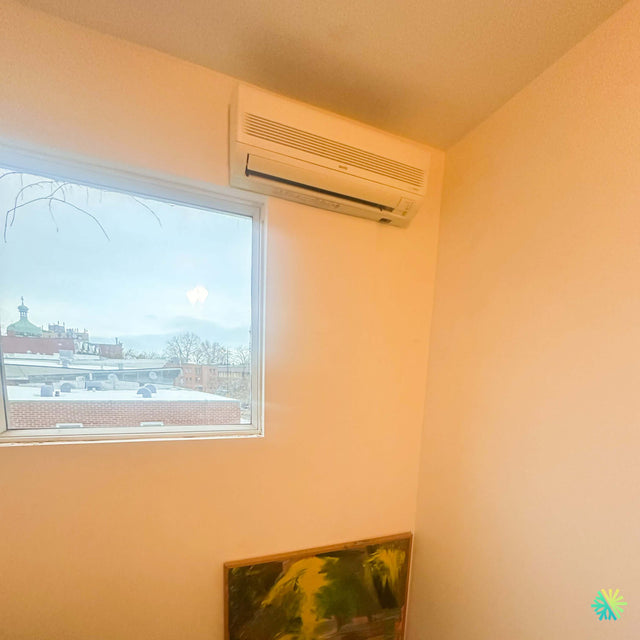
During a recent HVAC service call in Montreal, our AirGreen team was called for a wall heat pump installed in a particularly tight space, near the ceiling and at the intersection of two walls. This type of setup requires increased technical attention, as access to the indoor unit is limited, airflow can be affected, and some signs of failure become less obvious to detect during a simple visual inspection.
The client contacted us because the unit was no longer delivering the expected performance. Comfort was uneven: some areas of the room remained cool, while others stayed heavy and humid. The unit seemed to be running but without producing stable air conditioning. A slight intermittent noise was also heard at startup, and a trace of moisture was noticed near the bottom of the wall evaporator. Nothing extremely dramatic at first, but enough clues to justify a full intervention.
At AirGreen, we know that a wall heat pump repair is never just about pressing a few buttons or quickly cleaning a filter. A wall unit can keep blowing air even when a serious problem starts to develop: drain blockage, buildup in the fan wheel, poorly positioned sensor, dirty coil, low airflow, intermittent electrical fault, or poor condensate drainage. This is exactly the kind of situation we encountered here.
A wall unit installed very high, in a hard-to-reach corner
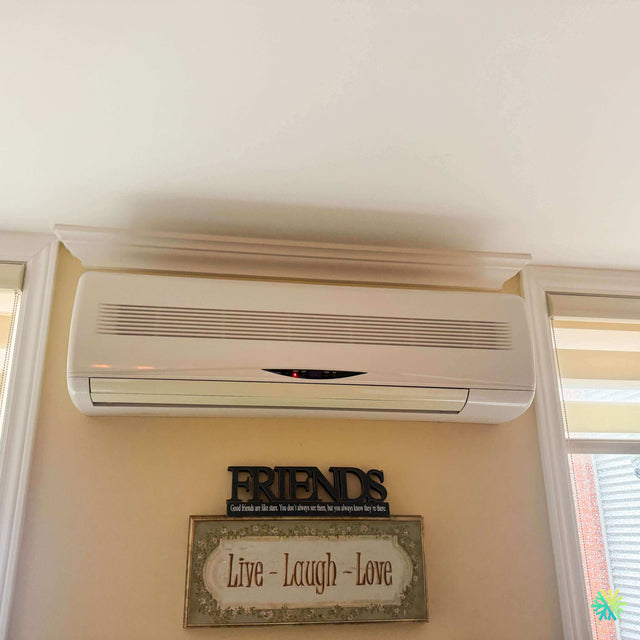
The intervention photo shows a wall-mounted indoor unit installed very close to the ceiling, in a tight corner. This position presents several concrete challenges for a service team:
- Access to the filters and front panel is more complex;
- The side clearance is reduced;
- The return air can be influenced by the proximity of the wall;
- Regular maintenance is often postponed because the unit is difficult to reach;
- Signs of leaks or condensation can remain subtle until the problem is more advanced.
In a residence in Montreal, where wall-mounted heat pumps are often installed in condos, plexes, townhouses, or homes with special ceilings, this kind of constraint is common. Our experience in HVAC repair in Montreal, Laval, Longueuil, on the North Shore and South Shore allows us to adapt our method according to the actual environment of the unit, and not just according to the manufacturer’s theory.
Symptoms observed before our diagnosis
The client described three main problems: a drop in cooling performance, a slight noise during operation, and suspected moisture near the wall unit. These symptoms can have several causes. A wall-mounted heat pump can lose efficiency due to lack of maintenance, but also because of drainage problems, ventilation defects, or refrigerant circuit imbalance.
On site, we started by observing the unit’s behavior in cooling mode. The unit started, but the airflow seemed irregular. The blowing temperature was not constant, and the unit seemed to work harder than it should. The front panel also showed signs of wear and buildup, which led us to a thorough inspection of the interior part.
Our HVAC diagnosis: complete inspection of the indoor unit
The first step was to secure the intervention, then carefully remove the accessible panels. In such a tight space, this step requires patience to avoid damaging clips, motorized flaps, or aging plastics. Poor handling can turn a simple repair into an expensive replacement of body parts.
We then inspected the filters, evaporator coil, fan wheel, drainage pan, and condensate line. The diagnosis confirmed several issues:
- the filters were loaded with fine dust;
- the fan wheel had an accumulation that reduced airflow;
- the coil was partially dirty;
- the condensate drain was slowed by a partial blockage;
- the drainage pan was starting to retain water instead of evacuating it quickly;
- the air distribution flaps were not operating perfectly smoothly.
The good news: the compressor was not at fault, and there was no immediate sign justifying the complete replacement of the system. The failure was rather due to a combination of maintenance, drainage, and air circulation factors. This is a common situation with wall-mounted heat pumps that operate several hours a day during the summer, especially in homes where the unit is difficult to access.
A condensate blockage that needs to be treated quickly
One of the most important points of this intervention was the condensate drain. In cooling mode, a wall-mounted heat pump removes moisture from indoor air. This water must be properly drained through the pan and drain. If the flow slows down, water can accumulate in the unit, create unusual noises, emit a musty smell, or eventually leak onto the wall.
In this particular case, the blockage was not total but enough to cause water retention. A quick intervention prevented damage to the wall, adjacent ceiling, or interior finish. For a device installed in a corner, it is even more important to check this point because water can follow a discreet path along the wall before being noticed.
A complete repair to restore performance, drainage, and comfort
Our team carried out a methodical refurbishment of the wall unit. The goal was not just to restart the device but to restore reliable, quiet, and stable operation.
Technical cleaning of the coil and ventilation wheel
We performed targeted cleaning of the evaporator coil to improve heat exchange. A dirty coil prevents air from passing properly through the fins, which reduces cooling capacity and can promote excessive moisture formation.
The ventilation wheel was also cleaned. This part is often overlooked, but it plays a central role in the performance of a wall-mounted heat pump. When dust accumulates there, airflow decreases, the motor works harder, noise increases, and the temperature becomes less uniform in the room.
After cleaning, the airflow became more consistent again. This improvement was quickly noticeable during operational tests.
Unblocking and inspection of the condensate drain
We then addressed the drainage pipe. The partial blockage was cleared, and the flow was tested with water to confirm that the pan was draining properly. This test is essential: a drain may seem clear at first glance but remain too slow when it handles a larger volume of water during a hot and humid day.
We also checked the slope and the absence of visible water backflow. In wall installations, especially when placed in a corner, even the slightest weakness in drainage can cause damage over the medium term.
Electrical verification and component inspection
Once the mechanical part was cleaned, we proceeded with basic electrical checks: connections, control board response, fan motor operation, flap reaction, sensor readings, and startup sequence. No major electronic board faults were detected.
We then compared the device’s behavior in different operating modes. The heat pump responded correctly to commands, ventilation adjusted better, and the intermittent noise decreased after cleaning and properly repositioning some accessible parts.
Checking refrigerant performance
Even when the problem seems to come from the indoor unit, it is important to check overall performance. A wall-mounted heat pump is a complete system: the indoor unit, refrigerant line, outdoor compressor, and controls must work together.
We then validated the operating performance, blowing temperature, cycle stability, and indicators that could reveal a refrigerant circuit anomaly. In this case, no clear symptom of refrigerant shortage was found after testing. This avoided unnecessary intervention on the sealed circuit and focused the repair on the real causes of the problem.
Final result: comfort restored and customer reassured
At the end of the service call, the wall-mounted heat pump offered significantly better airflow, more stable operation, and normal drainage. The customer quickly noticed a difference in air distribution and cooling consistency.
We also took the time to explain the signs to watch for: water noise, musty smell, reduced airflow, drops under the unit, flaps moving poorly, frequent shutdowns, or irregular performance. These details allow action before a small problem becomes a more costly repair.
Mistakes to avoid with a wall-mounted heat pump installed in a corner
An angled installation can work well, but it requires more rigorous maintenance. Here are the most common mistakes we observe during our HVAC service calls:
Waiting for a visible leak
A visible water leak is often a late sign. Before that, the drain may already be slowed, the pan may retain water, and moisture can accumulate inside the unit.
Cleaning only the filters
Filters are important, but they don’t solve everything. The fan wheel, coil, and drain pan also need to be inspected periodically.
Ignoring a slight noise
A small noise can indicate a dirty wheel, a stuck flap, panel vibration, or a motor under strain. The earlier the diagnosis, the simpler the repair.
Using unsuitable products
Some household products can damage plastics, leave residues, or attack internal components. A wall-mounted heat pump must be cleaned with methods adapted to HVAC equipment.
Neglecting access to the unit
When a unit is installed very high or in a tight corner, maintenance becomes more demanding. Safe access and a work method that protects walls, ceiling, and the unit must be planned.
Why call AirGreen for HVAC repair
A wall-mounted heat pump repair requires a combination of precision, field experience, and understanding of local conditions. In Montreal, as in Laval, Longueuil, on the North Shore and the South Shore, wall units are subjected to varied uses: intensive air conditioning in summer, supplemental or primary heating in fall and spring, prolonged operation in open spaces or well-insulated condos.
At AirGreen, we approach every service call with a clear method: listen to the symptoms, inspect accessible components, test drainage, check ventilation, validate controls, confirm performance, and explain the results to the client. This approach avoids unnecessary replacements and often extends the equipment's lifespan.
In this intervention in Montreal, the main issue was not a major breakdown, but a combination of small problems that gradually reduced comfort. By servicing the indoor unit, drainage, and ventilation, we restored performance without recommending premature replacement.
Preventive maintenance that protects performance
After the repair, we recommended regular maintenance adapted to the location of the unit. A wall-mounted heat pump installed in a corner, especially near the ceiling, should be inspected more carefully than a unit that is easily accessible. Cleaning the filters by the client remains useful, but periodic professional inspection allows checking what is not visible at first glance.
Well-done maintenance helps to:
- maintain better airflow;
- reduce the risk of condensate leaks;
- limit musty odors;
- improve energy efficiency;
- reduce operating noise;
- extend the system's lifespan;
- preserve indoor comfort during heat waves.
For condo, plex, and house owners in Montreal and the surrounding areas, this is a simple measure that can prevent many inconveniences.
The same service at your place?
Cleaning, repair or maintenance: tell us about your unit and we schedule the visit.
- RBQ licence 5645-9605-01Subclasses 15.8, 15.10 and 16
- $5M liability insuranceOn every job
- 15+ yearsFamily-owned, based in Montréal