Service Call for a Wall-Mounted Heat Pump in Montreal
| Service | Service call | Unit | Wall-mounted heat pump |
|---|---|---|---|
| Area | Montréal | Published | November 11, 2026 |
| Reading | 10 min | ||
Attachment 1 · job photo

A water leak under the indoor unit: a clear signal that an HVAC diagnosis is urgently needed
A wall-mounted heat pump that starts leaving water marks on the wall should never be treated as a mere aesthetic detail. During a recent HVAC service call in Montreal, our AirGreen team intervened in a residence where the indoor unit showed a very visible symptom: a vertical streak under the right side of the unit, directly below the area where the condensation tray, internal fittings, and drain outlet are usually located.
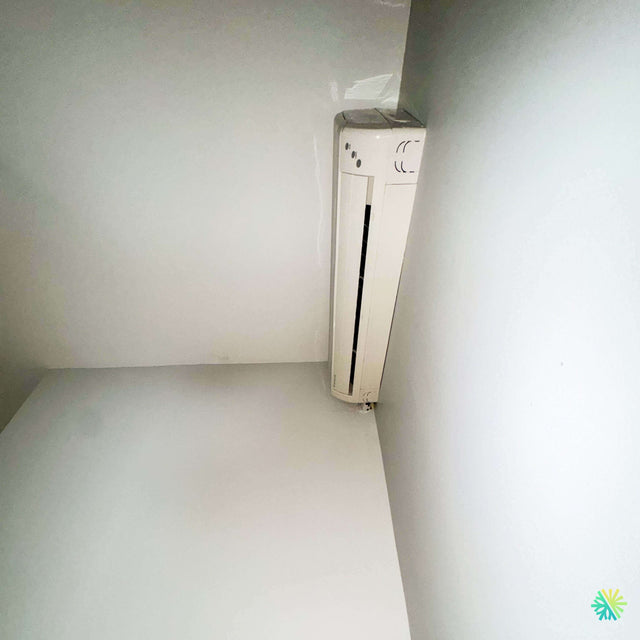
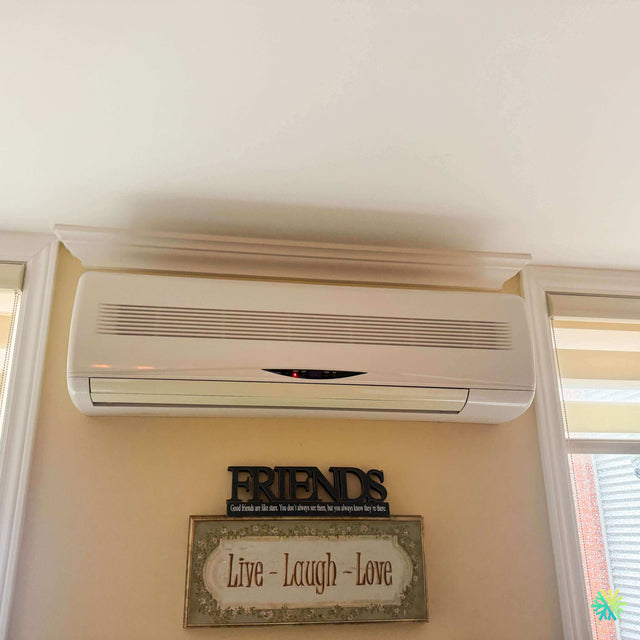
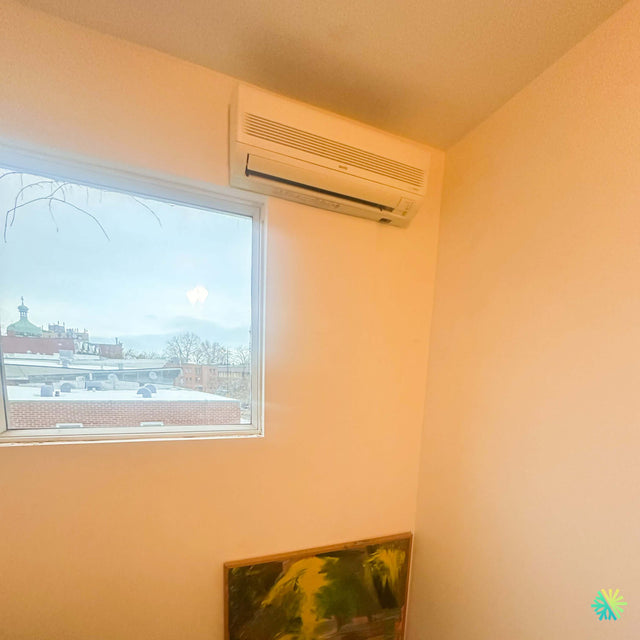
In the service photo, we see a white wall unit installed high on an interior wall, with two wall controls nearby, including a Broan ventilation control. The setup indicates a typical residential configuration: a mini-split wall-mounted heat pump, probably with a common capacity between 12,000 and 18,000 BTU, used to ensure comfort in a main living area. Since the exact brand is not clearly readable on the front, our diagnosis focused on the unit’s behavior, condensate management, and the actual condition of the installation.
In this type of situation, the problem may seem simple: "the unit is leaking." However, a water leak on a wall-mounted heat pump can come from several different causes. A partially clogged drain, improper slope, a dirty condensation tray, a dirty fan, a frozen evaporator, poor installation, a faulty condensate pump, or lack of maintenance can all produce a similar result. Our role is therefore to trace back to the exact cause, not just to wipe up the water.
The observed symptom: a water mark under the right side of the unit
The customer contacted us after noticing a vertical mark on the wall, descending from the base of the indoor unit. The mark was visible enough to indicate that the water was not draining properly to the designated drain. In a wall-mounted heat pump in cooling mode, indoor air humidity naturally condenses on the evaporator. This water must then fall into an internal tray and be evacuated by gravity or with the help of a condensate pump.
When everything works normally, the customer never sees this water. It quietly flows outside or to a drainage point. When a stain appears on the wall, it means the water’s path has been interrupted or the volume of condensate exceeds the system’s drainage capacity.
In Greater Montreal, this kind of call is common during hot and humid periods. In Montreal, Laval, Longueuil, on the North Shore and the South Shore, wall units can produce a lot of water in summer, especially when indoor humidity is high. A small blockage in the drain can then become a visible problem in a short time.
First check: confirm that the leak is indeed from the condensate
Before disassembling the unit, we checked if the leak really came from the indoor unit. A water stain under a wall unit can also be related to a wall, roof, plumbing, or condensation problem around a cold element. In this case, the location of the stain, directly under the lower right part of the unit, clearly pointed the diagnosis toward the condensate drainage system.
Our technicians therefore proceeded step by step:
- inspection of the unit’s front and base;
- filter check;
- observation of the condition of the louvers and air outlet;
- visual inspection of the wall under the unit;
- condensate pan inspection;
- drain check;
- flow test;
- restart to observe the actual behavior.
This method avoids drawing conclusions too quickly. A leak can be intermittent: it may only appear after several hours of air conditioning, only when humidity is high, or only when the device operates at a specific fan speed.
AirGreen Diagnosis: partial blockage and unstable drainage
During this service call for a wall-mounted heat pump in Montreal, the most likely diagnosis was unstable condensate drainage caused by a partial drain blockage and internal buildup in the pan. This type of problem often develops gradually. At first, the water still flows, but more slowly. Then, when the machine produces more condensate, the level rises in the pan and the water looks for another path. It can then come out the front or from a corner of the unit.
We paid particular attention to the right side of the device, as the visible trace started from this area. On several wall models, the drain, pipe fittings, and some internal passages are located on or near this side. A slight accumulation of biofilm, damp dust, or deposits can be enough to slow the flow.
Why wall heat pump drains get clogged
A drain from a wall air conditioner or a wall heat pump evacuates cold water, loaded with fine particles from the ambient air. Over time, this water can carry:
- dust;
- animal hairs;
- cooking residues;
- textile particles;
- organic deposits;
- biofilm;
- small dirt accumulated in the tray.
When these elements accumulate in the pipe or at the drain entrance, water flows less well. In some cases, the drain is not completely blocked, which makes the problem harder to detect. The device may operate normally for a few hours, then start leaking when the water volume increases.
This is exactly the type of situation that leads to service calls in the middle of summer. The customer often believes the machine is “broken,” when it is sometimes a maintenance, drainage, or installation issue to be corrected before it further damages the wall.
Inspection of filters and turbine
A water leak is not always caused solely by the drain. Lack of maintenance can alter the overall behavior of the unit. If the filters are clogged, the airflow decreases. If the turbine is dirty, ventilation becomes less uniform. If the evaporator receives less air, it can become too cold, create ice, then release an abnormal volume of water during defrosting or shutdown.
We therefore checked the cleanliness of the indoor unit. A superficial cleaning of the filters is not always enough. The internal part, especially the turbine and the evaporator, can accumulate deposits invisible from the outside. In a residence in Montreal, where the device regularly operates in air conditioning mode during humid periods, periodic maintenance becomes essential.
Drain flow test
The flow test is a key step. It allows you to see if the water is properly reaching the outlet point. When a technician pours or injects a controlled amount of water into the condensation tray, they can observe if the flow is fast, slow, intermittent, or absent.
In this case, the flow was not optimal. The water did not leave the tray with the expected fluidity, which confirmed the need to clean the drain and check its path. Slow drainage can be enough to cause a leak when the machine runs for a long time.
Intervention performed: cleaning, unclogging, and operation validation
After the diagnosis, our team made the necessary corrections to restore normal condensate drainage. The goal was to address the cause of the leak, not just temporarily stop the symptom.
Condensate tray cleaning
The internal tray was inspected and cleaned to remove deposits that could hinder flow. This step is essential because a cleaned drain without a clean tray can quickly become clogged again. The tray acts as the collection point for water produced by the evaporator; if it contains residues, these can be carried to the drain as soon as the system is restarted.
Drain unclogging
The drain was cleaned to restore a free passage. Depending on the installation configuration, this intervention can be done by suction, controlled blowing, or appropriate mechanical cleaning. Aggressive methods that risk displacing a fitting, damaging a pipe, or creating a hidden leak in the wall should be avoided.
In a finished dwelling, caution is essential. Poor handling can turn a visible leak into a hidden leak, which is much more costly to fix.
Checking the slope and drainage path
Once the drain was cleared, we checked if the slope allowed for reliable drainage. For a wall-mounted heat pump operating by gravity, the drain slope must be sufficient and continuous. A sag, a too-tight bend, or a low point can retain water and promote blockages.
When drainage depends on a condensate pump, it is also necessary to check the activation, the float, the power supply, and the discharge pipe. In the observed case, the most important element was to confirm that the water was properly leaving the unit after cleaning.
Restart and observation
After the intervention, the device was put back into operation. We observed the unit's behavior, the airflow, the normal formation of condensate, and the absence of any new visible leaks. This final check is essential because a wall-mounted heat pump leak can sometimes be linked to a combination of factors.
Result: flow restored and risk of damage reduced
The intervention restored a more stable condensate drainage and reduced the risk of new streaks on the wall. The customer also received concrete recommendations to avoid recurrence, especially regarding filter cleaning frequency, monitoring moisture stains, and the importance of periodic professional maintenance.
Comfort was maintained, the device could continue to cool properly, and the customer was reassured about the general condition of their wall-mounted heat pump. This type of call is particularly important because untreated water leaks can damage paint, drywall, moldings, furniture, or even create moisture problems inside the wall.
Practical lessons from an HVAC service call for a wall-mounted heat pump leak
An indoor leak is never normal
A wall-mounted heat pump produces water in cooling mode, but this water must always be drained in a controlled manner. If it appears on the wall, floor, or around the unit, there is a problem to diagnose.
Even a small stain should be taken seriously. A slight leak can indicate the beginning of a blockage. If ignored, it can become more significant on a very humid day or after several hours of continuous operation.
Signs to watch for before calling
Before water flows heavily, some signs may appear:
- moisture under the unit;
- vertical stain on the wall;
- drops near the shutters;
- water noise inside;
- damp smell at startup;
- reduced airflow;
- ice formation;
- intermittent device shutdown;
- leak only after several hours of air conditioning.
These signs allow for quicker action. The faster the intervention, the easier it is to limit damage.
Mistakes to avoid
Many customers try to fix the problem themselves by wiping the facade, only cleaning the filters, or using a household vacuum at the end of the drain. These actions can sometimes help temporarily, but they do not replace a complete diagnosis.
You should avoid:
- pouring chemicals into the unit;
- blowing too hard into the drain;
- dismantling the facade without knowing the model;
- forcing the shutters;
- ignoring a recurring stain;
- repainting the wall without addressing the cause;
- continuing to use the device if water is flowing heavily.
A poorly executed intervention can damage internal components, displace the drain, or cause a hidden leak.
The importance of regular HVAC maintenance
Periodic HVAC maintenance greatly reduces the risk of leaks. Filters should be regularly washed by the client, but professional cleaning goes further. It treats the turbine, evaporator, condensation tray, and internal areas where deposits accumulate.
In the regions of Montreal, Laval, Longueuil, the North Shore, and the South Shore, we generally recommend a full maintenance every 12 to 18 months for frequently used wall units. This frequency may be shorter if the residence has pets, high humidity, a nearby kitchen, or intensive summer use.
Why AirGreen uses a structured approach
At AirGreen, we know that a leak problem on a wall-mounted heat pump can have several causes. That’s why we favor a clear method: observation, diagnosis, testing, correction, validation. This approach helps avoid unnecessary repairs and addresses the real problem.
In this service in Montreal, the issue was not to replace a machine or conclude a major failure. The challenge was to understand why the water was no longer draining properly and to restore the system to reliable operation. This is precisely what distinguishes a simple repair from a true professional HVAC intervention.
A useful service to protect comfort and the building
A well-maintained wall-mounted heat pump ensures stable comfort, better energy efficiency, and a longer lifespan. Even a slight leak indicates that the system's balance is disturbed. By acting quickly, both the device and the building are protected.
AirGreen offers HVAC repair, diagnostic, cleaning, and maintenance services for wall-mounted heat pumps, wall air conditioners, multi-zone systems, and residential equipment throughout Greater Montreal. Whether the issue is a leak, noise, loss of performance, electrical failure, clogged drain, or lack of maintenance, our team responds with precision and professionalism.