
Repair of a Mitsubishi Wall-Mounted Heat Pump in Fabreville

A subtle water leak on a Mitsubishi Mr. Slim: the kind of problem that starts small but can quickly damage a wall
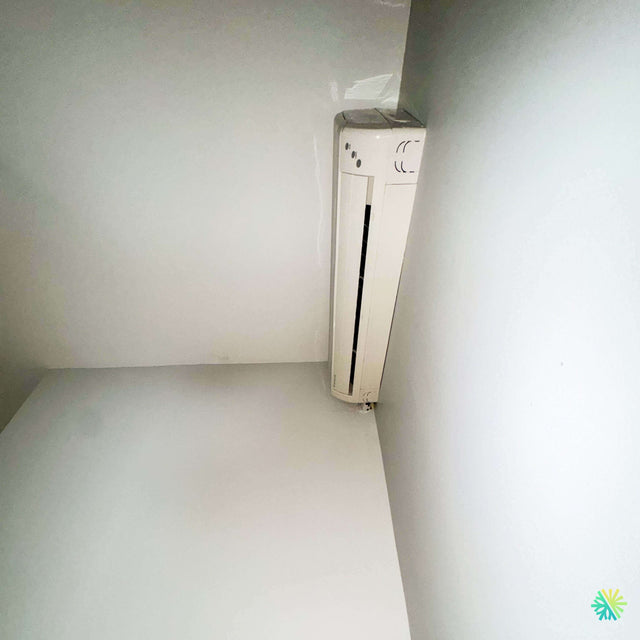
In Fabreville, in the Laval area, our AirGreen team was called for a Mitsubishi wall-mounted heat pump repair from the Mitsubishi Electric Mr. Slim range. The indoor unit was installed very close to the ceiling, in a corner of the room, with limited clearance on the right side. Visually, the device showed typical signs of a system in service for several years: slightly yellowed plastic, dust buildup on the louvers, marks near the air outlet, and the nameplate still present under the unit.
The client contacted us with a very specific problem: the device was still cooling, but a slight water leak appeared intermittently under the indoor unit, especially on hot and humid days. The symptom was not constant. Some days, nothing dripped. Other days, a few drops ran down the wall after a prolonged period of air conditioning. This irregularity is exactly what makes this type of HVAC service call more delicate: an intermittent leak can be caused by a partially clogged drain, a dirty condensate pan, insufficient slope, a dirty fan, a frozen indoor coil, or even inadequate refrigerant pressure.
At AirGreen, we know that a leaking wall-mounted heat pump indoors should never be taken lightly. Even a small amount of water can damage paint, cause drywall to swell, create musty odors, or falsely suggest that the device is at the end of its life. In this case in Fabreville, the goal was clear: find the real cause, fix the problem, and restore the Mitsubishi system to proper working order.
A Mitsubishi Electric Mr. Slim unit installed high on the wall
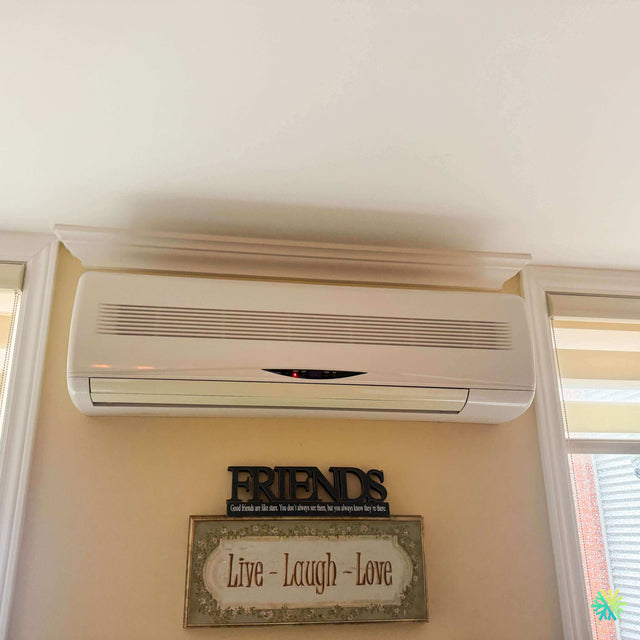
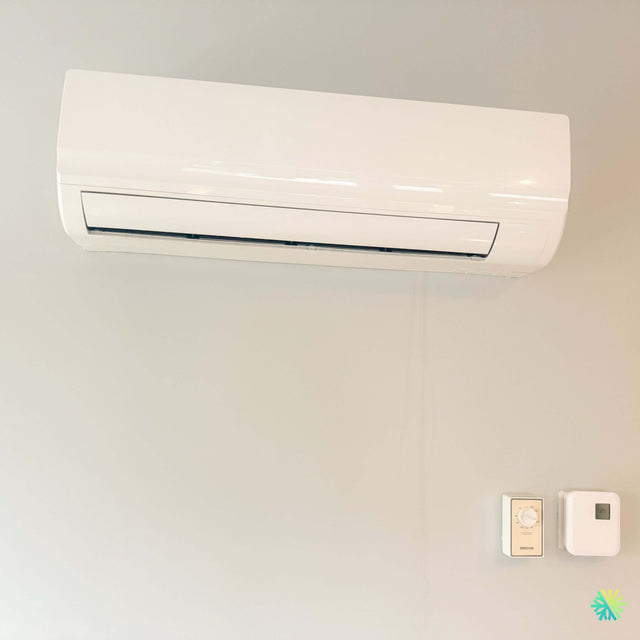
The observed device was a Mitsubishi Electric Mr. Slim wall-mounted indoor unit, a well-known range for its reliability and quiet operation. The unit's size indicated a typical residential capacity, probably around 9,000 to 12,000 BTU, used to cool and heat a main room, a floor, or an open area depending on the housing layout.
The installation up high, very close to the ceiling, is common for wall units. It allows good air distribution but sometimes complicates access for maintenance. When the unit is installed in a corner, checking the drain side becomes more demanding. The technician must work precisely to inspect the condensate pan, the drain pipe, the louvers, the fan, and the evaporator without damaging the plastic panels, which become more fragile with age.
In this service call in Fabreville, the machine was not completely broken. It was working but showed abnormal behavior. This kind of case requires a methodical diagnosis, because randomly replacing a part does not fix a water leak if the cause is actually clogging or condensate drainage.
Symptoms reported by the customer
The customer had noticed several signs:
- a few drops of water under the unit after several hours in cooling mode;
- a slightly damp smell at startup;
- airflow weaker than before;
- cooling still present, but less uniform;
- a heavier ventilation noise when the device was running at high speed.
These symptoms pointed to a drainage or internal maintenance problem. On a Mitsubishi wall-mounted heat pump, the water produced by condensation must naturally flow to the drain. When the evaporator cools the humid air, water forms on the fins, flows down into the condensate pan, then leaves the unit through the drainage pipe. If this path is slowed, water accumulates and eventually comes out the front or side of the device.
Initial inspection: understand before disassembling
The first step was to check the unit's operation under real demand. We set the heat pump to cooling mode, observed the opening of the louvers, the ventilation behavior, the noise level, and the blowing temperature. The device responded correctly to the command, which ruled out a major electronic board or communication failure from the start.
Next, our technician inspected the area under the unit, the visible marks on the casing, the position of the drain, and signs of moisture. The leak seemed to come from inside the housing rather than from an exposed pipe. This led us to focus on the condensate pan and the drainage path.
Condensate tray inspection
The condensate tray is a simple but critical component. On a wall unit, it receives all the water produced by the evaporator. Over time, dust, biofilm, fine particles, and residues can accumulate there. In a home where the device runs often in summer, especially in a humid area like the greater Montreal region, the buildup can become significant enough to slow drainage.
In this case, the tray showed visible deposits. Nothing extreme, but enough to explain intermittent leaks during periods of high humidity.
Drain pipe inspection
The drain was then tested. A partial blockage was detected. Water passed, but too slowly. This is exactly the kind of problem that often misleads owners: when you pour a little water, it eventually comes out, so the drain seems functional. But when the device produces water for several hours, the evacuation flow becomes insufficient and the tray fills faster than it empties.
We proceeded to unclog the drain, rinse the passage, and verify continuous flow. The goal was not just to pass water once, but to confirm that the drain could evacuate a regular volume without backup.
Internal cleaning of the wall unit
The diagnosis also revealed dirt buildup on the turbine and internal surfaces. On a Mitsubishi Mr. Slim, the design quality is excellent, but no wall system escapes dust accumulation over the years. When the turbine gets dirty, airflow decreases. The evaporator can then become too cold in spots, increasing the risk of abnormal condensation, water droplets being thrown, or even ice formation.
We therefore performed targeted cleaning of the indoor unit:
- cleaning of the condensate tray;
- cleaning of the louvers and air outlet;
- inspection and cleaning of the turbine;
- evaporator check;
- drain rinsing and testing;
- filter inspection;
- reinstalling the panels and testing operation.
This step improved the airflow and reduced the musty smell at startup. In many cases, customers think the odor comes from the refrigerant or an electrical problem, when it actually comes from a humid environment inside the unit.
A repair without major component replacement
In this specific case, no electronic board, motor, or compressor had to be replaced. The repair was mainly related to condensate drainage and internal maintenance. We replaced and secured some small drain fasteners to ensure better support, then confirmed that the pipe did not create any visible back slope inside the accessible passage.
This point is important: a successful HVAC repair does not always involve an expensive part. Sometimes, true expertise is about avoiding unnecessary replacement and fixing the physical cause of the problem. A water leak on a wall-mounted heat pump may seem serious, but if the device cools well, the system pressure is consistent, and the electricity is stable, the drainage, cleanliness, and airflow should be addressed first.
Performance test after intervention
After cleaning and correcting the drain, we restarted the device to validate the result. The system was observed in cooling mode during a full cycle. The airflow was more regular, the musty odor had decreased, and the water drained properly without backing up into the pan.
We also checked the blowing temperature to confirm that the cooling performance remained normal. The Mitsubishi unit produced stable cool air, with no visible frost on the evaporator. The ventilation noise was also more consistent after cleaning the turbine.
The client was mainly reassured by the fact that the system was not at the end of its immediate life. The machine needed professional intervention, but not a complete replacement. For a well-maintained Mitsubishi unit, this type of repair can extend comfort for several seasons.
What this intervention in Fabreville reminds us about wall-mounted heat pump maintenance
A Mitsubishi wall-mounted heat pump can be very durable, but it must be properly maintained. In Laval, as in Montreal, Longueuil, on the North Shore and the South Shore, we often see wall systems that still work very well mechanically but develop water, odor, or airflow problems simply because internal maintenance has been delayed too long.
A water leak is not always a refrigerant failure
A common mistake is to associate any leak or lack of performance with a refrigerant shortage. However, in wall units, condensate problems are much more common. The refrigerant circulates in a closed circuit. The water flowing inside is usually condensation water, not refrigerant gas. It comes from indoor air humidity.
That said, the possibility of a refrigerant problem should not be ignored either. A lack of refrigerant can freeze the evaporator, then cause water flow when the ice melts. That’s why our diagnosis always includes observing the evaporator, cooling behavior, and system stability.
The drain must be tested under realistic conditions
A partially clogged drain may seem functional during a quick test. That’s why we test the drainage more thoroughly, observing the drainage speed and checking that water does not stagnate in the pan. A system that leaks only after two or three hours of operation often gives a clear clue: water is produced faster than it is drained.
The fan directly affects condensation
The indoor fan plays a crucial role. If it is dirty, it moves less air. Less air through the evaporator means a colder surface, more condensation, and sometimes irregular behavior. A clogged fan can also cause vibrations, noise, and less comfortable air distribution.
In this service call in Fabreville, cleaning the fan was as important as unclogging the drain. The two problems reinforced each other: less airflow, more condensation, then too slow drainage.
Units installed near the ceiling require special attention
A wall unit installed very high can be more difficult for the owner to maintain regularly. The filters are less accessible, dust sometimes stays longer inside the device, and signs of leaks can go unnoticed until a stain appears on the wall.
We recommend having this type of unit inspected as soon as any change is noticed: damp smell, water drops, ventilation noise, low airflow, uneven cooling, or unexpected shutdown.
Practical tips to prevent a new leak
For owners of similar wall heat pumps, here are the most useful steps:
- clean the filters regularly during the cooling season;
- don’t wait for a smell to appear before requesting HVAC maintenance;
- check if water drains normally outside when the unit is cooling;
- avoid using the unit for long periods if it leaks inside;
- have any new noise or reduced airflow inspected promptly;
- schedule professional cleaning when the fan becomes visibly dirty.
A service that protects comfort and the building
The final result of this service call for a Mitsubishi wall heat pump in Fabreville was positive: the leak was fixed, the drain was unclogged, the condensate pan cleaned, ventilation improved, and the customer got back a cleaner, more stable, and more reassuring system.
At AirGreen, we take this type of service seriously because a condensate problem is never just a matter of comfort. It’s also about protecting the building. A small recurring leak can become costly if it reaches the wall, floor, or insulation. A quick check often helps avoid much more extensive repairs.
Our team handles heat pump repair, wall air conditioner, HVAC installation, HVAC maintenance, and residential service calls throughout the greater Montreal, Laval, Longueuil, North Shore, and South Shore areas. In Fabreville, this Mitsubishi Mr. Slim regained reliable operation thanks to an accurate diagnosis, drainage correction, and internal cleaning tailored to the actual condition of the unit.
The same service at your place?
Cleaning, repair or maintenance: tell us about your unit and we schedule the visit.
- RBQ licence 5645-9605-01Subclasses 15.8, 15.10 and 16
- $5M liability insuranceOn every job
- 15+ yearsFamily-owned, based in Montréal