Service Call for a Sanyo Wall-Mounted Heat Pump in Laval-Ouest
| Service | Service call | Unit | Wall-mounted heat pump |
|---|---|---|---|
| Brand | Sanyo | Area | Laval |
| Published | November 11, 2026 | Reading | 10 min |
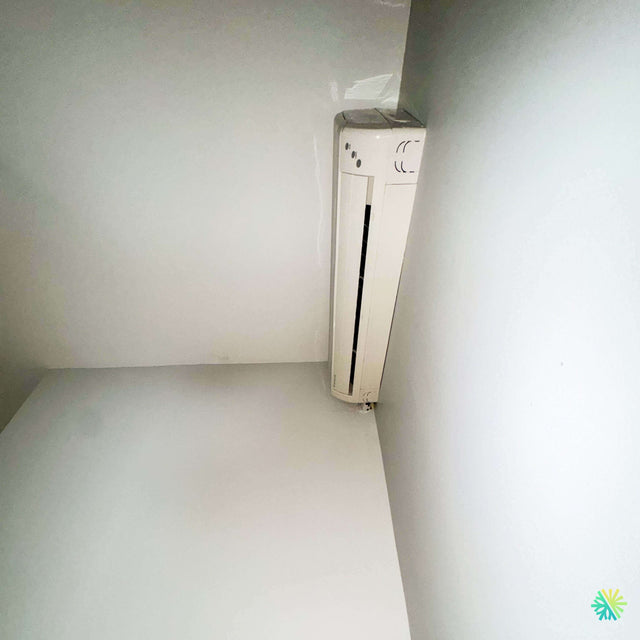
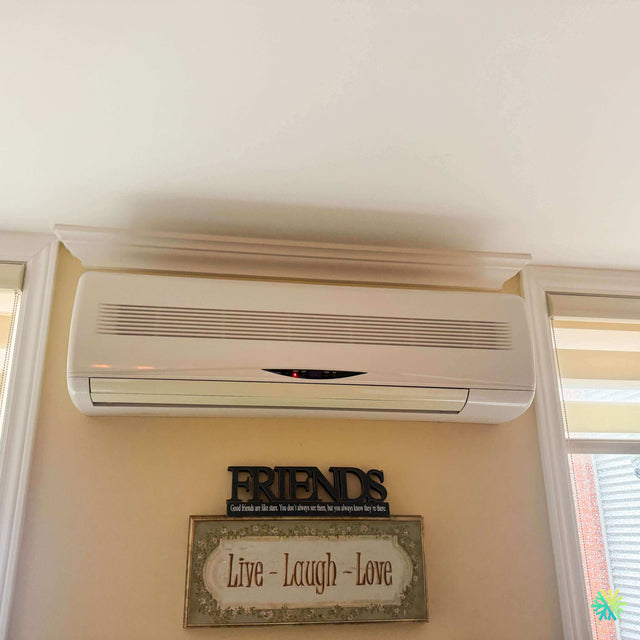
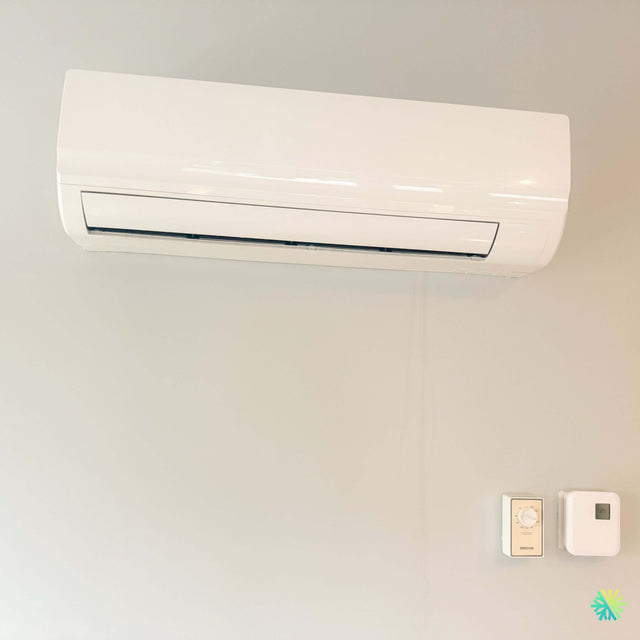
Attachment 1 · job photo

An aging Sanyo wall unit, installed high up, requiring a precise diagnosis before any repair
In this residence in Laval-Ouest, our AirGreen team was called to inspect a Sanyo wall-mounted heat pump installed high up, very close to a window, in a room where thermal comfort depended directly on this single wall unit. The device, visibly older than the recent models currently offered on the market, showed several symptoms that worried the client: power drop, irregular operation, louder ventilation noise, and suspicion of a condensate problem.
The indoor unit was positioned in a corner of the room, above a large window. This setup is common in some homes in Laval, especially in houses or plexes where a wall system was installed several years ago with the architectural constraints available at that time. The space above the window allowed direct diffusion into the room, but it also imposed an important technical reality: access to the unit is more delicate, clearance around the device is limited, and maintenance must be carried out methodically to avoid damaging aging components.
On site, our priority was to determine whether the wall-mounted heat pump could be effectively repaired or if the symptoms were related to more advanced wear. With older Sanyo units, it is always necessary to proceed carefully. Some parts can be harder to obtain, electronic boards can be sensitive, and a wrong diagnosis can quickly lead to unnecessary costs. Our approach was therefore structured: listen to the symptoms, check the actual behavior of the machine, inspect accessible components, control drainage, measure blowing performance, and assess the overall condition of the system.
A compact Sanyo wall-mounted heat pump, probably 9,000 to 12,000 BTU
The observed device corresponds to a Sanyo wall-mounted heat pump of the residential mini-split type. Given the size of the indoor unit, the room served, and the wall configuration, it is likely a compact unit, typically around 9,000 to 12,000 BTU. This capacity is commonly used for a bedroom, office, small living room, or a closed residential area.
Visible and technical features of this intervention:
- Machine type: wall-mounted heat pump
- Brand: Sanyo
- Category: residential mini-split wall system
- Location: Laval-Ouest
- Estimated capacity: about 9,000 to 12,000 BTU
- Installation: wall-mounted indoor unit high up, near a window
- Symptoms: reduced airflow, increased noise, less effective cooling, drainage to check
- Intervention: complete HVAC diagnosis, inspection of the indoor unit, targeted cleaning, drain check, performance tests
Even though Sanyo is no longer as common a brand in new residential installations as some current brands, several Sanyo units are still in service in Greater Montreal. These devices can operate for a long time when well maintained, but they become more sensitive to dirt buildup, drainage problems, electrical variations, and internal component failures.
In this specific case, the goal was not to condemn the device simply because it was older. An old machine can sometimes be restored to good condition with targeted intervention. Conversely, a machine that still seems functional can hide a more serious problem. The role of a good diagnosis is precisely to make this distinction.
Symptoms reported by the customer
The customer explained to us that the unit no longer provided the same comfort as before. In cooling mode, the room took longer to cool down. The airflow seemed weaker, even when the ventilation was set to a high speed. There was also a duller noise, as if the fan was straining or as if the air was circulating less freely inside the unit.
Another important point concerned the condensate. The customer had noticed unusual moisture near the device after long periods of operation. There was no major leak at the time of our visit, but the risk was present. In an installation placed above a window and near an interior wall, even a small leak can quickly cause stains, damage the paint, or create a localized moisture problem.
The main symptoms were therefore:
- slower cooling;
- weaker ventilation;
- heavier blowing noise;
- possible water accumulation in the tray;
- variable performance depending on operating time;
- device more sensitive on humid days.
These signs pointed to a possible issue with internal maintenance, a partially clogged drain, a dirty fan wheel, or air restriction at the evaporator.
Visual inspection: a high-mounted unit with limited access
The unit’s location immediately influenced our intervention method. A Sanyo wall-mounted heat pump installed very high, almost at ceiling level, requires careful handling. The plastics of older units sometimes become more fragile over the years, especially when exposed for a long time to heat, indirect sunlight, or temperature cycles.
We started with an external inspection of the unit: condition of the casing, alignment of the flap, presence of visible dust, the unit’s response to the remote control, flap opening at startup, and general fan behavior. The unit started, but the ventilation was not as smooth as it should have been.
The placement above the window may also have contributed to faster accumulation of fine dust. Air currents near windows often carry more particles, especially in a room where windows are regularly opened or where airflow is influenced by the outside.
Filter and evaporator check
Opening the unit revealed that the filters needed a thorough cleaning. Dirty filters don’t always completely block air, but they reduce airflow enough to harm performance. On an older machine, this restriction can amplify other weaknesses: more strain on the fan motor, less efficient heat exchange, and longer cycles.
We then inspected the evaporator. A buildup of dust and fine residues was present on certain sections. This type of dirt limits heat exchange between the room air and the internal coil. Result: the unit may seem to operate normally, but it transfers heat less effectively. The customer then feels a drop in comfort, even though the machine starts and blows air.
In several service calls in Montreal, Laval, Longueuil, on the North Shore and the South Shore, this scenario often comes up: the customer thinks the machine is low on refrigerant, while the primary problem is an air restriction caused by internal dirt buildup. A thorough diagnosis helps avoid jumping straight to an expensive or unnecessary repair.
Fan wheel inspection
The noise reported by the client led us to inspect the fan wheel. On a wall unit, this component is essential. It pushes air through the evaporator and ensures diffusion into the room. When it accumulates damp dust, the wheel can become unbalanced or less efficient. It can also produce a heavier sound, especially at medium or high speed.
During this intervention in Laval-Ouest, the wheel showed enough buildup to explain part of the noise and reduced airflow. We performed targeted cleaning of accessible areas, taking care not to force internal components. With older devices, caution is essential: too aggressive handling can damage a flap, a support, or a connector.
After cleaning, the ventilation became more consistent. The noise did not disappear artificially, but it returned to a level consistent with the age and type of the device.
Condensate drain inspection
The drain was one of the most important points of this visit. In cooling mode, a wall-mounted heat pump naturally produces water. This water must leave the indoor unit by gravity or by a condensate pump, depending on the installation. When a drain becomes partially blocked, water can accumulate in the tray before eventually overflowing.
In this case, the drain was not completely clogged, but the flow was slowed. This situation explained the client's concern about moisture near the device. We cleaned and cleared the passage to restore normal drainage. A water test then confirmed that the drainage was working properly.
This detail is crucial. Work on the drain should never be limited to just "blowing a little" into the line. It is necessary to check that the water is actually flowing, that the tray does not retain an abnormal amount of water, and that the problem does not recur as soon as the machine runs longer.
A cautious restart to extend the device's lifespan
After the cleaning and inspection work, we restarted the Sanyo heat pump to observe its behavior. The startup was normal, the flap responded better, the air flowed more consistently, and the fan noise was reduced.
Operation tests after service
We checked several elements after putting the unit back into service:
- unit response to the remote control;
- variation in fan speeds;
- stable airflow;
- no visible water at the front of the unit;
- normal drainage after testing;
- more consistent cooling;
- no alarming mechanical noise.
The result was positive: the unit could continue to be used, provided regular maintenance was maintained and its behavior monitored during periods of high heat. We also explained to the customer that, given the age of the device, some future symptoms might require a more thorough evaluation, especially if the electronic board, fan motor, or outdoor compressor showed signs of wear.
Why not automatically replace an old Sanyo
In the HVAC field, it is easy to recommend replacement as soon as a device is old. At AirGreen, we prefer to assess the actual situation. If a machine can be reasonably repaired, without costly replacement of rare parts and without significant technical risk, putting it back into service can be an excellent solution.
In this service, the problem was mainly related to maintenance, airflow, and drainage. There was no immediate sign of a major failure requiring complete replacement of the machine. The customer was therefore able to regain better comfort without having to start an installation project immediately.
That said, we also gave a professional recommendation: when an older device starts requiring repeated service calls, you should compare the cost of repairs with the cost of replacing it with a new wall heat pump that is more efficient, quieter, and eligible for certain subsidies depending on current programs.
Mistakes to avoid with an aging wall heat pump
This service in Laval-Ouest serves to highlight several common mistakes.
The first is to delay maintenance. A wall unit can continue to operate with dirty filters, but its performance gradually decreases. Sometimes the customer gets used to the reduced efficiency until the system is no longer sufficient on a hot day.
The second is to ignore a changing noise. A heavier sound or a new vibration often indicates that the fan wheel or an internal component needs inspection. The longer you wait, the greater the risk of wear.
The third mistake is minimizing a condensate problem. A little moisture near the unit is not normal. Water must be properly drained. If it appears inside, even occasionally, action must be taken before the problem causes damage.
The fourth mistake is using inappropriate cleaning products. A wall unit contains electrical components, fragile plastics, a delicate evaporator, and a drainage pan. Poor cleaning can create more problems than it solves.
HVAC expertise adapted to older installations
Older wall systems require a different approach than new machines. Parts are sometimes more sensitive, access is less convenient, and installation standards from the time don’t always match current practices. Field experience then becomes essential.
AirGreen regularly services wall systems of different generations in Greater Montreal, including Montreal, Laval, Longueuil, the North Shore, and the South Shore. Whether it’s a recent unit or an older model like this Sanyo wall-mounted heat pump, our method remains the same: clear diagnosis, targeted intervention, transparent communication, and measurable results.
The result for the client in Laval-Ouest
At the end of the service call, the Sanyo wall-mounted heat pump was working better, airflow was improved, drainage was restored, and the client knew exactly what to watch for in the coming weeks. The unit had regained a performance level consistent with its age, without unnecessary replacement.
This intervention clearly illustrates the importance of a structured HVAC service. A performance issue is not always a major breakdown. Sometimes, a methodical diagnosis, precise cleaning, and drainage correction are enough to revive a machine that seemed tired.
For owners in Laval-Ouest and surrounding areas, this service call reminds that a wall-mounted heat pump repair should always be entrusted to a team capable of distinguishing a simple blockage from a more serious problem. This precision helps protect comfort, budget, and system durability.