
Repair of a wall-mounted heat pump in Vaudreuil-Dorion

An outdoor wall unit that vibrated, performed less well, and required careful restoration
In Vaudreuil-Dorion, our AirGreen team was called for a wall-mounted heat pump repair on a residential system installed on an exterior brick wall, above a backyard. The outdoor unit was mounted on metal wall brackets, with the front fan directly exposed to weather, dust, temperature variations, and freeze-thaw cycles typical of the greater Montreal area.
The client had noticed a drop in performance, a noise more present than usual, and a noticeable vibration when the heat pump ran longer. The device was not completely stopped, but its behavior was no longer stable. In this kind of situation, it is important to avoid concluding too quickly that there is a major failure. A wall-mounted heat pump can lose a lot of efficiency due to a combination of small problems: dirty outdoor coil, unbalanced fan, weakened wall mount, deteriorated pipe protection, damaged refrigerant insulation, or worn electrical component.
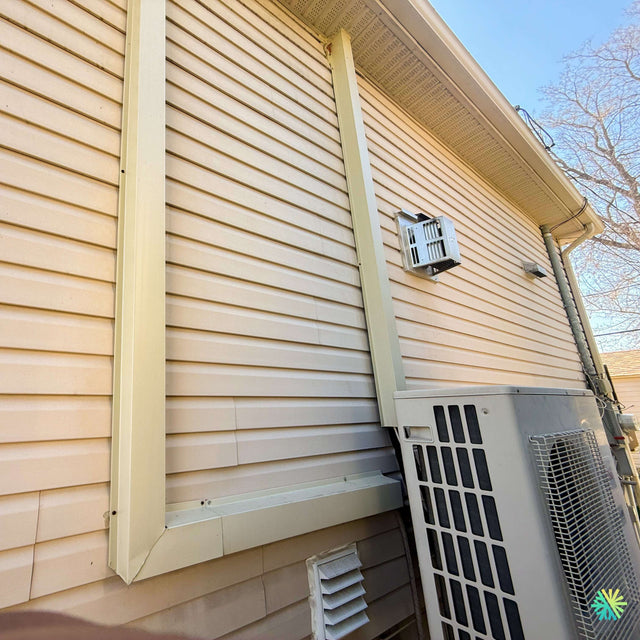
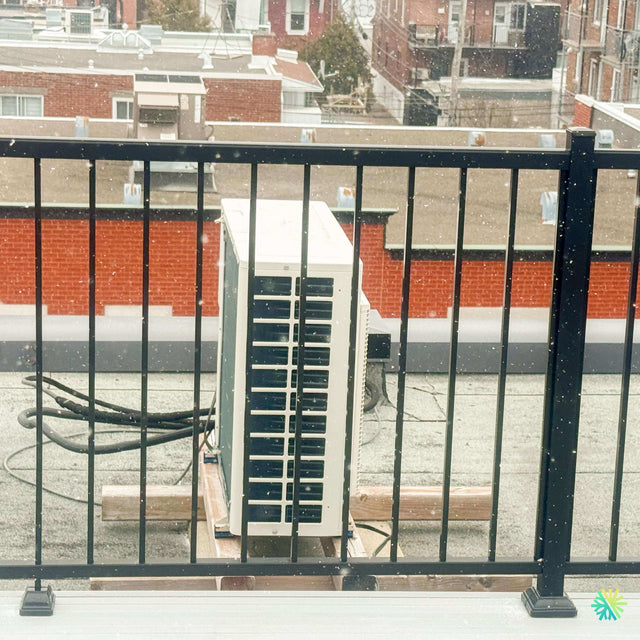
On site, the outdoor unit showed several important signs. The front fan showed visible oxidation in the center, the casing was weathered, the wall mounts required stability checks, and the refrigerant lines running along the wall appeared to have been exposed or temporarily partially protected. The installation context therefore required a thorough inspection, both mechanical and electrical.
A typical capacity residential wall system, with brand not visible
The exact brand and model were not clearly visible on the exterior facade at the time of the visual inspection. We therefore treated the intervention as a residential mini-split wall-mounted heat pump repair, with a compact outdoor unit of common capacity for this type of installation, generally used to supply one or more indoor zones depending on the system configuration.
In a service article, it might be tempting to automatically associate the unit with a well-known brand, but professional repair requires working with confirmed facts. When the nameplate is hard to read, worn off, or inaccessible without disassembly, our approach is to document the actual condition of the system, perform the necessary tests, and avoid unnecessary assumptions. This rigor is especially important on older devices, as replacement parts, operating pressures, and control sequences can vary from one manufacturer to another.
Symptoms reported by the client
The client contacted us because the heat pump seemed to still start but no longer provided the same comfort. At times, the unit ran longer than usual. At other times, the outdoor noise became more noticeable, especially when the fan sped up.
The main symptoms were as follows:
- decrease in cooling performance;
- more noticeable outdoor fan noise;
- vibration transmitted to the brick wall;
- prolonged operation without results as quick as before;
- concern about the condition of the pipes and outdoor installation.
These symptoms can stem from several different causes. A dirty or unbalanced fan can give the impression that the compressor is struggling. A clogged outdoor coil can raise operating pressures and reduce heat transfer. Damaged refrigerant line insulation can impair system efficiency. A less stable wall mount can amplify a noise that would otherwise be almost imperceptible.
First inspection: the condition of the outdoor unit
Our diagnosis began with a visual inspection of the outdoor installation. The unit was installed on wall mounts, which is common in residential areas of Vaudreuil-Dorion, Montreal, Laval, Longueuil, the North Shore, and the South Shore, especially when ground space is limited or when the yard layout does not allow for a traditional ground base.
This wall-mounted configuration has advantages but requires good maintenance. A unit fixed to the wall can transmit vibrations to the structure if the supports, rubber mounts, or anchor screws are worn out. Also, when an outdoor unit is placed near a window, balcony, or staircase, the noise often becomes more noticeable to occupants.
We paid special attention to four areas:
The outdoor fan
The center of the fan showed visible oxidation. This kind of corrosion does not automatically mean the motor must be replaced, but it indicates the unit has endured several seasons of exposure. The technician checked if the blade turned freely, if it rubbed against the grille, and if it was unbalanced.
A slightly misaligned or dirty fan can cause cyclical noise, vibration, and loss of efficiency. When air does not properly pass through the outdoor coil, the system works harder.
The outdoor coil
The coil must be able to dissipate heat in cooling mode and capture external energy in heating mode. If it is covered with dust, pollen, plant debris, or yard dirt, the heat pump loses performance.
In this case, the outdoor exposure and apparent age of the device made technical cleaning particularly important. A dirty coil can give the impression that the system is low on refrigerant, while the problem primarily comes from insufficient heat exchange.
Wall supports
The metal supports still seemed in place but required a stability check. Our technician inspected the anchor points, vibrations transmitted to the wall, and the overall condition of the fastening. A wall-mounted heat pump installed on brick must be securely supported, with particular attention to vibrations, especially on an older unit.
Refrigeration piping and external protection
The visible lines on the wall showed an installation that had clearly evolved over time. Some sections appeared unevenly exposed or protected. Insulation of refrigeration pipes is a crucial technical point: when it deteriorates, the system can lose efficiency, produce unwanted condensation, and expose the lines to mechanical damage.
Technical diagnosis: understand before repairing
After the visual inspection, we proceeded with a series of functional checks. The objective was to determine if the problem mainly came from a lack of maintenance, a worn outdoor component, an electrical issue, or a loss of cooling performance.
Start-up check
The outdoor unit started, but its behavior had to be observed over a full cycle. A heat pump can start correctly and still present a problem after a few minutes of operation, when pressures change and the fan is more heavily loaded.
Fan and motor check
The technician listened to the fan motor noise, observed the blade rotation, and checked for abnormal vibrations. Hub oxidation was not the only factor to consider. It was also necessary to check if the motor was straining, if the blades were unbalanced, and if the front grille was amplifying the noise.
In this case, the vibration mainly came from a fan-support assembly that needed tightening, cleaning, and slight realignment, rather than an immediate motor replacement.
Basic electrical check
A performance drop can also be related to a weakened capacitor, an oxidized connection, or a worn contactor. Our technician therefore checked the accessible electrical components, paying particular attention to safety and the condition of the connections.
On an outdoor unit exposed to the elements, electrical boxes and connection points must be carefully inspected. Moisture, freeze-thaw cycles, and vibrations can affect connections over the years.
Thermal transfer check
We compared the behavior of the outdoor unit with the performance felt inside. The goal was to determine if the system was exchanging heat properly. When the outdoor coil is dirty, the compressor may run longer and the indoor unit may produce less effective air.
After the initial observations, the clogging of the coil and the insufficiently optimal outdoor ventilation were among the main causes of the performance drop.
The repair carried out on site
The intervention was structured to correct visible problems, improve performance, and reduce the risk of recurrence. Our team carried out a technical overhaul of the outdoor unit, with particular attention to ventilation, mounting, and line protection.
The work performed included:
- Targeted cleaning of the outdoor unit;
- Clearing the coil to improve heat exchange;
- Inspection and cleaning of the front grille;
- Checking the fan blade;
- Tightening accessible components;
- Checking wall mounts;
- Checking for vibrations during operation;
- Inspection of accessible electrical connections;
- Inspection of visible refrigerant piping;
- Recommendation to restore protection of exposed lines;
- Complete operational test after intervention.
The goal was not just to make the unit cleaner. It was to restore adequate airflow around the condenser, stabilize fan operation, and ensure the unit could run without excessive vibration.
An HVAC repair that shows the importance of the outdoor unit
In many service calls, customers first think of the indoor unit because it is the one they see and hear most often. However, the outdoor unit plays a central role in the performance of a wall-mounted heat pump. If it is dirty, poorly ventilated, unstable, or aging, the whole system suffers.
Why a dirty outdoor unit reduces performance so much
The outdoor coil needs to breathe. When it is blocked, the compressor works under worse conditions. In summer, the unit has more difficulty rejecting heat outside. In heating mode, it may capture outdoor air energy less efficiently.
This can cause:
An increase in operating time
The system takes longer to reach the requested temperature, which increases wear and energy consumption.
A feeling of weak air conditioning
Even if the indoor unit is still blowing air, the actual cooling capacity may be reduced.
More frequent noises
When the fan is forced or the compressor operates under less favorable conditions, noises become more noticeable.
Protective shutdowns
In some systems, overheating or abnormal pressure can cause intermittent shutdowns.
The importance of wall mounts on a brick facade
In Vaudreuil-Dorion, as in many areas of Montreal, Laval, and Longueuil, outdoor units are often installed on brick facades. This method can be very effective when well executed, but it requires solid supports, appropriate anchors, and proper vibration management.
Poorly maintained wall mounting can create amplified noise inside the house. Even slight vibration can become annoying if transmitted directly to the structure. In this intervention, checking the supports helped reduce the felt vibration and confirmed that the unit could continue to operate safely, provided the recommended maintenance is continued.
Mistakes to avoid with an outdoor wall-mounted heat pump
This intervention allowed us to remind the customer of several important points.
Do not cover the unit in an improvised way
A bag, tarp, or temporary cover placed incorrectly can hinder ventilation, trap moisture, or create a debris risk around the fan. An outdoor unit must be protected smartly, without blocking air or trapping water.
Do not ignore the insulation of refrigerant lines
When insulation is cracked, missing, or poorly attached, performance can decrease. Exposed pipes can also be more vulnerable to mechanical damage and temperature fluctuations.
Do not wait for the fan to stop completely
A noisy or vibrating fan is an early warning sign. Waiting for a total failure can turn a simple repair into a motor, control board, or even a complete unit replacement.
Do not clean the coil with excessive pressure
An overly aggressive wash can bend the coil fins and further hinder air circulation. Cleaning must be done with the right products, the right pressure, and the right method.
Result after the intervention
After the repair, the heat pump returned to a more stable operation. The fan spun more freely, vibration was reduced, and the outdoor unit expelled air better. The customer noticed an improvement in indoor comfort and a decrease in noise near the facade.
We also recommended an additional intervention to improve the external protection of the refrigerant lines, notably through better finishing of exposed pipes. This recommendation aims to extend the system’s lifespan and prevent efficiency losses in the medium term.
Why call AirGreen for a wall-mounted heat pump repair
At AirGreen, we know that a residential HVAC repair is not just about replacing a part. It requires understanding the entire installation: indoor unit, outdoor unit, piping, drainage, electrical supply, mechanical support, air circulation, and maintenance history.
Our technicians regularly work on wall-mounted heat pumps installed for several years in Vaudreuil-Dorion, Montreal, Laval, Longueuil, on the North Shore and on the South Shore. This experience allows us to quickly identify an electrical failure, lack of maintenance, mechanical vibration, drainage problem, ventilation weakness, or refrigeration issue.
In this specific case, the methodical approach avoided premature replacement. The unit needed serious refurbishment, technical cleaning, and mechanical inspection, but it could still provide useful service if the recommendations were followed.
An intervention that extends the system’s life
An older wall-mounted heat pump can still be cost-effective if well maintained and repairs are done at the right time. Conversely, neglecting visible signs around the outdoor unit can accelerate system deterioration.
This service call to Vaudreuil-Dorion demonstrates the importance of a complete diagnosis. The noise, vibration, and loss of performance did not have a single isolated cause. They stemmed from a combination of factors: outdoor exposure, dirt buildup, vibration, aging components, and incomplete protection of the lines.
By directly addressing these elements, we improved the immediate operation of the heat pump while giving the customer a clear view of the next steps to monitor.

The same service at your place?
Cleaning, repair or maintenance: tell us about your unit and we schedule the visit.
- RBQ licence 5645-9605-01Subclasses 15.8, 15.10 and 16
- $5M liability insuranceOn every job
- 15+ yearsFamily-owned, based in Montréal