Central heat pump repair in La Prairie
| Service | Repair | Unit | Central heat pump |
|---|---|---|---|
| Area | La Prairie | Published | October 22, 2026 |
| Reading | 9 min | ||
Attachment 1 · job photo

An HVAC intervention in La Prairie on an outdoor central heat pump struggling to maintain indoor comfort
In La Prairie, on the South Shore, our AirGreen team was called for a performance issue on a residential central heat pump installed outside a single-family home. The customer contacted us after noticing that the system was running longer than usual without managing to maintain a stable indoor temperature. The air coming out of the vents seemed less tempered, cycles became more frequent, and the outdoor unit produced an irregular noise at startup.
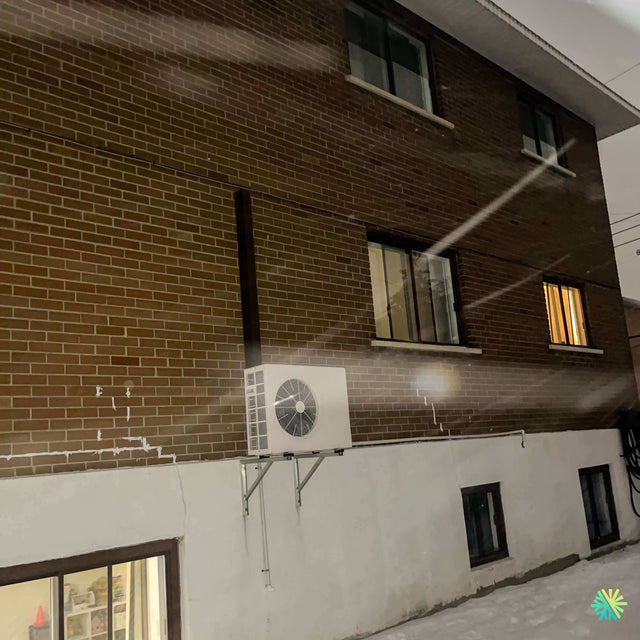
The equipment visible on site was an outdoor condenser of a central heat pump, installed on an elevated metal structure near the side wall of the house. The immediate environment gave several clues: accumulation of plant debris on the ground, conifer needles around the base, limited clearance on the wall side, wear marks on the outer grille, and coil blackened in places. The system was not simply “old” or “worn out”: it was working under conditions that harmed its performance.
This type of call is common in Greater Montreal, in Montreal, Laval, Longueuil, on the North Shore as well as on the South Shore. A central heat pump can still start, run its fan, and produce some level of heating or cooling, while technically struggling. This is precisely what makes the diagnosis important: it is necessary to distinguish a mechanical failure, an electrical problem, an air restriction, a loss of refrigeration performance, or a combination of several factors.
Symptoms reported before our arrival
The customer had noticed several progressive signs. The system had not completely stopped, but its behavior had changed:
- longer operating cycles;
- less stable indoor temperature;
- louder outdoor noise at startup;
- normal indoor ventilation, but less comfortable air;
- feeling that the heat pump was working without quickly reaching the setpoint;
- slight vibration coming from the outdoor unit;
- reduced performance during colder and humid periods.
These symptoms can be associated with several causes: dirty outdoor coil, weakened capacitor, worn contactor, fan motor losing power, incorrect refrigerant charge, circuit restriction, defrosting problem, or insufficient heat exchange. Our role is never to replace a part at random. We always proceed step by step to identify the real cause of the problem.
In this case, the external appearance of the installation already confirmed that the system deserved a thorough inspection. The heat pump was placed near a walkway, with greenery and conifers nearby. Needles, dead leaves, and organic residues can quickly accumulate at the bottom of the condenser and on the coil fins. Over time, this buildup reduces the unit’s ability to exchange heat with the outside air.
Visual inspection: a condenser exposed to debris and air restrictions
Upon arrival, the first step was to inspect the environment around the central heat pump. The unit was elevated, which is generally positive to limit snow accumulation and reduce some ground obstruction risks. However, the space around the condenser showed clear signs of insufficient maintenance.
We observed:
- plant debris accumulated under the unit;
- pine needles near the grille;
- a partially dirty coil surface;
- signs of oxidation on some metal parts;
- limited side clearance on the house side;
- an acceptable service access, but which required prior cleaning;
- external wiring to check near the wall.
Although these elements may seem minor, they directly affect operating pressure, discharge temperature, electrical consumption, and compressor stability. An effective HVAC repair often starts with this kind of observation. A dirty or poorly ventilated condenser works harder, especially when indoor demand is high.
Electrical and mechanical diagnosis of the central heat pump
After the visual inspection, we proceeded with a complete technical check. The equipment nameplate was not readable from the visible front of the unit, but the configuration matched a residential central heat pump connected to a duct system. On site, our technician confirmed the necessary data directly on the device and at the service panel to perform the tests safely.
The diagnosis covered several points:
Start-up check
The client mentioned a noisier and less regular start. We therefore checked the behavior of the compressor and fan motor at the time of the call. The outdoor motor started, but with slight hesitation. This symptom is often associated with a weakened capacitor or worn electrical contacts.
Contactor inspection
The contactor showed signs of wear. When contacts are pitted or oxidized, the power supply to the compressor and fan can become less stable. In some cases, the unit still starts, but the components receive a less clean power supply, increasing electrical stress.
Capacitor test
The run capacitor was measured and its capacity was below the expected value. A weak capacitor can cause difficult starting, fan motor overheating, reduced performance, and eventually complete failure. It is a relatively simple but essential part for the proper operation of many outdoor units.
Outdoor coil inspection
The coil was partially blocked by fine dirt and seasonal debris. The dirt was not uniform, but it was present enough to reduce heat exchange. In a central system, this lack of exchange affects the entire house, as the heat pump must supply the duct network with heating or cooling.
Vibration check
The metal frame was supporting the unit well, but we checked the mounting points and vibrations transmitted during operation. Uncorrected vibration can fatigue certain connections, create unpleasant noises, and accelerate equipment wear.
Work performed: cleaning, parts replacement, and controlled restart
Once the diagnosis was completed, we explained to the client the main causes of the problem. The central heat pump was not completely broken down, but it was operating with a weakened capacitor, a worn contactor, and a dirty outdoor coil. This combination explained the longer cycles, irregular starting, and reduced comfort.
We carried out the following work:
- professional cleaning of the outdoor coil;
- removal of plant debris around the base;
- inspection of the fan motor;
- replacement of the run capacitor;
- replacement of the worn contactor;
- verification of electrical connections;
- startup test after repair;
- operation cycle check;
- validation of the blowing temperature at the indoor system;
- maintenance recommendations to the client.
Replacing the capacitor corrected the startup hesitation. The new contactor restored a more reliable power supply to the main components. Cleaning the coil improved heat exchange, allowing the outdoor unit to operate with less effort.
Why a dirty coil can mimic a more serious breakdown
A dirty outdoor coil can give the impression that a central heat pump is at the end of its life. The system runs longer, seems less powerful, sometimes makes more noise, and can even trigger internal protections under difficult conditions. Yet, in many cases, specialized cleaning and some electrical fixes are enough to recover a significant part of the performance.
The coil is at the heart of heat exchange. In air conditioning, it must reject heat from the house. In heating, it must capture heat from the outside air. When the fins are partially blocked by dust, leaves, pollen, or conifer needles, air circulation is reduced. The compressor then has to work harder to produce the same result.
In La Prairie, several residences have mature trees, hedges, narrow side yards, and outdoor equipment installed near the walls. These conditions are common on the South Shore, but they require more attentive maintenance. Clearance around a central heat pump should never be neglected.
The results obtained and AirGreen's advice to prevent another breakdown
After the repair, we restarted the central heat pump and observed its operation through a full cycle. The startup was smoother, the outdoor noise was more stable, and the system responded better to demand. The blowing temperature improved, and the client quickly noticed a difference in indoor comfort.
The most important thing in this intervention was to avoid progressive deterioration. A weakened capacitor and a worn contactor may seem minor, but they impose real stress on major components. By fixing these elements in time, we reduced the risk of compressor failure or complete shutdown during a period of high demand.
Targeted repair rather than premature replacement
In this type of situation, some owners fear having to replace the entire central heat pump. Our diagnosis helped avoid a hasty conclusion. The unit showed wear and needed serious intervention, but it could still be properly restored with targeted repairs.
At AirGreen, we always favor a clear approach: understand the system’s real condition, explain the options, fix what can be fixed, and recommend replacement only when technical and economic logic justifies it. This rigor is essential, especially for central systems where replacement costs can be significant.
Mistakes to avoid around a central heat pump
After the intervention, we gave the client several concrete recommendations. These tips apply to many homeowners in La Prairie, Montreal, Laval, Longueuil, on the North Shore and the South Shore.
Letting debris accumulate under the unit
Even if the unit is elevated, leaves, needles, and plant debris can get into the coil or hinder air circulation around the base. Seasonal cleaning is recommended.
Planting too close to the condenser
Shrubs and hedges must be kept at a distance. Vegetation too close can block air, retain moisture, and promote coil clogging.
Waiting for the system to stop completely
A difficult start, unusual noise, or longer cycles are signs to take seriously. Preventive repair often costs less than emergency intervention.
Cleaning with too much pressure
The fins of the coil are fragile. Excessive water pressure can bend them and further reduce air exchange. Cleaning must be done methodically and with the right tools.
Ignoring electrical components
A worn contactor or capacitor can cause a breakdown even if the coil is clean. Maintenance must include an electrical inspection, not just a visual cleaning.
The importance of complete HVAC maintenance
A central heat pump is a complete system: outdoor unit, indoor unit, ducts, thermostat, electrical supply, refrigerant circuit, and ventilation. An external problem can affect the entire comfort of the home. That’s why a full inspection is always preferable to a quick check.
During this intervention in La Prairie, the problem mainly came from three elements: reduced heat exchange, a weakened electrical component, and a worn contactor. Taken separately, each of these elements might have seemed minor. Together, they clearly explained the performance drop.
AirGreen on the South Shore: precise and lasting HVAC service
Our team regularly works on central heat pumps in La Prairie, Brossard, Candiac, Saint-Constant, Longueuil, and throughout the South Shore. We understand the realities of local residential installations: narrow side yards, aging equipment, dense vegetation, sometimes limited access, and central systems connected to existing ducts.
This experience allows us to intervene effectively, without wasting time on unnecessary guesses. We analyze the symptoms, test the components, fix the causes, and validate the result before leaving the site.
Restored comfort and a better-protected heat pump for the future
At the end of the service call, the customer had a more stable, better-ventilated, and electrically more reliable central heat pump. The repair restored indoor comfort without a complete equipment replacement. The customer also received simple instructions to maintain clearance around the condenser and schedule maintenance before periods of heavy use.
This type of repair demonstrates the importance of a professional diagnosis. A central heat pump that seems to be losing power is not necessarily doomed. With a thorough inspection, proper cleaning, and replacement of the right parts, it is often possible to extend its lifespan and improve its performance.