
Repair of a Fujitsu Wall-Mounted Heat Pump in La Prairie
Beforewhat the article reports

Afterresults described
A Fujitsu Halcyon wall-mounted heat pump that was working but not regaining its full performance
In La Prairie, on the South Shore, our AirGreen team was called for a common problem, but one that is rarely simple to diagnose correctly: a Fujitsu wall-mounted heat pump from the Halcyon series that still seemed to respond to commands but no longer provided the expected comfort in the room. The indoor unit started, the louvers opened, ventilation was present, but the client noticed a clear drop in performance, a feeling of less cold air during cooling, and a more irregular operation than before.
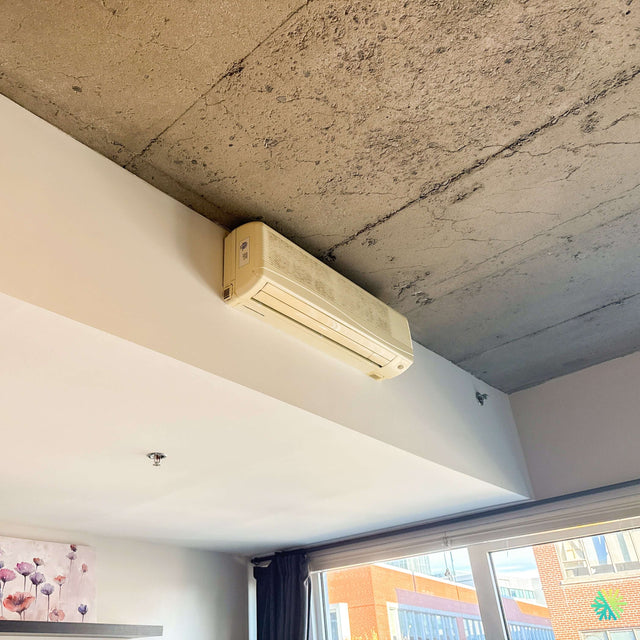
This type of service call requires a methodical approach. A wall-mounted heat pump may seem “functional” because it turns on and ventilates, while its actual performance is affected by an air circulation problem, internal clogging, a blocked condensate drain, a misinterpreted sensor, lack of maintenance, or an anomaly related to the refrigerant circuit. In this specific case, the device seen on site was a Fujitsu Halcyon indoor wall unit, installed near the ceiling, typical of the residential mini-split systems we regularly encounter during our HVAC installation, HVAC repair, and HVAC maintenance interventions in Greater Montreal.
Equipment identification during the service call
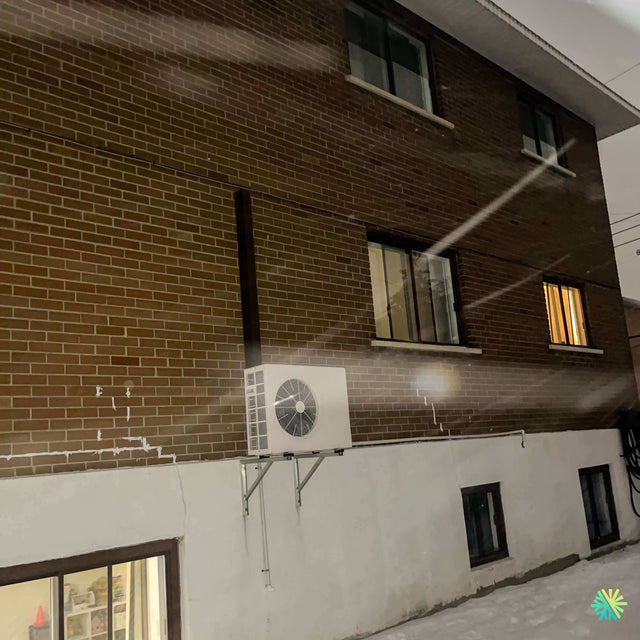
Upon our arrival, we confirmed that it was a Fujitsu wall-mounted heat pump of the mini-split type, with an indoor wall unit and an associated outdoor compressor. The Fujitsu brand is known for its reliable, quiet, and durable systems, but like any HVAC equipment, even a good machine can lose efficiency when an internal component starts to deteriorate or when maintenance has not been thorough enough over the years.
The indoor unit observed was a Fujitsu Halcyon, a well-known range in the residential market. The exact capacity of a device like this must always be confirmed on the nameplate or by the combination with the outdoor unit, but the observed wall format generally corresponds to a common residential capacity, often around 12,000 BTU to 18,000 BTU, depending on the installed configuration. For a serious diagnosis, we never rely solely on appearance: we validate the equipment data, the system’s actual behavior, and the installation conditions.
Symptoms reported by the customer
The customer did not describe a complete breakdown. That’s precisely what made the intervention more delicate. The wall heat pump started normally, but several signs indicated a performance problem:
- air blown less cold than before in cooling mode;
- ventilation present, but feeling of weakened airflow;
- less regular cycles;
- indoor humidity harder to control;
- slight noise at startup, more noticeable than usual;
- concern about a possible leak or a compressor problem.
These symptoms can come from several causes. On a Fujitsu wall heat pump, a loss of performance can be linked to a heavily loaded filter, a dirty fan wheel, a partially blocked evaporator, a temperature sensor affected by dust buildup, a slowed condensate drain, or abnormal refrigerant pressure. Our role is not to jump to conclusions too quickly.
A visual inspection revealed several clues
The wall unit was installed near the ceiling, with little space above for visual access. The machine’s front showed normal wear for a device in service for several years. The louvers were functional, but the air seemed less well distributed. Upon opening the unit, we found dust buildup on the filters and more ingrained dirt in some internal areas.
On wall-mounted devices, it’s not just the filter that matters. Filters trap some particles, but fine dust always ends up reaching the evaporator, the ventilation fan, and the internal areas where moisture is present. Over time, this combination of dust and condensation can create a film that reduces airflow. The result: heat exchange becomes less efficient, the machine works longer, comfort decreases, and the customer feels like the system “doesn’t push like before.”
HVAC diagnosis: check before replacing
At AirGreen, we avoid rushed diagnostics. A machine performing less does not automatically mean the compressor needs replacing or the unit needs changing. Our diagnosis took place in several stages.
We first checked the remote control, selected modes, temperature settings, and the indoor unit’s response. A mode error, a misunderstood automatic function, or a setting too close to room temperature can sometimes give the impression of a breakdown. Here, the settings were consistent.
We then inspected the filters, evaporator, louvers, turbine, and condensate drain. The goal was to determine whether the performance drop was due to an air circulation problem or a refrigeration issue. The difference is important: a system can lack power because air no longer passes properly through the indoor unit, even if the outdoor compressor is working normally.
Checking the ventilation and evaporator
The ventilation turbine showed signs of dirt buildup. This detail is important because a dirty fan wheel no longer moves the same volume of air. Even if the motor runs, the shape of the blades collects dust and loses efficiency. Ventilation becomes weaker, sometimes noisier, and the air is distributed less evenly.
The evaporator also showed an accumulation that could hinder heat transfer. In a mini-split system, the evaporator is the main contact point between indoor air and the refrigerant circuit. If its surface is blocked, the machine has to work harder for a less satisfactory result. In the long term, this can lead to abnormal cycles, ice, odors, or more difficult condensate drainage.
Checking the condensate drainage
The client was also concerned about a possible water leak. Although no significant leak was visible at the time of our visit, we checked the condensate drain because slow drainage can quickly become a problem during hot and humid periods. In La Prairie, as elsewhere on the South Shore, humid days can generate a significant amount of condensation water in a wall-mounted heat pump.
A partially clogged drain does not necessarily overflow immediately. It can first slow drainage, cause accumulation in the pan, produce odors, or cause occasional droplets. We therefore cleaned and tested the flow to ensure that water was properly leaving the indoor unit.
Technical cleaning, adjustments, and performance restoration of the heat pump
After confirming that the main problem was related to internal dirt buildup and reduced airflow, we performed a complete intervention on the Fujitsu indoor unit. The goal was not just to “do a cleaning,” but to restore the operating conditions necessary for the heat pump to regain stable performance.
Cleaning of filters, evaporator, and accessible components
The filters were removed, cleaned, and inspected. We then worked on accessible internal areas, including the evaporator, flaps, and surfaces where dust accumulation could affect performance. On a wall unit installed near the ceiling, care must be taken to protect the wall, floor, and surroundings, especially when working on components where moisture and residues may be present.
Cleaning the evaporator must be done methodically. Excessive pressure, an inappropriate product, or poor handling can damage the fins, move dirt toward the drain, or create a bigger problem than the one intended to be fixed. That’s why our technicians adapt their approach based on the age of the unit, its level of dirt buildup, and the available access.
Cleaning and inspection of the ventilation turbine
The turbine is often the forgotten element in residential maintenance. Yet, it is one of the most frequent causes of airflow loss on a wall-mounted heat pump. In this case, cleaning the turbine improved air circulation and reduced the noise perceived during operation.
A clogged turbine can give the impression that the machine is low on refrigerant, when the problem is simply poor air movement. This is a common mistake: replacing parts or suspecting the compressor without first confirming the condition of the indoor unit. For a customer, this difference can represent significant savings.
Drain test and water leak prevention
We also cleared and tested the condensate line. The goal was to prevent a possible leak during high humidity days. An effective HVAC repair is not only about fixing what is visible at the time of the visit; it must also reduce the risk of a service callback.
After cleaning, we poured water into the condensate pan to check the flow. The drainage had returned to a normal flow rate. This test is essential because a drain may seem fine at first glance but can clog under load when the unit produces more condensation.
Checking behavior in cooling mode
Once the components were cleaned and drainage confirmed, we restarted the system in cooling mode. We observed the startup, the opening of the vents, the stability of the ventilation, and the blowing temperature. The airflow was more consistent, the distribution in the room was better, and the machine no longer showed the same irregular behavior.
The customer immediately noticed a difference in the air feel. This is often the most noticeable result after a well-executed intervention on a wall unit: the system feels lighter, smoother, and more efficient, even without major replacement.
Why this type of problem often recurs on wall units
Wall-mounted heat pumps often operate for several months a year. They cool in the summer, heat during part of the fall and spring, and sometimes even a good part of the winter depending on the model. This prolonged use means that indoor air constantly passes through the unit. Dust, humidity, pet hair, cooking particles, and household residues eventually accumulate.
In the residential areas of Montreal, Laval, Longueuil, the North Shore and the South Shore, we regularly see machines still in good mechanical condition lose a lot of performance simply because internal maintenance has been delayed too long. A filter washed from time to time is not always enough. The visible part of maintenance is important, but it does not replace a complete technical inspection.
Mistakes to avoid with a Fujitsu Halcyon
During this type of intervention, some mistakes often recur. The first is believing that a device blowing less strongly automatically lacks refrigerant. A refrigerant shortage is possible, but it must be confirmed by measurements and circuit behavior, not by impression.
The second mistake is cleaning only the filters and considering the problem solved. On a wall unit, the fan and evaporator can be much more responsible for performance loss than the filters themselves.
The third mistake is ignoring the condensate drain as long as it doesn’t leak inside the house. A slow drain is a warning. When it overflows, the customer often discovers the problem at the worst time: a hot, humid day with the machine under full demand.
Finally, avoid harsh products or improvised methods. A Fujitsu wall-mounted heat pump is a precise piece of equipment. Poor cleaning can damage the fins, affect sensors, move debris into the tray, or create persistent odors.
Result of the intervention in La Prairie
At the end of the service call, the Fujitsu Halcyon wall-mounted heat pump had regained more stable ventilation and better cooling performance. The condensate drain was clear, the indoor unit was cleaner, and the customer better understood the source of the problem. The intervention also reassured them: it was not a major compressor failure but a combination of factors related to internal dirt buildup and maintenance.
This is exactly the kind of situation where field expertise makes a difference. Replacing too quickly is costly. Cleaning without diagnosis can be insufficient. Properly diagnosing, intervening cleanly, and testing the result helps extend the equipment’s lifespan while restoring comfort.
An AirGreen service tailored to Fujitsu wall-mounted heat pumps
AirGreen regularly works on Fujitsu, Gree, Sharp, Midea, Goodman, York, Carrier, Bryant, and several other residential and commercial brands. For each call, our priority is to understand the actual behavior of the equipment before proposing a solution. A well-done HVAC repair relies on observation, measurement, experience, and transparency.
Whether in La Prairie, Brossard, Candiac, Boucherville, Longueuil, Montreal, Laval, on the North Shore, or elsewhere on the South Shore, we know clients want a clear answer: can the machine be repaired, is maintenance enough, or should a replacement be considered? In this case, the right solution was a technical overhaul of the indoor unit, along with a check of drainage and operation.
When to schedule maintenance or a service call
A service call is recommended as soon as the wall unit shows unusual signs: reduced airflow, less cold air, odor, noise, water leak, frost, intermittent shutdown, or error code. Even if the machine is still running, these symptoms often indicate a developing problem.
For a regularly used wall heat pump, periodic maintenance helps preserve efficiency, reduce the risk of condensate leaks, and avoid unnecessary energy consumption. This is especially important before periods of intense heat, when demand for air conditioning rises quickly.
AirGreen: HVAC diagnosis, repair, and maintenance in Greater Montreal
This service call in La Prairie clearly illustrates our approach: observe the symptoms, confirm the brand and type of machine, diagnose the real cause, perform a clean intervention, and validate the result with the client. A well-maintained Fujitsu wall heat pump can still provide many years of comfort, provided the first signs of performance loss are not ignored.
For an issue with a heat pump, a wall air conditioner, condensate drain, reduced ventilation, noise, ice, or decreased performance, AirGreen offers professional service in HVAC maintenance, HVAC repair, and equipment replacement in Greater Montreal, including Montreal, Laval, Longueuil, the North Shore, and the South Shore.

The same service at your place?
Cleaning, repair or maintenance: tell us about your unit and we schedule the visit.
- RBQ licence 5645-9605-01Subclasses 15.8, 15.10 and 16
- $5M liability insuranceOn every job
- 15+ yearsFamily-owned, based in Montréal