
Installation of a MIDEA EVOX G3 electric furnace in Pierrefonds-Roxboro, Montreal
In Pierrefonds-Roxboro, AirGreen installs a MIDEA EVOX G3 electric furnace in a complex mechanical room: custom plenums, AIR CARE CUBE filtration, accessible drainage, and precise integration with the existing ductwork.
Take a tour of the installation
Each number is a point we check on site. Switch between summer and winter to watch air and heat move.
In summer, the outdoor unit rejects the house's heat outside.
Generic illustration of this type of installation, not a survey of this job site. Tap a number.
It captures or rejects heat outside. It sits on a level base, above the snow, with free space all around.
The insulated refrigerant lines enter the house through a sealed opening and run to the indoor coil.
A shut-off switch near the outdoor unit isolates it safely for service.
Sitting on the indoor module, it moves heat between the house air and the refrigerant.
Electric furnace or air handler: its fan pushes air through the ducts. The electric backup takes over in extreme cold.
Supply ducts bring air to the rooms; returns bring it back to the unit. Their condition matters as much as the unit's.
It protects the coil and the fan. A dirty filter cuts airflow, so it gets checked regularly.
It runs the heat pump and the backup heat. It must be compatible with the installed system.
In Pierrefonds-Roxboro, a compact mechanical room required much more than a simple furnace replacement
This installation carried out by our AirGreen team in Pierrefonds-Roxboro, in the west of Montreal, perfectly illustrates an often-underestimated aspect of replacing a central system: the new MIDEA EVOX G3 electric furnace must fit not only into the home, but also around everything that already exists there.
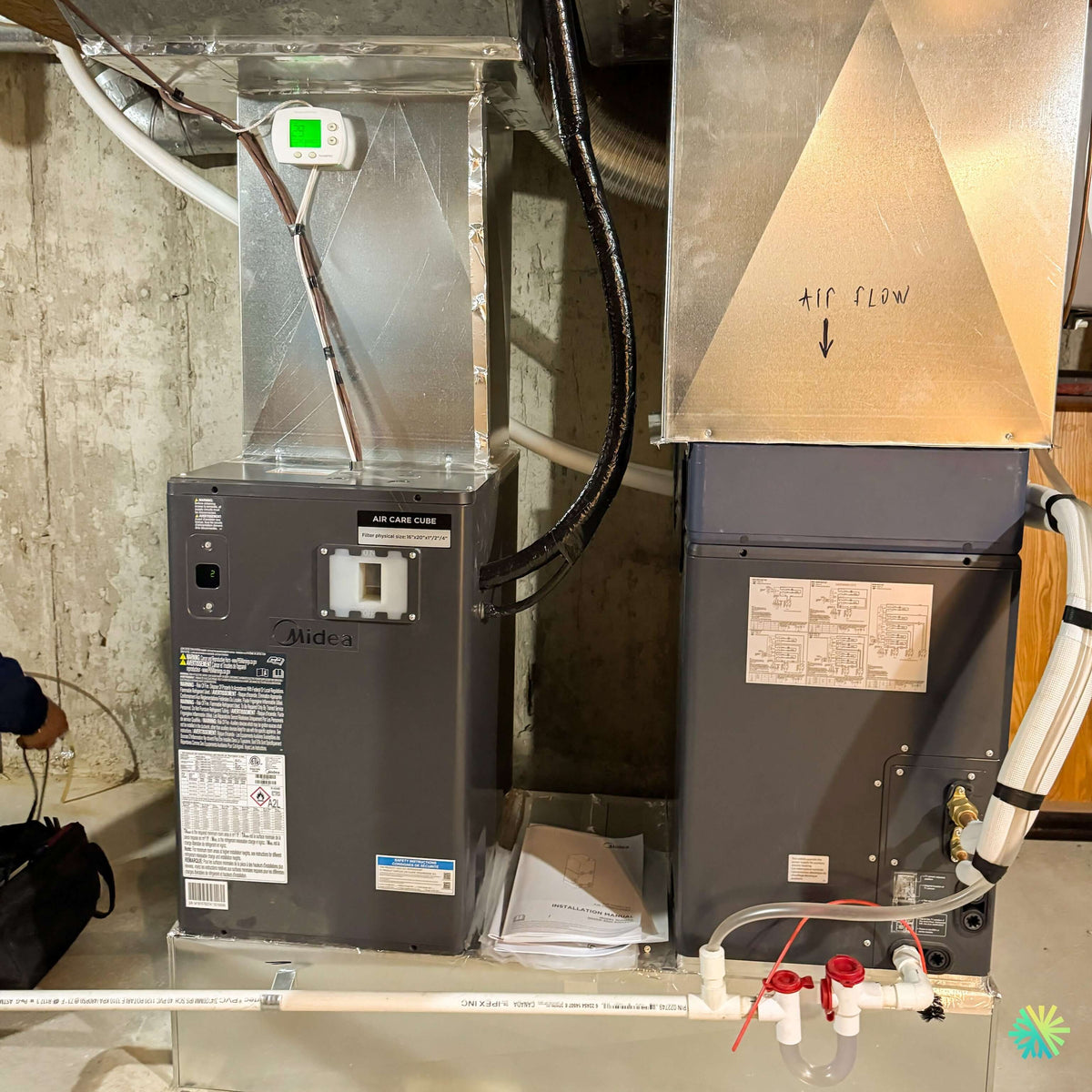
In the job-site photo, the mechanical room is particularly interesting. Two central units occupy the same area, with galvanized sheet-metal plenums, several refrigeration lines, condensate drains, and very little wasted space between the equipment. For our team, the challenge was therefore not simply to position a new MIDEA unit. We had to preserve consistent airflow, maintain service access, and connect everything cleanly to the existing ductwork.
The MIDEA EVOX G3 installed on the left in the photo is easily recognizable by its gray cabinet, the Midea logo, and its module AIR CARE CUBE integrated. Directly above it, we adapted the existing network with a sheet-metal transition fabricated according to the available dimensions. To the right, another central unit has its own plenum, on which the direction of airflow was clearly identified by an “AIR FLOW” arrow.
This proximity between two systems makes planning much more important: a few poorly used inches can complicate filter replacement, access to a panel, or future work on the refrigeration connections.
Why the EVOX G3 was particularly well suited to this configuration
In Quebec residential terminology, we often refer to electric furnace, but the EVOX G3 is more precisely a central air handler that can operate with a heat pump and accommodate auxiliary electric heating.
Midea developed this generation with a design particularly well suited to renovations. The manufacturer specifically advertises cabinet widths of approximately 14.5 to 21.5 inches, meaning dimensions designed to match those of many traditional furnaces. The indoor unit can also accommodate different electrical supplies depending on the system configuration.
This detail is important in an area such as Pierrefonds-Roxboro, where we frequently work in homes built well before the arrival of modern inverter central systems. The ducts, return-air systems, and mechanical rooms were not necessarily designed for the equipment we install today.
Our job is therefore to adapt the new equipment to the reality of the building without creating unnecessary restrictions.
A multiposition design that simplifies complex renovations
MIDEA documentation presents the EVOX G3 as a unit offering six installation options, including:
- upflow;
- downflow;
- right horizontal configuration;
- left horizontal configuration;
- low-boy configurations;
- different return-air and supply-air configurations.
This modularity is made possible by the Block N Lock, which makes it easier to reconfigure the unit for difficult spaces. Midea expressly states that this design is intended in particular for installations in basements, attics, and spaces where handling a conventional unit would be difficult.
The photo of our installation in Pierrefonds-Roxboro provides a good illustration of the practical usefulness of this feature. The existing system is not a theoretical drawing created on a blank page: it already exists, and the new components must be integrated into it.
Sheet metal transitions: a detail that directly affects performance
Above the MIDEA, we can see a transition made of custom-fabricated galvanized sheet metal to connect to the existing duct.
A transition should not simply close the gap between the furnace outlet and the duct. Its geometry influences how air leaves the unit.
A reduction that is too abrupt or a poorly designed change in direction can increase static pressure, generate more noise, and reduce the airflow available at the registers.
That is why, during an electric furnace installation in Montreal, we give the distribution network just as much importance as the choice of equipment.
We pay particular attention to:
- plenum cross-section;
- changes in dimensions;
- existing restrictions;
- air return;
- joint tightness;
- filter accessibility;
- at the airflow required by the installed capacity.
In the photo, the sheet metal joints are also sealed to limit air leakage around the transitions.
Much more advanced airflow management than with a traditional furnace
One of the most interesting technical features of the EVOX G3 is its Computational Constant Airflow 2.0.
According to Midea, the unit can operate with static pressure of up to 1.2 in. of water column in the intended configurations, while adjusting blower operation to maintain the desired airflow.
The manufacturer also provides up to 60 airflow adjustment levels, allowing us to fine-tune the system’s behavior according to the duct network and the building’s needs.
This technology is particularly relevant when we replace an old furnace in an existing home in Pierrefonds-Roxboro, Pointe-Claire, Dollard-des-Ormeaux, Kirkland, or elsewhere in the West Island.
However, this does not mean that a poor duct system can be ignored.
A sophisticated ECM blower can compensate for certain resistance variations, but it cannot turn a severely undersized duct into a properly designed system. That is why we inspect the entire system rather than simply connecting the new unit.
The AIR CARE CUBE visible directly on our installation
Another particularly visible detail in the photo is the module AIR CARE CUBE installed on the front of the unit.
The job-site label indicates a physical filter size of 16 x 20 inches, with the option of using different thicknesses depending on the module configuration.
The EVOX G3 documentation specifically provides for a filtration system that can accommodate filters measuring 1, 2, or 4 inches, with MERV 13 compatibility in the intended configurations. Better filtration captures more dust, pollen, particles, and pet hair while helping keep the indoor coil cleaner.
But here again, the filter must be chosen intelligently.
A higher-performance filter must remain compatible with the airflow
Installing a filter with the highest possible MERV rating is not automatically the best decision.
An overly restrictive filter in an already marginal duct system can increase static pressure and reduce airflow. In a central system, we therefore consider all of the following together:
filtration quality + filter surface area + airflow + static pressure.
This is a much more reliable approach than selecting a filter solely based on the number printed on its packaging.
Refrigerant lines: what can be seen between the two units
Several lines are also clearly visible in this Pierrefonds-Roxboro installation.
The refrigerant lines connecting the indoor unit to the outdoor system must be protected, properly supported, and arranged so that they remain accessible.
On the right side of the photo, we can see the refrigerant connections and an insulated line. Between the units, other insulated sections run up toward the mechanical room ceiling.
This installation clearly shows why we plan the line routing before finalizing the duct transitions. When two systems are side by side, a poor work sequence can make a connection almost inaccessible after installation.
The R454B and A2L markings visible on the equipment
The plate on the photographed Midea unit clearly bears the marking A2L.
The EVOX G3 product line uses R454B refrigerant, which Midea selected for its new central product line. The manufacturer states a global warming potential, or GWP, of 466 for this refrigerant.
Using an A2L-classified refrigerant involves requirements and procedures specific to this generation of equipment. For a homeowner, this mainly means that it is important to have the system installed and serviced by technicians familiar with the procedures applicable to the new refrigerants.
A condensate drainage system designed to remain accessible
Another interesting feature appears at the bottom of the system on the right: the condensate network includes a trap and cleaning access points identified by their red caps.
This may seem secondary next to a furnace rated at several tens of thousands of BTUs, but drainage problems are among the issues we regularly encounter in HVAC.
In cooling mode, the indoor coil removes moisture from the air. This water must be able to leave the unit without backing up.
A proper condensate connection should notably allow for:
- adequate drainage;
- access for cleaning;
- inspection of the trap;
- reduced risk of blockages;
- future maintenance without major disassembly.
This kind of detail distinguishes an installation designed to work today from one designed to remain serviceable for several years.
Performance, electric heating, and LogisVert eligibility: what you really need to check before choosing an EVOX G3
The MIDEA EVOX G3 covers several central system capacities. The documentation provided by Midea lists, among others, combinations of 18,000, 24,000, 30,000, 36,000, 48,000, and 54,000 BTU/h, with performance of up to 19 SEER2, 12.5 EER2 and 10.8 HSPF2, depending on the selected indoor/outdoor combination.
Midea's detailed technical table also shows that performance varies significantly from one capacity to another. For example, the configurations presented in the documentation show different SEER2, HSPF2, COP, and airflow values depending on the exact model.
The nameplate visible in our photo is not clear enough to confirm the exact model number and BTU capacity of this particular unit without ambiguity. We therefore prefer not to assign a specific capacity to the project without being able to read it directly.
This is also a good rule for homeowners comparing quotes: “MIDEA EVOX G3” does not refer to a single capacity.
Down to -30 °C for EVOX heat pump configurations designed for cold climates
Midea's documentation indicates that the EVOX heat pump platform operates down to -30 °C. For the three-ton system used in the tests presented by Midea, the manufacturer also reports significant performance at very low temperatures.
These figures concern the operation of the heat pump, rather than the furnace's electric heating elements.
The distinction is important: in a modern electric central system, the heat pump normally provides the primary heating when it can do so efficiently, while auxiliary electric heating operates as needed and according to the programming.
Auxiliary heating rated up to 25 kW
For the EVOX G3, Midea offers an auxiliary electric heating kit rated up to three stages, with options up to 25 kW, depending on the model and application. The manufacturer lists 10 kW, 15 kW, and 25 kW capacities, among others.
This does not mean that 25 kW is appropriate for every home.
Auxiliary heating must be selected based on:
- the property's heat loss;
- the heat pump capacity;
- the electrical panel capacity;
- the conductor ampacity;
- the circuit breakers;
- the selected control mode;
- the desired heating strategy.
Installing more electric heating “just in case” is not a sizing method.
Communicating thermostat or 24 V control
MIDEA has also provided several control methods for the EVOX G3 platform.
The documentation indicates compatibility with 24 V communication 485, the Midea controller, and certain conventional thermostats 24 V. The system is designed to identify the control mode being used and to allow different combinations depending on the existing installation.
With the Midea communicating thermostat and the SmartHome app, it is also possible, depending on the configuration, to manage schedules, certain comfort settings, and electricity consumption monitoring.
For a renovation in Montreal, Laval, Longueuil, on the North Shore or the South Shore, this flexibility can reduce unnecessary modifications when existing wiring can be retained in accordance with the system requirements.
Is this MIDEA furnace eligible for a LogisVert rebate?
It is necessary to distinguish the furnace or indoor unit of the complete heat pump.
Hydro-Québec does not determine eligibility simply because the indoor cabinet bears the name MIDEA EVOX G3. For installations completed since November 26, 2025, the heat pump must notably be ENERGY STAR certified to qualify for the Heat Pump measure under the LogisVert program. Hydro-Québec currently indicates an incentive of $50 per 1,000 BTU/h at -8°C for an eligible ENERGY STAR heat pump, or $120 per 1,000 BTU/h at -8°C when it is certified ENERGY STAR – Cold Climate, subject to compliance with all program conditions.
The crucial element is therefore the exact combination of the indoor and outdoor units, as well as the model listed in Hydro-Québec’s recognized list.
The electric furnace alone is not enough to determine a rebate amount.
Because the complete model number and outdoor capacity of this Pierrefonds-Roxboro installation cannot be confirmed with sufficient accuracy from the photo, we are deliberately not presenting any specific amount for this project.
Mistakes we aim to avoid when replacing a central system
This installation also illustrates several common mistakes we encounter when taking over or evaluating central systems.
Choosing solely based on the old unit’s tonnage
An old three-ton furnace does not automatically mean that a new three-ton unit is the best choice. A building and ductwork assessment is still necessary.
Neglecting the return air
A high-performance heat pump cannot move air properly if the return is too restrictive.
Installing a sheet-metal transition that is too abrupt
Every reduction or change in direction affects the system's static pressure.
Making the filter difficult to access
In our Pierrefonds-Roxboro installation, the filtration module is directly accessible from the front of the unit, an important detail that encourages regular maintenance.
Forgetting about future drain maintenance
The trap and service points must remain accessible after all other work has been completed.
Ignoring the space required around the connections
Refrigerant lines, electrical panels, and service components must be accessible without unnecessarily dismantling the ductwork.
An installation that shows what a homeowner should look at beyond the brand
The MIDEA EVOX G3 offers several interesting technologies: inverter operation when paired with the corresponding heat pump, advanced airflow control, adaptable filtration, multiposition design, compatibility with several control strategies, and adjustable auxiliary heating.
But our installation in Pierrefonds-Roxboro mainly shows that final performance depends on how these features are integrated into the home.
On this job, we had to work with:
- two central units side by side;
- limited service clearances;
- specific plenums and transitions;
- an airflow direction that must be clearly respected;
- refrigerant lines running through an already crowded mechanical area;
- integrated filtration AIR CARE CUBE;
- condensate drains and their service access points;
- connection to the existing ductwork.
That is precisely why, at AirGreen, we consider installation of an electric furnace or central heat pump as a complete HVAC project rather than simply replacing equipment.
To Pierrefonds-Roxboro, Montreal, Laval, Longueuil, the North Shore, and the South ShoreOur goal remains the same: to select the right equipment, but above all, to install it so that airflow, heating, cooling, drainage, filtration, and future maintenance work together.
A well-chosen MIDEA EVOX G3 is part of the solution. A properly designed HVAC installation is what truly allows it to deliver the expected performance.
The big day, step by step
The main steps of this kind of job at AirGreen. Every house has its quirks: the estimate brings them out.
We look at the ducts, the current indoor module, the electrical panel and the planned spot for the outdoor unit.
The equipment combination, capacity and price, in writing. We check whether the combination qualifies for assistance programs.
Access protected, old unit disconnected and removed when it is being replaced.
Electric furnace or air handler, with its coil, connected to the supply and return ducts.
On a level base, raised above the snow, with free space all around.
Insulated, they enter through a sealed opening and run to the indoor coil.
Dedicated circuits, accessible disconnect, a thermostat that works with the heat pump and the backup heat.
Leak test, vacuum, start-up, airflow check and a test of both modes.
Filter, thermostat, backup heat in extreme cold: what to know before winter.
- The on-site estimateWe look at the ducts, the current indoor module, the electrical panel and the planned spot for the outdoor unit.
- The quoteThe equipment combination, capacity and price, in writing. We check whether the combination qualifies for assistance programs.
- Getting readyAccess protected, old unit disconnected and removed when it is being replaced.
- The indoor moduleElectric furnace or air handler, with its coil, connected to the supply and return ducts.
- The outdoor unitOn a level base, raised above the snow, with free space all around.
- The refrigerant linesInsulated, they enter through a sealed opening and run to the indoor coil.
- Electrical and thermostatDedicated circuits, accessible disconnect, a thermostat that works with the heat pump and the backup heat.
- Tests and start-upLeak test, vacuum, start-up, airflow check and a test of both modes.
- The walkthroughFilter, thermostat, backup heat in extreme cold: what to know before winter.
What would it look like at your place?
Two quick checks with real numbers: what heat costs, and what your current heaters add up to in BTU/h.
Conversion: 1 W = 3.412 BTU/h. An indication, not a load calculation: baseboards and furnaces are often stronger than the real need, and they can stay as backup. AirGreen confirms the capacity on site.
Four mistakes we do not make
Flip each card to see what we do instead.
Your own project, step by step
What to do, season by season
Three habits per season for this unit. They take a few minutes and prevent many calls.
- Check the indoor module's filter.
- Clear winter debris from the outdoor unit.
- Test cooling before the heat arrives.
- Check the filter more often in peak season.
- Keep registers and returns clear.
- Watch condensate drainage near the coil.
- Change or clean the filter.
- Test heating and backup heat before the cold.
- Book periodic maintenance.
- Clear snow around the outdoor unit.
- Store nothing in front of the indoor module.
- Note any unusual noise or smell and call us.
Is your home ready?
Check what applies at your place. A "no" is not a refusal: it is what we sort out during the estimate.
Four statements: true or false?
It all comes down to details you have just seen.
1. A central heat pump uses the house's ducts.
It connects to the existing ducts to heat and cool everywhere.
2. In extreme cold, electric backup heat can take over.
The indoor module (furnace or air handler) works with the heat pump and takes over in extreme cold.
3. The filter only gets changed when the unit breaks down.
A dirty filter cuts airflow. It gets checked regularly.
4. You can reuse the old unit's size without checking.
The house may have changed: insulation, windows, added rooms. Capacity is confirmed on site.
0 / 4 right answers
What people ask us about this kind of work
Can I keep my current ducts?
What happens in extreme cold?
Furnace, air handler, ducted: what is the difference?
Are there grants?
Do I need a permit?
How much can I save?
How is the LogisVert assistance calculated?
Will my current thermostat work?
Central or wall units: which one?
Does AirGreen hold the required licences?
Is the estimate free?
No question matches. Write to us: we answer.
More jobs to see, near you
By town, by equipment or by region: browse more than 4,700 published projects.
Each dot: a town where AirGreen has published projects. The glowing dot: this job.
Every house has its constraints. We see them before we install.
The on-site estimate is free and the quote follows within 24 hours.
Text and photo: a real AirGreen Climatisation & Chauffage job. The diagrams are generic illustrations of the type of installation, not a survey of this job site. Sources of the added figures: airgreen.ca product pages (NEEP / AHRI performance), Hydro-Québec (Heat pumps page, LogisVert, read on 13 October 2026), Régie de l’énergie (rate D as of 1 April 2026).