
Installation of a Samsung WindFree™ MaxHeat wall-mounted heat pump in Outremont, Montreal
In Outremont, AirGreen installs a Samsung WindFree™ MaxHeat in a tight space above a glass door, with careful attention to clearances, curtains, drainage, and air distribution.
- City
- Region
- Equipment
- Brand
- Challenges
- Published
The job on one screen
The article, chapter by chapter
An installation above a glass door where every centimetre had to be planned
This Samsung WindFree™ MaxHeat wall-mounted heat pump installation in Outremont presents a configuration we regularly encounter in Montreal apartments, condos, and plexes: the best air-distribution area is above a large glazed opening, but the space available between the frame and the ceiling is limited.
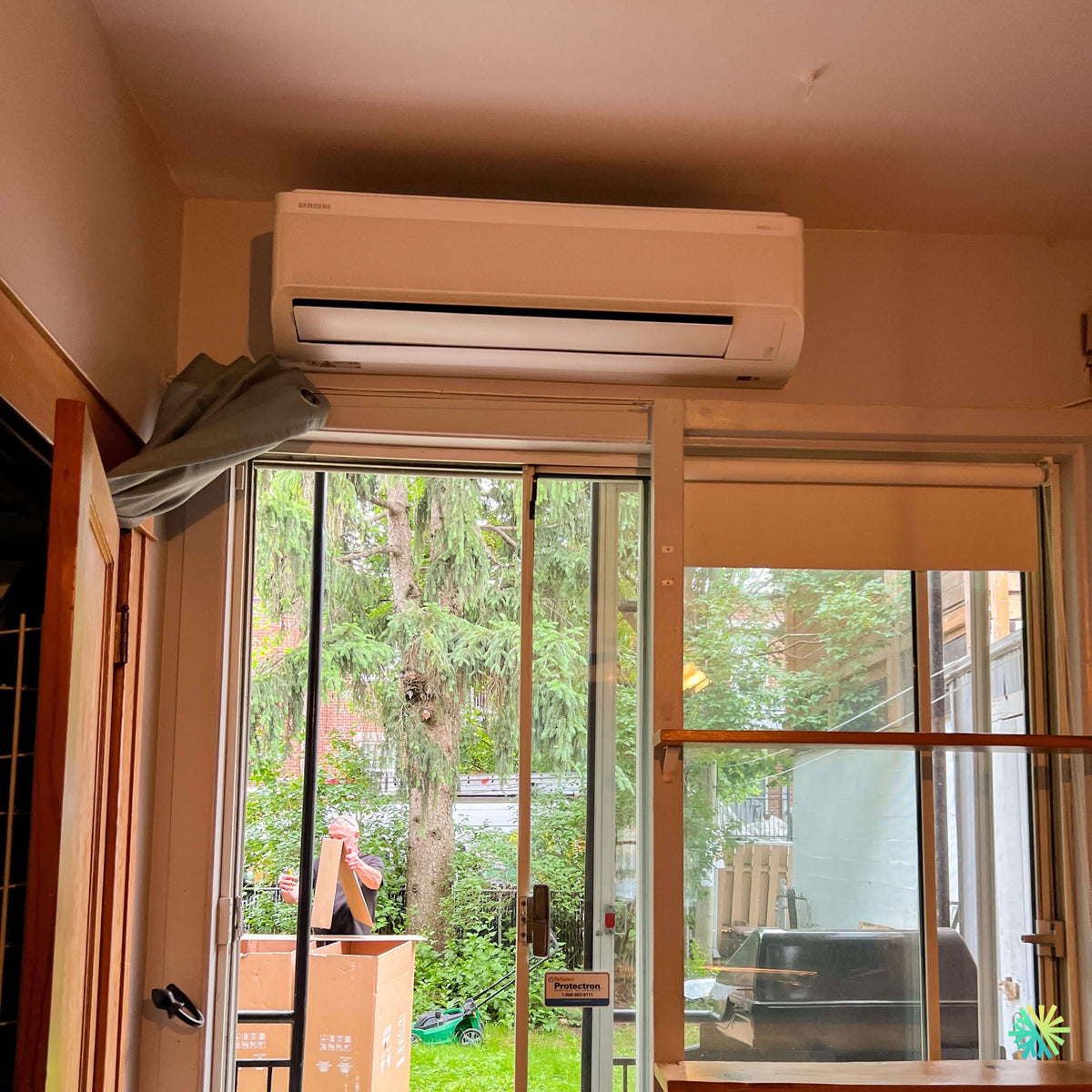
In the project photo, the Samsung indoor unit occupies a narrow strip of wall above a door leading to a terrace or balcony. On the left, a heavy curtain rises almost to the wall-mounted air conditioner. Beneath the unit, the door frame, blind track, and vertical structure of the opening impose several limitations. The unit therefore had to be integrated without preventing the curtains from operating, obstructing the door’s opening, or compromising access to the filters.
Our work did not simply involve fitting the unit into the available space. We had to determine a position that would allow:
- secure mounting on the wall;
- sufficient air intake above the unit;
- opening of the front panel;
- filter removal;
- full movement of the lower louver;
- effective air distribution throughout the room;
- protected refrigerant-line connection;
- reliable condensate drainage;
- a finish compatible with the interior architecture.
The result is a compact HVAC installation, suited to a bright room whose glazed surfaces can produce significant heat gains during Montreal summers.
Why this location was suitable for the room
The location of a wall-mounted heat pump largely determines how cooled or heated air circulates. A unit installed on a poorly chosen wall may blow directly on occupants, leave certain areas uncomfortable, or be obstructed by furniture.
In this Outremont residence, the wall above the glass door offered several practical advantages.
First, this section of wall could not accommodate a bookcase, television, or tall cabinet. Installing the Samsung unit therefore preserved the room’s other useful surfaces.
Next, the elevated position promotes air distribution toward the interior of the home. In cooling mode, cooled air naturally tends to descend. In heating mode, the louver direction can be adjusted to direct the air lower and reduce heat accumulation near the ceiling.
Finally, proximity to an exterior wall can simplify the route between the indoor unit and the condenser. A more direct connection helps reduce the amount of visible line-set cover and limits unnecessary detours in the refrigerant lines.
A glazed opening that increases cooling requirements
The large glazed area visible below the heat pump provides plenty of natural light, but it can also contribute to a rapid increase in indoor temperature.
A room's cooling load does not depend solely on its floor area. It is also influenced by:
- the orientation of the facade;
- the duration of sun exposure;
- the type of glazing;
- the presence of blinds or curtains;
- the door sealing;
- the floor of the dwelling;
- the quality of the insulation;
- the number of occupants;
- the electrical appliances present;
- communication with adjoining rooms.
In Outremont, many buildings have large windows, solid walls, unique interior layouts, or renovations carried out at different times. Two homes with the same floor area may therefore require very different cooling capacities.
We avoid automatically recommending a 12,000, 15,000, or 18,000 BTU heat pump based on an approximate rule. The choice must take into account the room's volume and all its sources of heat gain and loss.
The challenge of clearance near the ceiling
The photo shows that the top of the indoor unit is relatively close to the ceiling. This constraint requires careful measurements before securing the wall plate.
A Samsung unit draws a significant portion of its air from above. If the housing is installed too high, the air intake may be restricted. This could reduce airflow, decrease efficiency, and increase dust accumulation.
The clearance above the unit also plays a role in maintenance. The front panel must be able to lift, and the filters must be removable without hitting the ceiling.
Before drilling, we must therefore confirm:
- the total height of the unit;
- the minimum clearance required by Samsung;
- the height of the door frame;
- the space required for the air outlet louver;
- the position of the studs or structural supports;
- the planned route for the lines;
- the possible presence of wires or pipes in the wall.
A mistake of a few centimeters may require redoing the drilling, hinder maintenance, or leave the unit in a visually unbalanced position.
The proximity of the curtains: a detail that affects operation
The curtain visible to the left of the unit is an important element of this installation. Fabric placed too close to the unit may be drawn toward the air intake or move in front of the air outlet louver.
This situation can cause several problems:
- reduced airflow;
- poor temperature distribution;
- rubbing noise;
- continuous curtain movement;
- dust being drawn into the filters more quickly;
- fabric coming into contact with the casing.
We recommend keeping the curtain sufficiently far from the wall-mounted air conditioner while it is operating. The rod, rings, and upper part of the fabric must also be taken into account when choosing the location.
In this room, the heat pump was installed so that the center of the opening remains clear and interaction with the window treatment is limited. However, the owner must avoid folding the curtain against the side or underside of the unit.
A Samsung WindFree™ MaxHeat for comfort without a constant stream of air
The Samsung WindFree™ MaxHeat range combines cold-climate heat pump operation with a distribution method designed to reduce the sensation of a direct draft.
At startup, the unit may use its main louver to bring the room to the requested temperature quickly. Once that temperature is reached, WindFree™ mode provides gentler air distribution through the numerous micro-openings on the front panel.
This feature is particularly useful in a room where the unit’s location is dictated by the arrangement of the windows and walls. When occupants regularly walk beneath the unit or sit in its path, less concentrated airflow can improve comfort.
WindFree™ mode does not mean that the unit produces no air movement. The heat pump must still circulate a certain volume of air to transfer heat. The difference lies in how that air is distributed throughout the room.
Technical performance and capacity to be confirmed based on the installed models
The photo identifies the Samsung WindFree™ family, but it does not show the model numbers or the exact capacity of the installation. We never infer the BTU capacity solely from the apparent width of the casing.
The specifications must be confirmed using the nameplates on the indoor and outdoor units.
For reference, certain 12,000 BTU Samsung WindFree™ MaxHeat combinations offered for the Quebec market may have the following characteristics:
- efficiency of approximately 24 SEER2;
- heating operation down to approximately −30 °C;
- AHRI certification specific to the installed combination;
- variable-speed compressor;
- cooling, heating, dehumidification, and ventilation;
- smart connectivity depending on the model and compatible accessories.
These figures should not be applied automatically to all WindFree™ MaxHeat capacities. A 9,000, 12,000, 15,000, or 18,000 BTU system may have different efficiency, electrical requirements, and winter performance.
To prepare an accurate quote, we verify in particular:
- the complete number of each unit;
- the corresponding AHRI listing;
- the rated capacity;
- the capacity delivered at low temperatures;
- the SEER2 and HSPF2;
- the line diameters;
- the MCA and MOCP;
- the supply voltage;
- clearance requirements;
- the maximum length of the refrigerant circuit.
Sizing: bigger is not necessarily more comfortable
A homeowner may be tempted to choose the highest possible capacity to cool the room more quickly. However, this strategy can reduce comfort quality.
An oversized heat pump can quickly reach the setpoint and shorten its cooling cycles. It then has less time to remove moisture from the air. The room may become cold while retaining a humid feeling.
An oversized unit can also produce more noticeable airflow and create temperature differences between the area near the unit and the rest of the home.
Conversely, an undersized heat pump may operate almost continuously during very hot days or the coldest nights without managing to maintain the desired temperature.
In this Outremont project, the presence of a large glass opening had to be factored into the calculations. We also had to consider the possible movement of air toward adjacent spaces and how the room would actually be used.
The refrigerant connection behind a discreet finish
The image mainly shows the indoor unit and does not reveal all the mechanical work behind or near the enclosure.
A wall-mounted heat pump installation usually includes:
- a copper liquid line;
- an insulated gas line;
- a communication cable;
- the electrical power supply according to the configuration;
- a condensate drain;
- a watertight wall penetration;
- an indoor or outdoor line cover when necessary.
When the unit is located above an opening, the drain route must be planned particularly carefully. Water produced during cooling must drain continuously without flowing back toward the unit’s drain pan.
A poorly sloped drain can cause:
- draining sounds;
- water accumulation;
- odors;
- a leak in the wall;
- damage to the door frame;
- paint or drywall deterioration.
We therefore give drainage just as much importance as the refrigerant connections. In an installation located above a door or window, a small leak quickly becomes visible and can damage materials that are difficult to repair.
A fastening system that must withstand vibrations without deforming the wall
The wall-mounted air conditioner’s back plate must be installed perfectly level and fastened to a solid structure. We select the anchors according to the wall type: wood, masonry, concrete, drywall over studs, or a renovation assembly.
The goal is not merely to prevent the unit from moving. An improperly leveled plate can affect condensate pan drainage. Uneven fastening can also cause creaking, vibrations, or improper engagement of the casing with its support points.
In Outremont buildings, walls may have been modified over the course of several renovations. It is not uncommon to encounter different finishing thicknesses, slightly uneven surfaces, or older structures behind a more recent covering.
Our technicians must therefore confirm the support’s strength rather than relying solely on the wall’s exterior appearance.
Vacuum evacuation and leak testing
Once the lines are installed, we do not immediately release the refrigerant contained in the outdoor unit.
The circuit must first be checked and prepared according to a precise procedure:
- completing and tightening the connections in a controlled manner;
- leak test according to applicable practices;
- connecting the vacuum pump;
- removing air and moisture;
- checking vacuum stability;
- opening the service valves;
- system start-up;
- temperature and operation checks.
Vacuum evacuation is not a mere formality. Moisture left in the lines can contaminate the refrigerant oil and compromise the compressor’s reliability.
An installer must use suitable instruments and confirm that the circuit remains stable before commissioning.
Starting the system in a room with extensive glazing
After start-up, we check the heat pump’s operation in the room’s actual configuration.
The glazed opening visible in the photo may create a warmer area near the façade in summer and a cooler area during winter. The unit’s location allows us to treat this part of the home directly while projecting air inward.
In particular, we check:
- the full movement of the shutter;
- the absence of contact with the curtain;
- flow rate at different speeds;
- the remote control's response;
- cooling operation;
- heating operation when conditions permit;
- drain flow;
- abnormal noises;
- the stability of the mounting.
We also explain to the customer how to use the main modes without unnecessarily changing the settings repeatedly.
How to Use the Heat Pump Efficiently in Outremont
A variable-compressor heat pump generally works best when it maintains a relatively stable temperature.
In summer, it is preferable to select a comfortable setpoint and let the unit modulate its capacity. Turning the unit off completely for several hours can allow heat and humidity to build up in the home. Upon restart, the heat pump will have to operate more intensively.
In winter, maintaining a steady setpoint also helps the system provide consistent heat. A significant decrease followed by a rapid increase may activate the electric backup system more often when another heating appliance is used as a supplement.
For this installation, best practices include:
- keep the filters clean;
- keep curtains away from the intake;
- avoid blocking the louver;
- do not point the remote control at a heat source;
- choose a realistic temperature;
- use automatic mode judiciously;
- keep the doors open when you want to treat several zones;
- watch for any leaks or unusual noises.
WindFree™ Indoor Unit Maintenance
The microperforated front panel of the Samsung WindFree™ contributes to its distinctive air distribution, but it must remain clean to maintain uniform airflow.
Routine maintenance starts with the filters. How often they should be cleaned depends on the home's environment, the presence of pets, and the number of hours of use.
In a room with curtains, textile fibers and dust may be drawn in more quickly if the fabric is too close to the unit.
The owner can generally:
- inspect the filters every few weeks during peak season;
- clean them according to the manufacturer's recommendations;
- gently remove exterior dust;
- check that the drain has no leaks;
- make sure nothing is blocking the upper intake.
A professional HVAC maintenance service goes further by checking the coil, turbine, condensate pan, drainage, and system connections.
When the turbine is heavily soiled, simply washing the filters is no longer enough. A deep cleaning may be required to restore airflow and reduce odors.
Eligibility for financial assistance: verification must come before making a promise
Certain cold-climate wall-mounted heat pumps may be eligible for financial assistance programs in Quebec. However, eligibility depends on the exact combination of equipment and the conditions applicable to the building.
The trade name WindFree™ MaxHeat alone is not enough to confirm an amount.
We must verify:
- the indoor and outdoor models;
- the AHRI number;
- the recognized capacity at the reference temperature;
- cold-climate certification;
- the type of residence;
- the primary heating system;
- the purchase and installation date;
- the rules of the current program;
- the required documents.
We recommend keeping the detailed invoice, proof of payment, serial numbers, and photos of the rating plates.
Mistakes to avoid when installing a unit above a door
Placing the unit too close to the ceiling
This mistake can restrict airflow intake and make filter removal more difficult.
Ignoring the rod and the movement of the curtains
The curtain may block the airflow or be drawn against the housing.
Neglecting the drain slope
Poor drainage can damage the wall and the frame beneath the unit.
Choosing the capacity based on floor area alone
The windows, exposure, and insulation must also be taken into account.
Installing the unit without checking the wall structure
A superficial mounting can cause vibrations and make the mounting plate sag.
Allowing the louver to blow constantly onto an occupied area
The positioning and settings must contribute to comfort, particularly in a compact room.
A Samsung heat pump precisely integrated into the architecture of an Outremont home
This Samsung WindFree™ MaxHeat wall-mounted heat pump installation in Outremont demonstrates that a restricted location can accommodate a high-performance HVAC system when measurements, clearances, and the room’s everyday use are assessed before the work begins.
The unit was installed above a large window opening to preserve usable wall space and effectively condition an area exposed to temperature fluctuations. The proximity of the ceiling, curtain, frame, and blind required precise positioning.
Beyond the visible appearance, successful installation depends on the quality of the mounting, the refrigerant line routing, the drain slope, the vacuuming process, and a complete operational check.
At AirGreen, we install wall-mounted heat pumps in Montreal, Laval, Longueuil, on the North Shore and the South Shore, adapting each project to the actual characteristics of the home. A house, condo, plex, or older building never presents exactly the same constraints, and our approach takes this reality into account from the assessment onward.
The job tools
Two quick checks with real numbers: what heat costs, and what your current heaters add up to in BTU/h.
Conversion: 1 W = 3.412 BTU/h. An indication, not a load calculation: baseboards and furnaces are often stronger than the real need, and they can stay as backup. AirGreen confirms the capacity on site.
How the job unfolds
The main steps of this kind of job at AirGreen. Every house has its quirks: the estimate brings them out.
We look at the room, the outside wall, the line route and where the outdoor unit will go. That is where the capacity gets chosen.
Model, capacity and price, in writing. We also check whether the model qualifies for assistance programs.
Floors and furniture protected, wall plate position marked level, wall opening located.
A single opening, with the slope the drain needs to flow outside.
Set on a stand raised above the snow, with the clearances the manufacturer requires.
Connected, insulated and protected. The opening is then sealed against water, cold air and insects.
A dedicated circuit and an accessible disconnect near the outdoor unit.
Leak test, vacuum, then start-up and a check of heating and cooling.
Remote, modes, filters: we show you the essentials before we leave.
- The on-site estimateWe look at the room, the outside wall, the line route and where the outdoor unit will go. That is where the capacity gets chosen.
- The quoteModel, capacity and price, in writing. We also check whether the model qualifies for assistance programs.
- Getting readyFloors and furniture protected, wall plate position marked level, wall opening located.
- The wall openingA single opening, with the slope the drain needs to flow outside.
- The outdoor unitSet on a stand raised above the snow, with the clearances the manufacturer requires.
- Lines, cable and drainConnected, insulated and protected. The opening is then sealed against water, cold air and insects.
- The electrical workA dedicated circuit and an accessible disconnect near the outdoor unit.
- Tests and start-upLeak test, vacuum, then start-up and a check of heating and cooling.
- The walkthroughRemote, modes, filters: we show you the essentials before we leave.
What we check on a job like this one
Each number is a point we check on site. Switch between summer and winter to watch air and heat move.
In summer, the outdoor unit rejects the house's heat outside.
Generic illustration of this type of installation, not a survey of this job site. Tap a number.
Mounted level on a wall plate, high enough for the air to reach the whole room, with enough space around it to slide the filters out easily.
The refrigerant lines, the communication cable and the drain go through the wall in a single opening, sealed against water, cold air and insects.
Two insulated copper pipes connect the two units. Outside, a line cover can protect them from sun, knocks and weather.
A shut-off switch near the outdoor unit isolates it safely for service. It must stay accessible at all times.
The compressor and the fan. In heating mode it captures heat from the outdoor air, even in winter, and moves it inside.
On the ground or on the wall, it keeps the unit above accumulated snow. The unit stays clear and defrost water can drain away.
The fan needs to blow freely. Storage, a fence or a wall too close, and efficiency drops while noise goes up.
Is your home ready?
Check what applies at your place. A "no" is not a refusal: it is what we sort out during the estimate.
Good habits, once the unit is in place
Six simple habits that keep the unit going. Your list stays on this device.
What to do, season by season
Three habits per season for this unit. They take a few minutes and prevent many calls.
- Clean the indoor unit's filters.
- Clear leaves and debris left on the outdoor unit by winter.
- Test cooling before the first hot days.
- Clean the filters more often when the unit runs a lot.
- Keep plants away from the outdoor unit.
- Check that no water drips from the indoor unit.
- Rake the leaves around the outdoor unit.
- Test heating before the first cold days.
- Book periodic maintenance before winter.
- Keep snow away from the stand and the front of the unit.
- Let the unit defrost: it is normal.
- Never hit the ice on the fins; call us if the unit stays iced up.
The right pages, at the right time
Four statements: true or false?
It all comes down to details you have just seen.
1. In heating mode, the outdoor unit can produce water.
During defrost cycles. That water must drain away without forming ice.
2. You pick the capacity with a simple square-footage rule.
Windows, insulation, orientation and how the room is used all count. Capacity is chosen on site.
3. A multi-zone connects several indoor heads to a single condenser.
One head per room, all on the same condenser. Each room keeps its own temperature.
4. The disconnect can sit behind the patio furniture.
It must stay accessible: it is what shuts the unit off for service.
0 / 4 right answers
What people ask us about this kind of work
Does a wall-mounted heat pump heat in winter?
Wall-mounted or multi-zone: how do I choose?
Where does the outdoor unit go?
Are there grants?
Do I need a permit?
How cold can it heat?
How much can I save?
How is the LogisVert assistance calculated?
Is it noisy?
The outdoor unit is covered in ice: is that normal?
Does AirGreen hold the required licences?
Is the estimate free?
No question matches. Write to us: we answer.
More jobs to see, near you
By town, by equipment or by region: browse more than 4,700 published projects.
Each dot: a town where AirGreen has published projects. The glowing dot: this job.
An on-site estimate, the right capacity, the right equipment.
The on-site estimate is free and the quote follows within 24 hours.
Text and photo: a real AirGreen Climatisation & Chauffage job. The diagrams are generic illustrations of the type of installation, not a survey of this job site. Sources of the added figures: airgreen.ca product pages (NEEP / AHRI performance), Hydro-Québec (Heat pumps page, LogisVert, read on 13 October 2026), Régie de l’énergie (rate D as of 1 April 2026).