
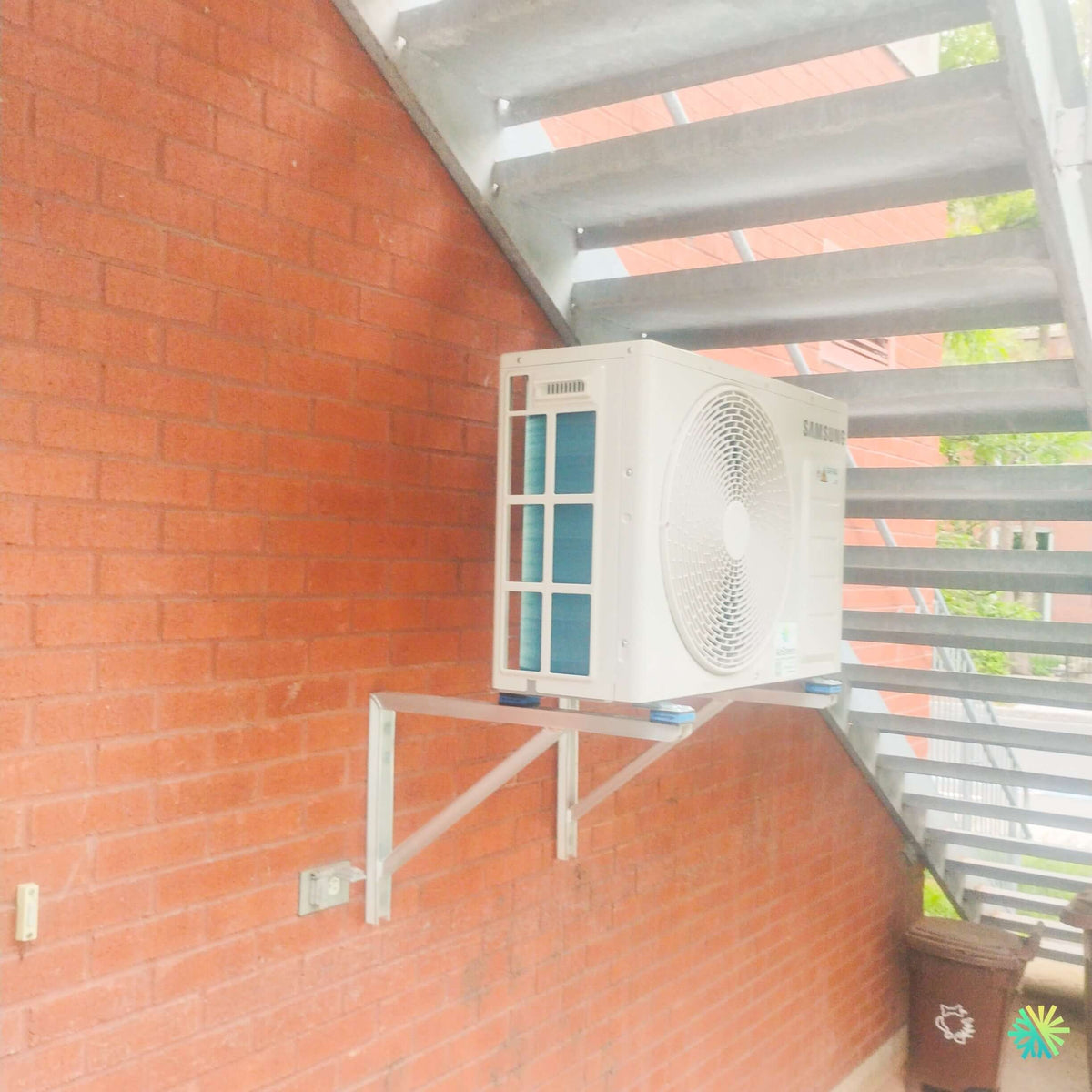
Installation of a Samsung WindFree™ MaxHeat wall-mounted heat pump under an exterior staircase in Verdun, Montreal
In Verdun, AirGreen installs a Samsung WindFree™ MaxHeat on a wall bracket beneath a metal staircase, with airflow clearance, winter protection, vibration isolators, and the floor passage kept clear.
Take a tour of the installation
Each number is a point we check on site. Switch between summer and winter to watch air and heat move.
In summer, the outdoor unit rejects the house's heat outside.
Generic illustration of this type of installation, not a survey of this job site. Tap a number.
Mounted level on a wall plate, high enough for the air to reach the whole room, with enough space around it to slide the filters out easily.
The refrigerant lines, the communication cable and the drain go through the wall in a single opening, sealed against water, cold air and insects.
Two insulated copper pipes connect the two units. Outside, a line cover can protect them from sun, knocks and weather.
A shut-off switch near the outdoor unit isolates it safely for service. It must stay accessible at all times.
The compressor and the fan. In heating mode it captures heat from the outdoor air, even in winter, and moves it inside.
On the ground or on the wall, it keeps the unit above accumulated snow. The unit stays clear and defrost water can drain away.
The fan needs to blow freely. Storage, a fence or a wall too close, and efficiency drops while noise goes up.
A compact installation on a brick wall without obstructing the passage
This Samsung WindFree™ MaxHeat wall-mounted heat pump installation in Verdun had to fit into a particularly structured outdoor space. The outdoor unit could not be placed on the ground or positioned freely along the façade: a metal staircase occupies the entire upper and side portions of the passage, while a brick wall limits the positioning options.
The project photograph shows the solution selected by our AirGreen team. The Samsung condenser was installed high on metal wall brackets beneath the staircase flight. Anti-vibration isolators are visible beneath the unit’s feet. The fan is directed toward the open area of the structure, preserving the ground-level passage while maintaining conditions favorable to air circulation.
This configuration appears simple once completed, but it required several factors to be balanced:
- the available height beneath the steps;
- clearance in front of the fan;
- air intake through the outdoor coil;
- the strength of the support on the masonry;
- drainage during defrost cycles;
- vibrations transmitted to the wall;
- access to the service panel;
- the proximity of the electrical installation;
- the possible accumulation of snow beneath the stairs;
- daily use of the passage.
Our goal was not merely to fit the heat pump into the available space. We had to create a durable HVAC installation that was accessible and suited to the winter operation of a cold-climate heat pump.
Why the wall was the best location
A ground-level installation would have occupied a significant portion of the visible passage beneath the stairs. It would also have placed the base of the unit closer to leaves, debris, water, and snow.
The wall-mounted installation makes it possible to reclaim the unused vertical space here. The unit remains above the circulation area and sufficiently far from the ground to facilitate the drainage of water produced during defrost cycles.
This choice offers several concrete advantages:
- the passage remains clear;
- the condenser is less exposed to impacts;
- maintenance of the area beneath the unit is easier;
- the snow can be removed without moving the heat pump;
- the connections can be routed directly to the building;
- the technician retains reasonable access to the components.
The height must nevertheless be chosen carefully. A unit installed too high could become difficult to maintain. A unit too close to the steps could lack clearance or transmit its vibrations to the metal structure.
In this Verdun project, the condenser was positioned to remain under the stairs while avoiding contact with the stringers and steps. The service panel remains accessible from the passageway.
Open steps do not automatically guarantee good ventilation
The metal structure visible in the photo has open steps. This design allows more air to circulate than a fully enclosed staircase, but it does not eliminate the need to analyze the location.
When the heat pump operates in cooling mode, it expels the heat extracted from the home outdoors. In heating mode, it captures the energy contained in the outdoor air. In both cases, the condenser must move a significant volume of air.
An obstacle that is too close in front of the fan can cause partial recirculation of the discharged air. The system may then operate for longer or under less favorable conditions.
We therefore assessed:
- the distance between the fan grille and the structure;
- the actual opening between the steps;
- the space available on the sides;
- the clearance above the cabinet;
- the possibility of adding items under the stairs later;
- the access required to clean the coil.
The space should not be considered storage once the installation is complete. Boxes, materials, bicycles, or bins placed directly in front of the fan could alter the operating conditions anticipated at the time of installation.
Wall brackets suitable for masonry
The outdoor unit rests on two reinforced metal brackets. The weight is thus transferred to the wall rather than to the stair treads.
Before mounting, we must verify the nature and condition of the support. The brick visible at the surface is only part of the wall assembly. Anchor selection depends in particular on the load, the structure behind the masonry, and the actual site conditions.
A wall mounting must withstand:
- to the static weight of the unit;
- variations in compressor speed;
- fan vibrations;
- the effects of wind;
- freeze-thaw cycles;
- maintenance work;
- normal building movement.
The two horizontal arms must also be level. A tilted unit can hinder drainage from its base and impose an uneven load on the condenser feet.
On this installation, the support width matches the unit’s footprint. The feet are fully supported and are not positioned at the edge of the rails.
The vibration isolators visible under the unit
The small components placed under the condenser feet are not decorative. They help limit vibration transmission to the supports and brick wall.
This precaution is important when a heat pump is mounted on a façade directly connected to living spaces. Even a variable-speed compressor can produce certain frequencies that are perceptible at different operating speeds.
To achieve a quiet result, we must consider the entire installation:
- bracket rigidity;
- anchor quality;
- isolator placement;
- leveling;
- securing the lines;
- no contact between the copper and the masonry;
- clearance from the staircase;
- proper panel closure.
Adding pads under a unit is not enough when the refrigerant lines rest against a rigid surface. The pipe routing must therefore be arranged so that it does not create a second path for vibration transmission.
Winter drainage under the staircase
The Samsung WindFree™ MaxHeat is designed for heating in cold weather. Samsung states that the range can maintain full heating performance at approximately -15 °C, continue to provide heating capacity at approximately -30 °C, and use an integrated base heater to facilitate defrosting and water drainage.
These considerations are relevant to Montreal, but they do not replace a properly elevated installation.
During a defrost cycle, water leaves the coil and drains through the base of the unit. Under a staircase, this water may fall into an area less exposed to sunlight and freeze for longer than elsewhere.
Therefore, we must prevent water from:
- remains trapped against the bottom of the condenser;
- forms a block of ice down to the base;
- accumulates on the anchors;
- creates a dangerously icy surface in the passage;
- heads toward the foundation wall;
- reaches the electrical components.
The wall bracket provides appreciable clearance between the heat pump and the ground in this case. However, the owner must monitor ice accumulation after periods of freezing rain and keep the space beneath the unit clear.
Partial protection from precipitation
The flight of stairs provides some protection from vertically falling snow. However, it does not constitute a completely enclosed shelter.
Wind can push snow between the steps or cause it to accumulate around the unit. The side coil visible in the photo must always have an unobstructed air intake.
During winter, it is best to:
- remove snow around and beneath the condenser;
- do not strike the grille with a shovel;
- avoid using hot water to remove ice;
- never cover the unit while it is operating;
- check that the drainage openings remain clear;
- request an inspection when a thick layer of ice remains on the coil.
A light layer of frost followed by defrosting is normal. A unit completely covered in ice for an extended period may indicate an obstruction, a drainage problem, or an operating issue.
A Samsung WindFree™ MaxHeat chosen for comfort and Montreal winters
A product line available in several capacities
The name Samsung WindFree™ MaxHeat refers to a product line comprising several capacities, not a single universal unit. Samsung offers configurations of 9,000, 12,000, 15,000, 18,000 and 24,000 BTU/h. The exact sizing must match the home's heat loss and heat gain.
Depending on the selected combination, Samsung publishes the following efficiency ratings:
- 9,000 BTU version: up to 25.0 SEER2 and 10.5 HSPF2;
- 12,000 BTU version: up to 24.0 SEER2 and 10.5 HSPF2;
- 15,000 BTU version: up to 23.5 SEER2 and 11.0 HSPF2;
- 18,000 BTU version: up to 21.0 SEER2 and 9.7 HSPF2;
- 24,000 BTU version: up to 20.0 SEER2 and 9.5 HSPF2.
The manufacturer also indicates a heating operating range down to -30 °C for the configurations shown. These values must always be associated with the exact indoor and outdoor unit combination listed on the invoice and the nameplates.
At AirGreen, we do not select capacity solely according to square footage. We also consider:
- of the number of floors;
- of the insulation;
- of air infiltration;
- of the window area;
- of solar exposure;
- of the number of exterior walls;
- of the ceiling height;
- of the circulation between rooms;
- of the existing heating system;
- of the temperature desired by the occupants.
An oversized unit can reduce its dehumidification cycles and produce temperature fluctuations. An undersized unit may run continuously without meeting the load under the most demanding conditions.
WindFree™ airflow inside the home
WindFree™ technology operates on the indoor unit side. Once the temperature is close to the setpoint, air can be distributed through numerous microperforations rather than through a concentrated jet.
Samsung specifies that the air speed produced in WindFree™ mode remains below 0.15 m/s, a condition corresponding to air considered almost still according to the technical reference cited by the manufacturer.
This airflow is particularly beneficial when the indoor evaporator is located:
- facing a sofa;
- near a workspace;
- in a bedroom;
- above a table;
- in an open area occupied for long periods.
Indoor positioning nevertheless remains essential. Even with WindFree™ mode, the unit must be able to draw in and distribute air without being blocked by a cabinet, curtain, or beam.
The refrigeration lines behind the condenser
On this Verdun installation, the connections do not visibly cross the passageway. The route was arranged near the wall and behind the unit, protecting the lines from impacts.
The harness connecting the units generally includes:
- two copper lines;
- the refrigeration insulation;
- the communication wiring;
- the required conductors;
- the indoor condensate drain;
- outdoor protection according to the route.
The connections must be prepared precisely. After making them, we perform a leak test and evacuate the circuit before starting it up.
Proper evacuation removes the air and moisture present in the lines. This step should not be assessed solely based on the number of minutes the pump has operated. We verify the level reached and its stability before releasing the refrigerant charge.
Electrical power and disconnect
An outdoor electrical box is visible on the wall, beneath the area occupied by the heat pump. The electrical installation must allow the power supply to be disconnected locally during maintenance.
The circuit rating and protection are not determined solely by the number of BTUs. They must correspond to the electrical values listed on the outdoor unit’s nameplate, particularly the minimum circuit ampacity and the maximum permitted overcurrent protection.
We also check that:
- the disconnect remains accessible;
- the outdoor wiring is protected;
- the penetrations are sealed;
- the wires do not touch sharp surfaces;
- the connections withstand outdoor conditions;
- the components are not located directly in the path of defrost water.
Mistakes to avoid under an outdoor staircase
This type of project can quickly lose its benefits when the installation is improvised.
Mount the unit too close to the steps
The unit may vibrate against the structure or lack space for removing its panels.
Point the fan toward a closed surface
Exhaust air could bounce back toward the condenser and reduce conditions favorable to heat transfer.
Use supports that are too short
The feet must rest fully on the rails, without overhanging or placing stress on the chassis.
Neglect ice beneath the unit
A cold-climate heat pump produces water during defrost cycles. A high support height does not eliminate the need to monitor the ground.
Let the lines touch the wall
Contact can transmit vibrations and damage the insulation over time.
Turn the space into storage
Objects placed in front of the fan or against the coil can block airflow and complicate maintenance.
Install a full cover
A heat pump used in winter should not be wrapped. It needs to move outdoor air freely.
Recommended maintenance for this configuration
A location under a staircase can encourage the accumulation of dust, leaves, and small debris carried in on footwear or by the wind.
The owner should regularly:
- inspect the back and sides of the condenser;
- remove leaves without bending the fins;
- keep the ground clear;
- check the supports;
- watch for new noises;
- clean the indoor unit filters;
- make sure the fan is not obstructed;
- Schedule HVAC maintenance when the coil becomes dirty.
High-pressure cleaning is not recommended for delicate fins. Excessive pressure can bend them and reduce airflow.
Potential eligibility for LogisVert financial assistance
An ENERGY STAR® cold-climate certified heat pump may qualify, when all conditions are met, for LogisVert financial assistance of $120 per 1,000 BTU/h of heating capacity at -8 °C. For some eligible multi-unit buildings, the increased amount offered for installations completed since June 15, 2026, may raise this to $220 per 1,000 BTU/h at -8 °C.
The building’s appearance or its location in Verdun is not enough to confirm eligibility. The applicant must verify:
- the exact model pairing;
- the AHRI or ENERGY STAR® number;
- the installation date;
- the published capacity at -8 °C;
- the building’s status;
- the conditions specific to the application;
- the model’s presence in the official tool.
Hydro-Québec states that heat pumps installed since November 26, 2025, must be ENERGY STAR® certified to qualify and that the application must be submitted within nine months of installation.
We recommend keeping the detailed invoice, serial numbers, the models of both units, photographs of the rating plates, and proof of payment.
The tangible result of this Verdun installation
This Samsung WindFree™ MaxHeat wall-mounted heat pump installation makes use of a space that would otherwise have been difficult to use. The condenser is securely installed on the brick wall, the passage remains clear, and the air discharge is directed toward the open part of the staircase.
The visible details sum up our approach:
- metal support sized for the unit;
- raised installation for winter;
- anti-vibration isolators under the feet;
- clearance around the coil;
- access to the service panel;
- connections grouped near the wall;
- integration adapted to the existing architecture.
We apply the same method to our projects involving wall-mounted heat pumps and wall-mounted air conditioners in Montreal, Laval, Longueuil, the North Shore, and the South Shore. A narrow yard, balcony, flat roof, or exterior staircase does not call for the same solution.
Our work consists of adapting the HVAC system to the building, Quebec winters, and how the space is actually used. In this Verdun project, the quality of the result depends as much on choosing Samsung equipment as on positioning the support, managing vibrations, and directing airflow under the stairs.
The big day, step by step
The main steps of this kind of job at AirGreen. Every house has its quirks: the estimate brings them out.
We look at the room, the outside wall, the line route and where the outdoor unit will go. That is where the capacity gets chosen.
Model, capacity and price, in writing. We also check whether the model qualifies for assistance programs.
Floors and furniture protected, wall plate position marked level, wall opening located.
A single opening, with the slope the drain needs to flow outside.
Set on a stand raised above the snow, with the clearances the manufacturer requires.
Connected, insulated and protected. The opening is then sealed against water, cold air and insects.
A dedicated circuit and an accessible disconnect near the outdoor unit.
Leak test, vacuum, then start-up and a check of heating and cooling.
Remote, modes, filters: we show you the essentials before we leave.
- The on-site estimateWe look at the room, the outside wall, the line route and where the outdoor unit will go. That is where the capacity gets chosen.
- The quoteModel, capacity and price, in writing. We also check whether the model qualifies for assistance programs.
- Getting readyFloors and furniture protected, wall plate position marked level, wall opening located.
- The wall openingA single opening, with the slope the drain needs to flow outside.
- The outdoor unitSet on a stand raised above the snow, with the clearances the manufacturer requires.
- Lines, cable and drainConnected, insulated and protected. The opening is then sealed against water, cold air and insects.
- The electrical workA dedicated circuit and an accessible disconnect near the outdoor unit.
- Tests and start-upLeak test, vacuum, then start-up and a check of heating and cooling.
- The walkthroughRemote, modes, filters: we show you the essentials before we leave.
What would it look like at your place?
Two quick checks with real numbers: what heat costs, and what your current heaters add up to in BTU/h.
Conversion: 1 W = 3.412 BTU/h. An indication, not a load calculation: baseboards and furnaces are often stronger than the real need, and they can stay as backup. AirGreen confirms the capacity on site.
Four mistakes we do not make
Flip each card to see what we do instead.
Your own project, step by step
What to do, season by season
Three habits per season for this unit. They take a few minutes and prevent many calls.
- Clean the indoor unit's filters.
- Clear leaves and debris left on the outdoor unit by winter.
- Test cooling before the first hot days.
- Clean the filters more often when the unit runs a lot.
- Keep plants away from the outdoor unit.
- Check that no water drips from the indoor unit.
- Rake the leaves around the outdoor unit.
- Test heating before the first cold days.
- Book periodic maintenance before winter.
- Keep snow away from the stand and the front of the unit.
- Let the unit defrost: it is normal.
- Never hit the ice on the fins; call us if the unit stays iced up.
Is your home ready?
Check what applies at your place. A "no" is not a refusal: it is what we sort out during the estimate.
Four statements: true or false?
It all comes down to details you have just seen.
1. In heating mode, the outdoor unit can produce water.
During defrost cycles. That water must drain away without forming ice.
2. You pick the capacity with a simple square-footage rule.
Windows, insulation, orientation and how the room is used all count. Capacity is chosen on site.
3. A multi-zone connects several indoor heads to a single condenser.
One head per room, all on the same condenser. Each room keeps its own temperature.
4. The disconnect can sit behind the patio furniture.
It must stay accessible: it is what shuts the unit off for service.
0 / 4 right answers
What people ask us about this kind of work
Does a wall-mounted heat pump heat in winter?
Wall-mounted or multi-zone: how do I choose?
Where does the outdoor unit go?
Are there grants?
Do I need a permit?
How cold can it heat?
How much can I save?
How is the LogisVert assistance calculated?
Is it noisy?
The outdoor unit is covered in ice: is that normal?
Does AirGreen hold the required licences?
Is the estimate free?
No question matches. Write to us: we answer.
More jobs to see, near you
By town, by equipment or by region: browse more than 4,700 published projects.
Each dot: a town where AirGreen has published projects. The glowing dot: this job.
Every house has its constraints. We see them before we install.
The on-site estimate is free and the quote follows within 24 hours.
Text and photo: a real AirGreen Climatisation & Chauffage job. The diagrams are generic illustrations of the type of installation, not a survey of this job site. Sources of the added figures: airgreen.ca product pages (NEEP / AHRI performance), Hydro-Québec (Heat pumps page, LogisVert, read on 13 October 2026), Régie de l’énergie (rate D as of 1 April 2026).