

Project
Installation of a Sharp ZU1 18,000 BTU wall heat pump in Westmount, compared with the BOSCH Climate 5000
In Westmount, an 18,000 BTU/h SHARP ZU1 replaced an old system in a classic house with modern interiors. How far down each unit can slow on mild days, what it delivers in deep cold and the certified values, next to the BOSCH Climate 5000 Regular of the same size.
–chapters in this story
16 minreading time
–type of installation
2024year published
The tour
Take a tour of the installation
Each number is a point we check on site. Switch between summer and winter to watch air and heat move.
In summer, the outdoor unit rejects the house's heat outside.
Generic illustration of this type of installation, not a survey of this job site. Tap a number.
Mounted level on a wall plate, high enough for the air to reach the whole room, with enough space around it to slide the filters out easily.
The refrigerant lines, the communication cable and the drain go through the wall in a single opening, sealed against water, cold air and insects.
Two insulated copper pipes connect the two units. Outside, a line cover can protect them from sun, knocks and weather.
A shut-off switch near the outdoor unit isolates it safely for service. It must stay accessible at all times.
The compressor and the fan. In heating mode it captures heat from the outdoor air, even in winter, and moves it inside.
On the ground or on the wall, it keeps the unit above accumulated snow. The unit stays clear and defrost water can drain away.
The fan needs to blow freely. Storage, a fence or a wall too close, and efficiency drops while noise goes up.
The job
Comparison · Project in Westmount · Wall heat pump · 18,000 BTU/h
Modernizing a Westmount house: the SHARP ZU1 that was installed, next to the BOSCH Climate 5000 Regular
The owner wanted to replace an old heating and cooling system in a house that mixes classic architecture with modern interiors. An 18,000 BTU/h SHARP ZU1 was installed. Here is what the certificates and the manufacturers publish for this unit and for the 18,000 BTU/h BOSCH Climate 5000 Regular R-454B, starting with a question people rarely ask: how far down each one can slow.
SEER2 (cooling)24and23.5
HSPF2 Region V (heating)9and8
Certified min. capacity at −8.3 °C7,500and3,800
Certified max. capacity at −15 °C18,000and12,800

Climate 5000 Regular R-454B · 18,000 BTU/h
Indoor BMS500-AAU018-1AHWXD · outdoor BMS500-AAS018-1CSXRD · AHRI 215223302 Same type, same size, cold-climate certified See the product pageEstimated operating cost
What the electricity costs, in dollars, winter and summer
AirGreen estimate for the same 18,000 BTU/h zone in Montréal, at Hydro-Québec Rate D, taxes included. Both heat pumps are calculated exactly the same way, with the same method as on all our comparison pages; only their certified efficiencies change. Electric baseboards serve as the reference.
How this amount is calculated
- Heat needed over the winter. A zone whose heat loss reaches 18,000 BTU/h ( kW) at −23.1 °C, Montréal's design temperature: kW × 24 h × 4,167 degree-days ÷ (18 − (−23.1)) = kWh of heat for heating around the clock, all winter. Heating degree-days (base 18 °C) and design temperature: Natural Resources Canada, HOT2000 climate data, Montréal Intl station. With fewer hours a day ("Heating" slider), the heat is reduced in the same proportion, for the heat pump and for the baseboards: this is a simplification that does not account for recovery after a temperature setback.
- Electricity for heating. Heat pump: heat × 3.412 ÷ HSPF2 Region V, the AHRI certificate value published by NEEP. Region V is the coldest in the standard, and its calculation includes the electric backup expected when the heat pump is no longer enough. Electric baseboards: 1 kWh of electricity for 1 kWh of heat.
- Electricity for cooling. 18,000 BTU/h ÷ SEER2 × hours a day × 60 days ÷ 1,000: the method of Hydro-Québec's air-conditioning calculator, with the seasonal SEER2 efficiency from the AHRI certificate. The number of hours is a scenario, adjustable above from 1 to 24 h. At 24 h, the calculation assumes rated capacity all day: this is a maximum, since a variable-speed unit slows down once the room is at the right temperature.
- Price. Hydro-Québec Rate D in force on April 1, 2026: 7.065¢ per kWh up to 40 kWh a day, 11.142¢ above; the average price, 9.104¢, is the one Hydro-Québec's calculators use. GST and QST included. Network access charges, the same with or without a heat pump, are not counted.
AirGreen method v1.1, November 9, 2026. An estimate is for comparing units under the same conditions. The actual bill depends on the house, the insulation, the settings and the use; this amount is not a promise.
The project
Westmount, an old system to replace and an outdoor unit on the balcony
In Westmount, the owner called us to modernize his old heating and cooling system. His house mixes classic architecture with modern interiors; he wanted a unit that is efficient, discreet in the decor and reliable in cold weather.
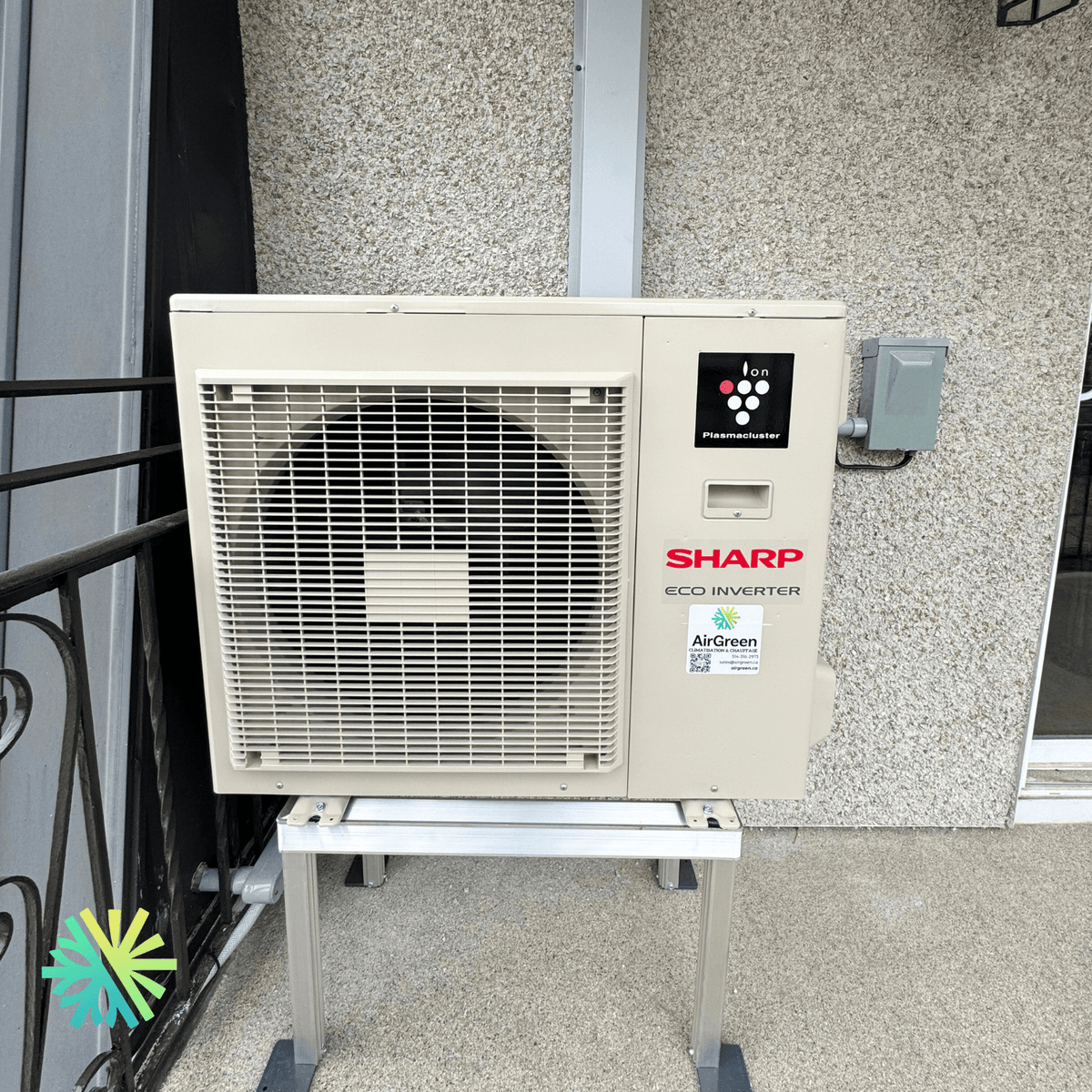
An 18,000 BTU/h SHARP ZU1 was installed (indoor unit AY-XP18ZU1, outdoor unit AE-X18ZU1, R-32 refrigerant). In the photo, the outdoor unit sits on an aluminium stand on the balcony, against the stucco wall, with its disconnect switch beside it. The owner especially liked the Wi-Fi control from his phone.
When replacing an old system, people look at maximum output first. But a heat pump spends most of the year far from its limits: on mild autumn and spring days, what matters most is how far down it can slow. So this page compares, with certified values, the range of each unit from lowest to highest.

LocationWestmount, Island of Montréal
HouseClassic architecture, modern interiors
Unit installedSHARP ZU1, 18,000 BTU/h, R-32
Outdoor unitOn a stand, on the balcony
What changed in this text. The earlier version presented this unit as the recommended pick of a buying guide, credited it with "unmatched" efficiency, environmental qualities, health effects, a country of engineering, and the "highest" grant with an amount. It also claimed even air distribution in every room. Those passages have been removed: a comparison page does not rank, makes no environmental or health claim, and assistance programs change (check Hydro-Québec's official list). The figures below come from the certificates and the manufacturers' documents.
How far down
From a mild day to a cold night: each unit's certified range
At each test temperature, NEEP publishes a minimum, a rated and a maximum capacity. Between the minimum and the maximum, the unit adjusts its speed. Below the minimum, it cannot slow down any further. Above the maximum, it is no longer enough. Choose a temperature and the size of the heated zone.
Certified range, minimum to maximumRated capacityZone's need at this temperature
The zone's need is an assumption: it grows in a straight line with the gap between 18 °C and outdoors, as in the cost calculation above. A real house also gains heat from the sun and its occupants; on mild days its need is often lower. Capacities come from NEEP records 507396 and 392002; the coldest point is published without a rated capacity, at −27.2 °C for the SHARP and −25 °C for the BOSCH. The max. ÷ min. ratio is an AirGreen calculation.
Deep cold
When the night drops below −15 °C: what SHARP and BOSCH publish
NEEP certifies both units down to −15 °C, then gives one colder point: −27.2 °C for the SHARP ZU1, −25 °C for the BOSCH. The SHARP brochure adds maximum capacities at −20 and −25 °C; the heating table in the BOSCH submittal sheet gives a value at −20 °C. Cells with no published value show the range between the two points around them.
BOSCH: the submittal table also gives 13,396 BTU/h at −15 °C and 8,991 BTU/h at −25 °C, above the certified values (12,800 and 8,100). It states that only the values in bold were measured and that the others are simulated. This page shows the certificate and takes from the table only the value at −20 °C, where NEEP publishes nothing. SHARP: at the temperatures they share, the ZU/ZHU brochure values are identical to the ZU1 certificate.
Functions
What SHARP and BOSCH describe, from Wi-Fi to defrost
The functions come from the SHARP brochure, the BOSCH submittal sheet and remote controller manual, and the Climate 5000 catalogue. A function missing from a document is not necessarily missing from the unit; it is simply not described there.
Wi-Fi and remote control
SHARP: built-in Wi-Fi announced for the series.
BOSCH: the remote controller manual does not mention Wi-Fi; the catalogue states compatibility with the Bosch Connected Control Wi-Fi thermostat, sold separately.
Limiting power
SHARP: not described in the brochure consulted.
BOSCH: ECO and GEAR modes, which cap power at 75% or 50%.
Air direction
SHARP: Coanda effect with a long louver that sends air along the ceiling.
BOSCH: "Breeze Away", which deflects the airflow so it does not blow directly on occupants; louver swing.
Comfort modes
SHARP: not described in the brochure consulted.
BOSCH: Sleep, Follow Me (temperature read at the remote), Turbo, Silent, 0.5 to 24-hour timer, humidity adjustable from 35 to 85% in dry mode.
Heating in deep cold
SHARP: heating announced from −27 to 24 °C; "Hot Gas Pipe" defrost.
BOSCH: heating announced from −25 to 24 °C; "Super Heat" to heat faster at low temperatures; freeze protection at 8 °C.
Cleaning and detection
SHARP: Plasmacluster technology (name only, no effect attributed here).
BOSCH: "Active Clean", which frosts then thaws the indoor coil; built-in A2L leak detector.
Sound
When the unit slows down: the sound of the low speeds
A heat pump that slows down spends more time at its low speeds: those are the ones you hear most. Each manufacturer publishes its own steps.
Indoor unit
dB
How to read these numbers. dB(A) weights noise by the ear's sensitivity: the lower the value, the quieter the unit, and the speeds on the left are the ones you hear most when it modulates. Each dot is a fan speed published by the manufacturer, from slowest to fastest.
Why this is not a ranking. SHARP publishes five speeds in heating; BOSCH publishes five speeds (Silent, low, medium, high, Turbo) without stating the mode. Neither gives the distance or the measurement conditions. Outdoors, SHARP publishes 52 dB(A) and BOSCH 58 dB(A) at maximum, with the same caveat.
Measurements taken by each manufacturer with its own method: read them separately, not as a ranking.
Installation
From the balcony to the indoor unit: what each installation requires
The two outdoor units take almost the same space. The BOSCH accepts a longer line and a greater height difference; its line set is 1/4 – 1/2 in.
| Installation, per the manufacturer | SHARP ZU1 18,000 | BOSCH Climate 5000 Regular 18,000 |
|---|---|---|
| Maximum piping length | 66 ft (20 m)ZU/ZHU brochure | 98.4 ft (30 m)Submittal sheet BTC 769208310 B |
| Precharged lengthand charge to add beyond it | 25 ft; 0.16 oz/ft beyondZU/ZHU/BU installation manual | 24.6 ft; 0.16 oz/ft beyond |
| Maximum height difference | 33 ft (10 m) | 65.6 ft (20 m) |
| Liquid – gas diameters | 1/4 – 3/8 in | 1/4 – 1/2 in |
| Outdoor unit, dimensions and weight | 33 15/32 × 27 15/16 × 13 in (W × H × D), 95 lb | 35.04 × 26.50 × 13.46 in (W × H × D), 92.6 lb |
| Indoor unit, weightW × H × D | 41 27/64 × 12 7/16 × 9 51/64 in, 31 lb | 38.0 × 12.56 × 9.8 in, 27.3 lb |
| Indoor fan, airflow at the highest speed | Heating: 752 cfm | Turbo: 635.7 cfmmode not stated |
| Electrical protection | Max. fuse 25 A; 208-230 V | Min. circuit ampacity 18 A; max. fuse 20 A; 208-230 V |
| Dehumidification | 2.4 L/h5.1 pints/h printed | 2.0 L/h4.23 pints/h printed |
| Announced heating / cooling range | −27 to 24 °C / −10 to 46 °C | −25 to 24 °C / −25 to 50 °C |
On a balcony like the one in Westmount, the stand must account for the unit's weight, snow and the clearances each installation manual requires. The dimensions above are for the casing, without the stand.
Questions
Your questions about the Westmount project
Why put the BOSCH Climate 5000 Regular next to the SHARP ZU1?
Both are 18,000 BTU/h wall heat pumps, sold by AirGreen and certified for cold climates, with two different refrigerants (R-32 and R-454B). Their certified ranges are very different, which makes them a good example to explain modulation. The page does not rank the two units.
What does "minimum capacity" mean?
It is the lowest heating output NEEP publishes for the unit at a given temperature. When the room needs even less, the unit cannot slow down further: it stops once the setpoint is reached, then starts again.
Should you always pick the unit with the most output in deep cold?
Not necessarily. A unit whose maximum covers the coldest night can end up below its minimum on mild days, and the reverse. A heat-loss calculation for the zone is what guides the choice; this page only shows where the certified ranges lie.
Why does the BOSCH table give more than the certificate?
At −15 and −25 °C, the BOSCH submittal table gives 13,396 and 8,991 BTU/h; NEEP certifies 12,800 and 8,100 BTU/h. BOSCH states that only some values in its table were measured and that the others are simulated. When a source contradicts the AHRI certificate, this page follows the certificate.
Does a wall unit spread air into every room?
A wall unit treats the room where it is mounted first; air reaches neighbouring rooms through doors and openings. Neither manufacturer publishes a value for air distribution between several rooms.
Are these units eligible for LogisVert?
Hydro-Québec decides eligibility and amounts, and they change. Check each unit's AHRI certificate number in the official list at the time of your project; this page promises no amount.
Certified data
The AHRI certificates, from minimum to maximum
| Certified value (NEEP) | SHARP ZU1 18,000 | BOSCH Climate 5000 Regular 18,000 |
|---|---|---|
| Seasonal efficiency | ||
| SEER2 | 24 | 23.5 |
| EER2 | 13 | 12.7 |
| HSPF2 Region IV | 11 | 10.8 |
| HSPF2 Region V | 9 | 8 |
| Rated capacity at 35 °C (cooling) | 18,000 BTU/h | 18,000 BTU/h |
| Heating, min. / rated / max. capacity | ||
| Min. / rated / max. capacity at 8.3 °C | 5,500 / 21,600 / 25,600 BTU/h | 7,700 / 18,000 / 21,000 BTU/h |
| Min. / rated / max. capacity at −8.3 °C | 7,500 / 22,000 / 22,000 BTU/h | 3,800 / 15,000 / 15,000 BTU/h |
| Min. / rated / max. capacity at −15 °C | 5,800 / 18,000 / 18,000 BTU/h | 2,200 / 12,800 / 12,800 BTU/h |
| Min. / rated / max. COP at 8.3 °C | 5.76 / 4.22 / 3.68 | 5.37 / 3.49 / 3.22 |
| Min. / rated / max. COP at −15 °C | 2.93 / 2.2 / 2.2 | 1.29 / 2.1 / 2.1 |
| Coldest point published by NEEP | ||
| Test temperature | −27.2 °C (−17 °F) | −25 °C (−13 °F) |
| Min. / max. capacity | 3,200 / 11,500 BTU/h | 2,100 / 8,100 BTU/h |
| COP at maximum | 1.88 | 1.63 |
| Documents | ||
| AHRI certificate · NEEP record | 213246053 · 507396 | 215223302 · 392002 |
| ENERGY STAR | Yes; cold climate: yes | Yes; cold climate: yes |
| Refrigerant | R-32, GWP 675 (IPCC AR4), A2L class | R-454B, GWP 466 (IPCC AR4), A2L class |
"higher" marks the higher value of a same measurement, under the same conditions. It is not a recommendation. Minimum capacities, capacities at different temperatures and the coldest point are never marked.
An old system to replace, like in Westmount? Let's talk.
To replace an old system in a house like the one in Westmount, or for any other question about these two units, call or write to us.
Sources
Documents consulted
NEEP, record 507396 · SHARP ZU1 18,000AY-XP18ZU1 + AE-X18ZU1, AHRI certificate 213246053. Consulted November 17, 2026.
NEEP, record 392002 · BOSCH Climate 5000 Regular 18,000BMS500-AAU018-1AHWXD + BMS500-AAS018-1CSXRD, AHRI certificate 215223302 ("BMS Series"). Consulted November 17, 2026.
ENERGY STAR, heat pump datasetAHRI 215223302: SEER2 23.5, EER2 12.7, HSPF2 10.8, cold climate yes, 12,800 BTU/h and COP 2.1 at −15 °C, 15,000 BTU/h at −8.3 °C. Consulted November 17, 2026.
SHARP, "ZU/ZHU" brochure (French)AY-XPC18ZU / AE-X18ZU column. Undated. ZU/ZHU/BU installation manual for the precharged length and additional charge. Consulted November 17, 2026.
BOSCH, submittal sheet "18K Btu Single Zone Regular System – Wall Mounted IDU"Climate 5000 Series Gen 4, BTC 769208310 B, 01.2026, pp. 1 to 4: efficiencies, ranges, sound, airflow, dimensions, piping, heating table. Consulted November 17, 2026.
BOSCH, Climate 5000 Gen 4 wall remote controller manualBTC 769203309 B, 07.2024: modes and functions. Consulted November 17, 2026.
BOSCH, Climate 5000 catalogueBuilt-in A2L detector, compatibility with the Bosch Connected Control Wi-Fi thermostat. Consulted November 17, 2026.
Hydro-Québec, Electricity ratesApril 1, 2026, Rate D, art. 2.5. Consulted November 17, 2026.
NRCan, HOT2000 climate mapMontréal Intl station: 4,167 degree-days (base 18 °C), design temperature −23.1 °C.
Data verified on November 17, 2026. Performance: AHRI certificates and the NEEP database. Dimensions, sound, airflow, piping and functions: per the manufacturer. When a source contradicts the AHRI certificate, the certificate prevails.
Trademarks. SHARP, ZU1, Plasmacluster, BOSCH, Climate 5000 and Bosch Connected Control are trademarks of their respective owners. Logos are used only to identify the products compared. AirGreen is a dealer for both brands; this page is not produced, sponsored or endorsed by the manufacturers.
Photos: AirGreen and manufacturers, for identification.
Does a figure look wrong? Write to us: every reported figure is re-checked.
The unit
The unit on this job, in figures
The range as published on airgreen.ca: pick a size to see its capacity in deep cold.
| Size | Heating at −8 °C | Heating at −15 °C | Coldest certified point | COP at −15 °C | SEER | HSPF | Indicative LogisVert aid |
|---|---|---|---|---|---|---|---|
| Sharp ZU1 12 000 | 14,500 | 12,000 | −27 °C: 7,200 | 2.11 | 22.0 | 11.0 | $1,740 |
| Sharp ZU1 15 000 | 18,100 | 15,300 | −27 °C: 10,100 | 2.1 | 24.0 | 11.0 | $2,172 |
| Sharp ZU1 18 000 | 22,000 | 18,000 | −27 °C: 11,500 | 2.2 | 24.0 | 11.0 | $2,640 |
| Sharp ZU1 24 000 | 22,400 | 19,000 | −27 °C: 12,300 | 2.2 | 22.0 | 11.0 | $2,688 |
14,500Its full nominal heating at −8 °C
According to NEEP, it delivers 14,500 BTU/h at −8 °C (17 °F), more than at 8 °C (14,000 BTU/h). It heats as hard in moderate cold as in mild weather.
7,200Still 7,200 BTU/h at −27 °C
According to NEEP, its certified maximum capacity at −27 °C (−17 °F) is 7,200 BTU/h, 60% of its nominal 12,000 BTU size.
17,100A 17,100 BTU/h reserve in mild weather
At 8 °C, its certified maximum capacity reaches 17,100 BTU/h, 42% more than its nominal 12,000 BTU size.
18,100Its full nominal heating at −8 °C
According to NEEP, it delivers 18,100 BTU/h at −8 °C (17 °F), more than at 8 °C (18,000 BTU/h). It heats as hard in moderate cold as in mild weather.
10,100Still 10,100 BTU/h at −27 °C
According to NEEP, its certified maximum capacity at −27 °C (−17 °F) is 10,100 BTU/h, 67% of its nominal 15,000 BTU size.
21,800A 21,800 BTU/h reserve in mild weather
At 8 °C, its certified maximum capacity reaches 21,800 BTU/h, 45% more than its nominal 15,000 BTU size.
22,000Its full nominal heating at −8 °C
According to NEEP, it delivers 22,000 BTU/h at −8 °C (17 °F), more than at 8 °C (21,600 BTU/h). It heats as hard in moderate cold as in mild weather.
1.88The family’s best efficiency at −27 °C
According to NEEP, its COP at −27 °C is 1.88: the highest of the ZU1 line, which ranges from 1.79 to 1.82 at that temperature.
11,500Still 11,500 BTU/h at −27 °C
According to NEEP, its certified maximum capacity at −27 °C (−17 °F) is 11,500 BTU/h, 64% of its nominal 18,000 BTU size.
3,200It modulates down to 3,200 BTU/h
At −27 °C, its certified minimum capacity is 3,200 BTU/h (5,500 at 8 °C). It slows down instead of cycling on and off.
19,00019,000 BTU/h certified at −15 °C
According to NEEP, its certified heating capacity at −15 °C (5 °F) is 19,000 BTU/h, 79% of its nominal 24,000 BTU size. Its COP there is 2.20.
Data read live from the airgreen.ca page of each size (NEEP / AHRI certified performance). When the title names the installed size, it is highlighted; otherwise the whole range is shown. The aid shown is today’s, using Hydro-Québec’s rule ($120 per 1,000 BTU/h at −8 °C); amounts quoted in the article date from its publication. Only Hydro-Québec confirms the assistance granted.
The steps
The big day, step by step
The main steps of this kind of job at AirGreen. Every house has its quirks: the estimate brings them out.
Step 1 of 9The on-site estimate
We look at the room, the outside wall, the line route and where the outdoor unit will go. That is where the capacity gets chosen.
Step 2 of 9The quote
Model, capacity and price, in writing. We also check whether the model qualifies for assistance programs.
Step 3 of 9Getting ready
Floors and furniture protected, wall plate position marked level, wall opening located.
Step 4 of 9The wall opening
A single opening, with the slope the drain needs to flow outside.
Step 5 of 9The outdoor unit
Set on a stand raised above the snow, with the clearances the manufacturer requires.
Step 6 of 9Lines, cable and drain
Connected, insulated and protected. The opening is then sealed against water, cold air and insects.
Step 7 of 9The electrical work
A dedicated circuit and an accessible disconnect near the outdoor unit.
Step 8 of 9Tests and start-up
Leak test, vacuum, then start-up and a check of heating and cooling.
Step 9 of 9The walkthrough
Remote, modes, filters: we show you the essentials before we leave.
- The on-site estimateWe look at the room, the outside wall, the line route and where the outdoor unit will go. That is where the capacity gets chosen.
- The quoteModel, capacity and price, in writing. We also check whether the model qualifies for assistance programs.
- Getting readyFloors and furniture protected, wall plate position marked level, wall opening located.
- The wall openingA single opening, with the slope the drain needs to flow outside.
- The outdoor unitSet on a stand raised above the snow, with the clearances the manufacturer requires.
- Lines, cable and drainConnected, insulated and protected. The opening is then sealed against water, cold air and insects.
- The electrical workA dedicated circuit and an accessible disconnect near the outdoor unit.
- Tests and start-upLeak test, vacuum, then start-up and a check of heating and cooling.
- The walkthroughRemote, modes, filters: we show you the essentials before we leave.
Your numbers
What would it look like at your place?
Two quick checks with real numbers: what heat costs, and what your current heaters add up to in BTU/h.
Before / afterThe cost of the same heat
Baseboards and electric furnaces turn 1 kWh of electricity into 1 kWh of heat. A heat pump delivers more: that is its COP. At Hydro-Québec’s rate D (11.142¢/kWh above 40 kWh a day, since 1 April 2026):
Before · baseboards11.142¢/kWh
After · heat pump–
Hydro-Québec: a heat pump can be up to three times more efficient than baseboards for heating in the colder months.
Estimate per kWh of heat, at the chosen temperature, using the certified COP from the product page. Taxes, access charge and backup heat not included.
Size checkYour baseboards, in BTU/h
–BTU/h of installed electric heat
Conversion: 1 W = 3.412 BTU/h. An indication, not a load calculation: baseboards and furnaces are often stronger than the real need, and they can stay as backup. AirGreen confirms the capacity on site.
Mistakes avoided
Four mistakes we do not make
Flip each card to see what we do instead.
Going further
Your own project, step by step
Through the seasons
What to do, season by season
Three habits per season for this unit. They take a few minutes and prevent many calls.
- Clean the indoor unit's filters.
- Clear leaves and debris left on the outdoor unit by winter.
- Test cooling before the first hot days.
- Clean the filters more often when the unit runs a lot.
- Keep plants away from the outdoor unit.
- Check that no water drips from the indoor unit.
- Rake the leaves around the outdoor unit.
- Test heating before the first cold days.
- Book periodic maintenance before winter.
- Keep snow away from the stand and the front of the unit.
- Let the unit defrost: it is normal.
- Never hit the ice on the fins; call us if the unit stays iced up.
At your place
Is your home ready?
Check what applies at your place. A "no" is not a refusal: it is what we sort out during the estimate.
0 / 6 checked
True or false
Four statements: true or false?
It all comes down to details you have just seen.
1. In heating mode, the outdoor unit can produce water.
During defrost cycles. That water must drain away without forming ice.
2. You pick the capacity with a simple square-footage rule.
Windows, insulation, orientation and how the room is used all count. Capacity is chosen on site.
3. A multi-zone connects several indoor heads to a single condenser.
One head per room, all on the same condenser. Each room keeps its own temperature.
4. The disconnect can sit behind the patio furniture.
It must stay accessible: it is what shuts the unit off for service.
0 / 4 right answers
Frequently asked questions
What people ask us about this kind of work
12 questions
Does a wall-mounted heat pump heat in winter?
Yes, it heats and cools. Its capacity drops in very cold weather; the operating range depends on the model and is listed on its spec sheet.
Wall-mounted or multi-zone: how do I choose?
One wall head and one condenser outside: the direct solution for a room or an open area. For two to five rooms, a multi-zone puts one head in each room on a single condenser.
Where does the outdoor unit go?
Where it stays above the snow, clear and accessible, away from walkways. We decide it with you during the estimate.
Are there grants?
Depending on the model and your situation, assistance programs may apply, including Hydro-Québec's LogisVert. AirGreen checks the model number before quoting an amount. See the grants.
Do I need a permit?
Rules vary from city to city: location, distances, noise. See permits and by-laws, and we check for your address.
How cold can it heat?
It depends on the model. According to Hydro-Québec, newer models work down to a temperature between −15 °C and −25 °C, and some cold-climate models are certified lower. The minimum temperature is on each unit's spec sheet.
How much can I save?
Hydro-Québec says a heat pump can be up to three times more efficient than baseboards for heating in the colder months. The result depends on the house, the climate and how it is used.
How is the LogisVert assistance calculated?
For ENERGY STAR cold-climate certified heat pumps, Hydro-Québec lists assistance of $120 per 1,000 BTU/h of heating capacity at −8 °C. AirGreen checks the exact model before quoting an amount; only Hydro-Québec confirms the assistance granted. See the grants.
Is it noisy?
The sound level depends on the model and is listed in decibels on each unit's spec sheet. Location matters too: when possible, we avoid putting the outdoor unit under a bedroom window.
The outdoor unit is covered in ice: is that normal?
Some frost is: the unit runs defrost cycles. Never hit the ice. If the unit stays iced up or stops heating, call us.
Does AirGreen hold the required licences?
Yes. AirGreen holds RBQ licence 5645-9605-01, subclasses 15.8 Ventilation, 15.10 Refrigeration and 16 Electricity.
Is the estimate free?
Yes. The on-site estimate is free and the quote follows within 24 hours. Book my free estimate.
No question matches. Write to us: we answer.
Similar projects
More jobs to see, near you
By town, by equipment or by region: browse more than 4,700 published projects.
Each dot: a town where AirGreen has published projects. The glowing dot: this job.
Your project
Every house has its constraints. We see them before we install.
The on-site estimate is free and the quote follows within 24 hours.
Text and photo: a real AirGreen Climatisation & Chauffage job. The diagrams are generic illustrations of the type of installation, not a survey of this job site. Sources of the added figures: airgreen.ca product pages (NEEP / AHRI performance), Hydro-Québec (Heat pumps page, LogisVert, read on 13 October 2026), Régie de l’énergie (rate D as of 1 April 2026).