FUJITSU AIRSTAGE
ORION XLTH
ASUH12KZAS / AOUH12KZAH1
AHRI 214888802 · NEEP 392122
Also sold under the GENERAL AIRSTAGE name.
See the product page
514-316-2973
sales@airgreen.ca
A wall heat pump in Montréal works from −31.8 °C (January 1994) to 36.6 °C (May 2020), the two extremes recorded at Montréal–Trudeau between 1991 and 2020. We followed the year with two 12,000 BTU R-32 units sold by AirGreen, the FUJITSU AIRSTAGE ORION XLTH and the GREE EXTRÊME R32: what each publishes for cold, heat, snow and power coming back, with Environment Canada data. Neither one is put ahead: each month has its own numbers.
ASUH12KZAS / AOUH12KZAH1
AHRI 214888802 · NEEP 392122
Also sold under the GENERAL AIRSTAGE name.
See the product page
GWH12AVDXE-D6DN***/I / GWH12AVDXE-D6DNA1B/O
AHRI 215386290 · NEEP 389444
GREE AIRY R32: same AHRI certificate. GREE SAPPHIRE R32: same NEEP certified values.
See the product pageAirGreen estimate for the same 12,000 BTU/h zone in Montréal, at Hydro-Québec Rate D, taxes included. Both heat pumps are calculated exactly the same way, with the same method as on all our comparison pages; only their certified efficiencies change. Electric baseboards serve as the reference point.
AirGreen method v1.1, November 9, 2026. An estimate is for comparing units under the same conditions. The actual bill depends on the house, the insulation, the settings and how the unit is used; this amount is not a promise.
Choose a month. The bar shows the average daily minimum and maximum at Montréal–Trudeau (1991–2020); the dots, the coldest and hottest recorded that month over the same period. For each unit, the page reads what is published at those temperatures: a value, the two values that frame it, or the last published point. Nothing is calculated between two points.
On average, 12 days a year have a minimum below −20 °C at Montréal–Trudeau, mostly in January (6.7) and February (3.4). Here is what each manufacturer publishes at those temperatures, temperature by temperature.
A bracket is not an estimate: it is the two published values that frame the temperature, each with its source. Manufacturer values are outside the certificate.
Between 1991 and 2020, Montréal–Trudeau averaged 10.6 days a year above 30 °C, mostly in July (4.0), and 0.23 days above 35 °C. Both units state cooling up to 50 °C outdoors. Here is what is certified at 35 °C, the AHRI test temperature, and at 27.8 °C.
Same scale for both on each line. Capacities in BTU/h from NEEP records 392122 and 389444; SEER2 and EER2 from the AHRI certificates; dehumidification from brochures FG8153C and 032025. Both are certified at 12,000 BTU/h rated at 35 °C.
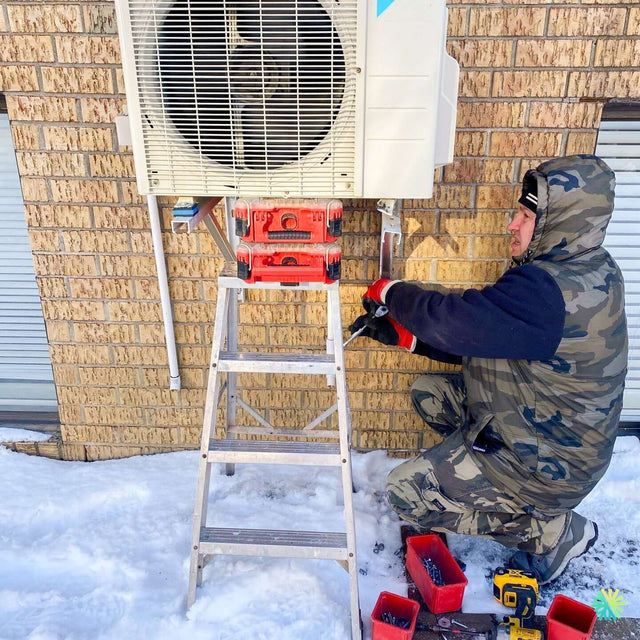
An average of 216.6 cm of snow falls each year at Montréal–Trudeau, and the ground keeps at least 5 cm for 77.9 days. The outdoor unit has to defrost and let the water drain without freezing. Here is what each manufacturer publishes for that part of the unit.
| Installation and outdoor unit | FUJITSU AIRSTAGEORION XLTH | GREEEXTRÊME R32 |
|---|---|---|
| Base pan heater | Yes, 150 WNEEP record 392122. | Yes, 72 WNEEP record 389444: on below 1 °C or during defrost. |
| Outdoor unit W × H × D, weight | 31 7/16 × 24 7/8 × 11 7/16 in, 86 lb799 × 632 × 290 mm, 39 kg. | 34 3/8 × 21 27/32 × 14 51/64 in, 78.3 lb873 × 555 × 376 mm, 35.5 kg. |
| Maximum piping length | 82 ft25 m; minimum 10 ft. Brochure FG8153C. | 131.2 ft40 m according to the EXTRÊME R32 brochure; the GREE Airy Inverter R32 service manual gives 65.6 ft for the 12,000 BTU, to be confirmed in the quote. |
| Pre-charged length | 49 ftAdd 0.22 oz/ft beyond that (manual DR_AS233ES_02, section 7-1). | 24.6 ftGREE AIRY R32 brochure and service manual; add 0.2 oz/ft beyond that. |
| Maximum height difference | 66 ft20 m. | 82 ft25 m according to the brochure; 32.8 ft according to the service manual. |
| Liquid – gas diameters | 1/4 – 3/8 in | 1/4 – 1/2 in |
| Indoor unit W × H × D, weight | 38 9/16 × 11 × 9 7/16 in, 28 lb980 × 280 × 240 mm, 12.7 kg. | 38 3/16 × 13 21/32 × 10 1/8 in, 33.1 lb970 × 347 × 257 mm, 15 kg. |
| Electrical protection | 15 A breakerBrochure FG8153D. | MOP 15 A (MCA 11 A)GREE Canada brochure, document 032025. |
| Stated heating / cooling range | −26 to 24 °C / −10 to 50 °C | −30 to 30 °C / −29 to 50 °C |
Ice storms and power outages are part of a Québec winter: the third card says what each unit does when power comes back. Only what the manufacturers' documents say; “not specified” means the documents consulted do not mention it.
Indoor units, in cooling, as each manufacturer publishes them.
How to read these figures. dB(A) measures a sound level; the lower the number, the quieter the unit. Each dot is a fan speed published by the manufacturer.
Why they do not compare figure against figure. Measuring distance, test room and fan speed differ from one brand to another, and are not always published.
Measured by each manufacturer with its own method; read them brand by brand, not against each other.
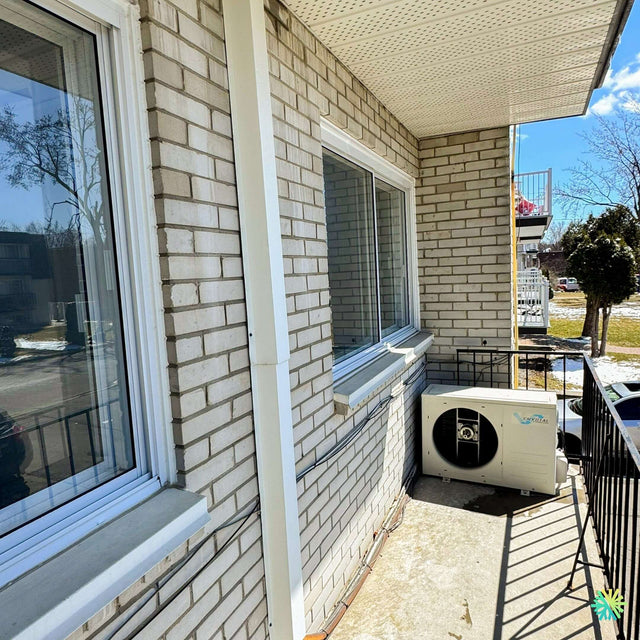
The indoor units differ by only 3/8 in in width; the EXTRÊME R32 is 2 21/32 in taller. At the same scale, then the available wall width.


Widths according to the manufacturers. Cut-out photos, scaled to their published width.
Width of the unit alone; also allow for the side clearances required by the installation manual of the chosen model.
AHRI certificates and NEEP records, read November 16, 2026, cooling first since this article follows the whole year.
| Certified value | FUJITSU AIRSTAGEORION XLTH | GREEEXTRÊME R32 |
|---|---|---|
| Cooling, same test conditions | ||
| 35 °C: capacity min. / rated / max.BTU/h | 3,100 / 12,000 / 16,000 | 2,900 / 12,000 / 17,000 |
| SEER2 | 30.5 | 29.5 |
| EER2 | 16.0 | 15.2 |
| Heating, same test conditions | ||
| HSPF2 Region IV | 12.7 | 10.0 |
| HSPF2 Region V | 10.1 | 8.0 |
| 8.3 °C: capacity min. / rated / max.BTU/h | 3,500 / 16,000 / 23,600 | 3,270 / 12,200 / 16,200 |
| 8.3 °C: COP min. / rated / max. | 5.13 / 4.64 / 3.07 | 5.04 / 4.53 / 3.77 |
| −8.3 °C: capacity min. / rated / max.BTU/h | 2,200 / 10,000 / 18,700 | 2,800 / 13,000 / 13,000 |
| −8.3 °C: COP min. / rated / max. | 3.39 / 3.45 / 2.44 | 4.32 / 2.06 / 2.06 |
| −15 °C: capacity min. / rated / max.BTU/h | 1,950 / 16,600 / 16,600 | 2,600 / 12,200 / 12,200 |
| −15 °C: COP min. / rated / max. | 3.36 / 2.16 / 2.16 | 4.23 / 2.00 / 2.00 |
| Coldest point of each NEEP record — different temperatures, no direct comparison | ||
| Test temperature | −26.1 °C (−15 °F) | −30 °C (−22 °F) |
| Capacity min. / max. | 1,400 / 12,200 BTU/h | 2,600 / 8,500 BTU/h |
| COP at maximum capacity | 1.81 | 1.75 |
| Certifications and refrigerant | ||
| ENERGY STAR / cold climate | Yes / YesENERGY STAR directory, ID 3554345 | Yes / YesENERGY STAR directory, ID 3621214 |
| AHRI certificate · NEEP record | 214888802 · 392122 | 215386290 · 389444 |
| Refrigerant | R-32 · GWP 675 · A2LGWP per IPCC (AR4); ASHRAE 34 class | R-32 · GWP 675 · A2LGWP per IPCC (AR4); ASHRAE 34 class |
Bar: span between minimum and maximum capacity; yellow tick: rated capacity. Same scale for both on each row.
On January 27, 1994, Montréal–Trudeau recorded −31.8 °C, the lowest of the 1991–2020 period (ECCC). Neither unit publishes a capacity at that temperature: the ORION XLTH record stops at −26.1 °C (12,200 BTU/h) and FUJITSU AIRSTAGE states operation without automatic shutoff below that; the EXTRÊME R32 record stops at −30 °C (8,500 BTU/h), the end of its stated range. Such nights are rare: on average 0.21 days a year below −30 °C between 1991 and 2020. Backup heat is still planned for them.
Both state cooling up to 50 °C outdoors, well beyond the 1991–2020 record at Montréal–Trudeau (36.6 °C, May 27, 2020). At 35 °C, the AHRI test temperature, NEEP certifies 12,000 BTU/h rated for both, and a maximum of 16,000 BTU/h for the ORION XLTH and 17,000 BTU/h for the EXTRÊME R32.
FUJITSU AIRSTAGE states automatic restart for the ORION XLTH. For the EXTRÊME R32, the GREE service manual describes resuming the last settings when power returns and a low-voltage start-up. Neither heats during the outage.
It keeps the bottom of the outdoor unit warm so defrost water drains instead of freezing. NEEP lists 150 W for the ORION XLTH and 72 W for the EXTRÊME R32, on below 1 °C or during defrost according to GREE.
The same two units, read differently: our page ORION XLTH and EXTRÊME R32 follows each certified value; this article follows Montréal's calendar, month by month, and the four extreme situations of the year.
It is chosen from the room's heat loss at −23.1 °C, not the square footage. Our page Sizing a heat pump explains the calculation.
Eligibility depends on Hydro-Québec's list in effect on the day of purchase, which can change. Each model's AHRI certificate number is shown above so you can check it.
Terms vary by manufacturer, unit registration and dealer; they are not compared here. The warranty documents for the chosen model come with the quote.
Our estimator comes to your home for free: he measures the room and the wall, looks at where the outdoor unit can go, and you receive a written quote within 24 hours.
Data verified November 16, 2026. Certified values: AHRI certificates read from the NEEP records; declared values: manufacturers' documents, cited line by line. Climate: ECCC, Montréal–Trudeau 1991–2020 normals. Cost: AirGreen estimate, method v1.1 described above.
FUJITSU, AIRSTAGE, GENERAL, GREE, EXTRÊME, AIRY, SAPPHIRE and the model names are trademarks of their respective owners. The logos identify the products only. AirGreen is a dealer; this page is not produced, sponsored or approved by the manufacturers.
Photos: AirGreen and manufacturers, for identification.
Does a figure look wrong? Write to us at sales@airgreen.ca and we will check it.
An AirGreen advisor assesses your situation on site, free of charge, and gives you a quote within 24 hours.