ORION XLTH · 18,000 BTU/h
Head ASUH18KZAS · outdoor unit AOUH18KZAH1
AHRI certificate 215647921 · NEEP listing 385842
Also sold as GENERAL AIRSTAGE ORION XLTH (same AHRI certificate).
See the product page
514-316-2973
sales@airgreen.ca

This article compares two 18,000 BTU/h wall heat pumps sold by AirGreen, the FUJITSU AIRSTAGE ORION XLTH and the GREE CLIVIA R32, for a Villeray duplex built in the 1950s. The figures come from the AHRI certificates published by NEEP, the manufacturers' documents and Environment and Climate Change Canada hourly records, all listed at the bottom of the page.
One wall head in the dining room to heat the kitchen and the living room, an outdoor unit in the side lane, a brick wall, an old panel and neighbours on the other side of the party wall. For this house, we put side by side two 18,000 BTU/h wall units we sell: the FUJITSU AIRSTAGE ORION XLTH and the GREE CLIVIA R32. Their certificates are close at 8.3 °C; they part ways when Montréal drops below −15 °C.
Head ASUH18KZAS · outdoor unit AOUH18KZAH1
AHRI certificate 215647921 · NEEP listing 385842
Also sold as GENERAL AIRSTAGE ORION XLTH (same AHRI certificate).
See the product page
Head GWH18AUDXF-D6DNA2C/I · outdoor unit GWH18AGDXF-D6DNA4B/O
AHRI certificate 216052270 · NEEP listing 383415
Also sold as GREE CLIVIA R32 black and GREE CROSSOVER R32 (same AHRI certificate); KINGHOME CLIVIA R32 publishes the same NEEP certified values.
See the product pageWhere this page comes from. The old article told the story of the longevity of a Lennox wall unit installed in this duplex in 2012 and compared it with GREE, FUJITSU AIRSTAGE and a third brand. That story is not documented: we kept the house and its constraints, not the "records". The Lennox wall units we sell still use R-410A, and AirGreen does not sell the third brand mentioned; the comparison therefore covers two R-32 wall units we sell, of the same size, from the other two brands mentioned.
AirGreen estimate for the same 18,000 BTU/h zone in Montréal, on Hydro-Québec Rate D, taxes included. Both heat pumps are calculated exactly the same way, with the same method as on all our comparison pages; only their certified efficiencies change. Electric baseboards serve as the reference point.
AirGreen method v1.1, November 9, 2026. An estimate is used to compare units under the same conditions. The actual bill depends on the house, insulation, settings and use; this amount is not a promise.
On February 4, 2023, Montréal-Trudeau airport recorded −29.3 °C, the coldest reading in eleven winters of hourly records (2015 to 2026). We took the 48 hours of February 3 and 4 and, for each hour, the maximum capacity each manufacturer publishes at that temperature or around it. Move the slider.
February 4, 5 a.m.: −29.3 °C
On a small screen, scroll the chart sideways. Hourly temperatures from the MONTREAL INTL A station (climate ID 7025251), Eastern Standard Time. The 4 a.m. reading on February 4 is missing from the Environment and Climate Change Canada data; the line skips that hour, but the count of hours below −26 °C includes it (red bands on the chart), since the 3 a.m. (−28.3 °C) and 5 a.m. (−29.3 °C) readings frame it. Villeray is about fifteen kilometres from the airport: the temperature there may have been slightly different.
A published maximum capacity is not the heat your house needs at that hour: it says what the heat pump can deliver at most, according to its certificate or its manufacturer. Between two published temperatures, we show the two values that frame the hour's temperature, without calculating a value between them.
At −15 °C, the same temperature for both, NEEP certifies a maximum capacity of 25,400 BTU/h for the ORION XLTH and 14,600 BTU/h for the CLIVIA R32. Colder, each manufacturer publishes a different point: FUJITSU AIRSTAGE down to −26 °C, GREE down to −30 °C.
The old article's three constraints, taken one by one with the manufacturers' figures.
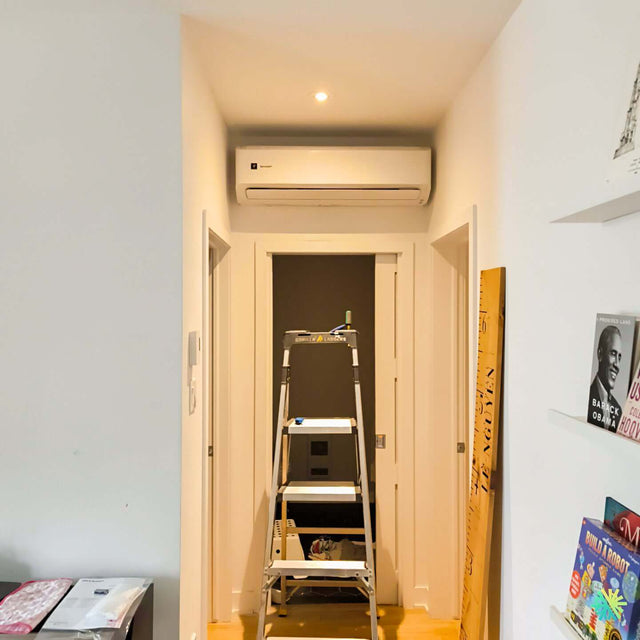
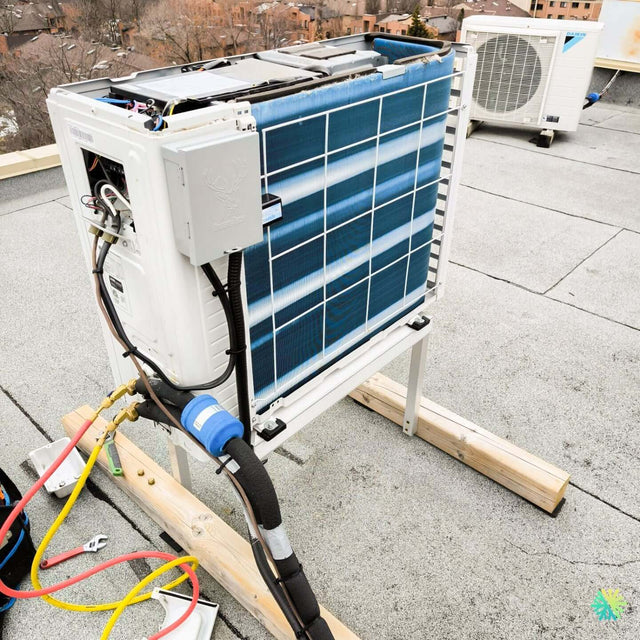
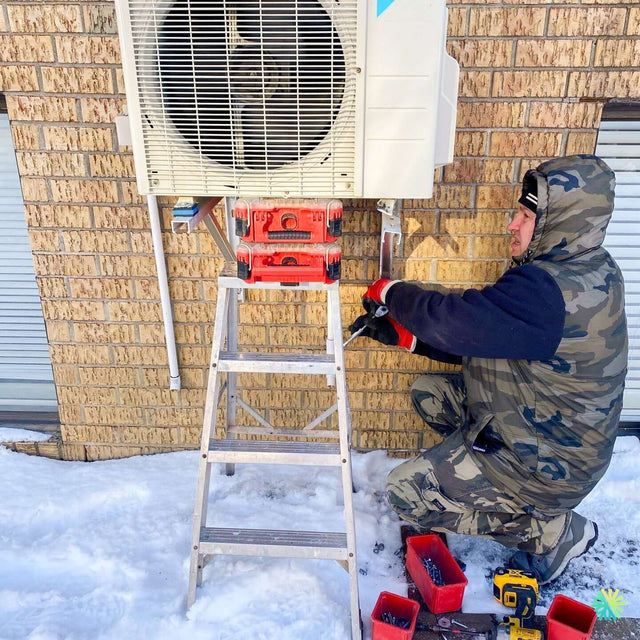
The head is fixed to the wall with its mounting plate; the outdoor unit sits on a bracket or a base.
Both manufacturers ask for the same protection rating. The circuit is checked with a master electrician.
Published sound level of the outdoor unit, in dB(A). Different methods: see the Sound section.
Set the free width of the wall. The heads are drawn at the same scale from their published dimensions (diagram); each manufacturer's clearances come on top and are listed in its installation manual.
| Installation | ORION XLTH | CLIVIA R32 |
|---|---|---|
| Indoor unit H × W × D, weight | 13 3/8 × 45 1/4 × 11 in, 36 lb | 12 1/4 × 39 3/32 × 8 47/64 in, 28.7 lb |
| Outdoor unit H × W × D, weight | 31 × 37 × 12 5/8 in, 117 lb | 25 63/64 × 37 23/32 × 15 53/64 in, 94.8 lb |
| Maximum piping length | 164 ftminimum 16 ft | 131.2 ft |
| Precharged length | 66 ft+0.43 oz per ft beyond | Not published by the manufacturerin GREE Canada brochure 062025 |
| Maximum height difference | 98 ft | 82 ft |
| Liquid – gas diameters | 3/8 – 5/8 in | 1/4 – 1/2 in |
| Electrical protectionminimum circuit ampacity | 20 A breaker19.4 A | 20 A max. protection16 A |
| Published heating / cooling range | −26 to 24 °C / −10 to 50 °C | −30 to 30 °C / −29 to 50 °C |
| Outdoor unit base pan heater | Yes, 150 Wdepending on temperature and mode (NEEP) | Yes, 96 Wper NEEP |
Sources: brochure FG8153D (rev. 4/2025) and 18KZAH1 submittal (version 20250825A) for the ORION XLTH; GREE Canada brochure 062025 for the CLIVIA R32; base pan heaters declared to NEEP. Fastening into the brick, the piping route through the lane and the space in the panel are settled during the visit.
A function missing from a brochure is not necessarily missing from the unit: the document just does not mention it. The chips show which document names it.
"Built-in Wi-Fi" at FUJITSU AIRSTAGE; "Wi-Fi connectivity" at GREE.
Six speeds plus Auto for the ORION XLTH; seven published airflows for the CLIVIA R32.
3.6 L/h published for the ORION XLTH, 1.8 L/h for the CLIVIA R32, each by its manufacturer's method.
"Indoor unit self-cleaning function", named by GREE.
"Optional wired thermostat" at GREE; "compatible with a wide range of optional controllers" at FUJITSU AIRSTAGE.
"No low temperature cut out" written in the FUJITSU AIRSTAGE submittal; a range down to −30 °C published by GREE.
We did not repeat the savings promises of the two brochures ("up to 30%" in one, "up to 10% per year" in the other), nor their environmental statements: they are manufacturer statements, not certified values.
How to read these figures. dB(A) measures a sound level weighted the way the ear hears it; the lower the figure, the quieter. Each dot is a published fan speed. FUJITSU AIRSTAGE measures in an anechoic chamber and warns that an installed unit can sound louder; GREE states neither the method nor the mode for the CLIVIA R32 head.
Why this is not a ranking. The two manufacturers do not measure the same way and do not publish the same number of speeds: the ranges are read side by side, not as the result of a common test.
FUJITSU AIRSTAGE: 18KZAH1 submittal. GREE: brochure 062025, mode not stated.
FUJITSU AIRSTAGE: 18KZAH1 submittal (brochure FG8153D prints 49 in cooling). GREE: brochure 062025.
Next to a party wall, the outdoor unit's location, its base and the distance to the neighbours' windows matter as much as the published figure.
The Lennox wall heat pumps AirGreen sells use R-410A. Our comparison pages put A2L-refrigerant units side by side, like the R-32 of these two wall units. The old article cited no verifiable values for the Lennox; we did not carry them over.
AirGreen does not sell that brand. We only compare units we can offer and install.
None of the documents consulted publishes a service life for these two units. Each manufacturer's warranty comes with the quote; maintenance and installation matter, but we do not publish a figure that no document gives.
The 18KZAH1 submittal states that the system keeps operating below its published range, subject to conditions, with no low-temperature cut-out, and that its capacity is not tested outside that range. The last published figure is the −26.1 °C one: 19,110 BTU/h maximum, NEEP certified.
Both manufacturers ask for 20 A protection, with a minimum circuit ampacity of 19.4 A for the ORION XLTH and 16 A for the CLIVIA R32. Wire size, the panel's condition and the space available are checked with a master electrician.
The ORION XLTH is also sold as GENERAL AIRSTAGE ORION XLTH, with the same AHRI certificate. The CLIVIA R32 shares its AHRI certificate with the GREE CROSSOVER R32 and the black CLIVIA R32; the KINGHOME CLIVIA R32 publishes the same certified values at NEEP. Our page on the CLIVIA platform details these names.
Eligibility is checked model by model on the official list of the program concerned, on the date of your project. We give no amount and no promise here.
| Value | ORION XLTH · AOUH18KZAH1 | CLIVIA R32 · GWH18AGDXF |
|---|---|---|
| Seasonal efficiency | ||
| SEER2 | 25.5 | 24.5 |
| EER2 | 14 | 13.65 |
| HSPF2 region IV | 12.5 | 9 |
| HSPF2 region V | 10.1 | 7.6 |
| Capacity min. / rated / max. | ||
| Cooling at 35 °C (95 °F)BTU/h, min. / rated / max. | 7,000 / 18,000 / 26,200 | 4,400 / 18,000 / 22,178 |
| Heating at 8.3 °C (47 °F)BTU/h, min. / rated / max. | 8,000 / 21,600 / 31,800 | 4,400 / 18,000 / 19,310 |
| Heating at −8.3 °C (17 °F)BTU/h, min. / rated / max. | 5,200 / 13,600 / 27,200 | 7,900 / 18,000 / 18,500 |
| Heating at −15 °C (5 °F)BTU/h, min. / rated / max. | 5,000 / 24,800 / 25,400 | 6,700 / 14,600 / 14,600 |
| COP at 8.3 °Cmin. / rated / max. | 5.45 / 4.37 / 3.21 | 5.37 / 3.91 / 3.33 |
| COP at −15 °Cmin. / rated / max. | 3.57 / 2.08 / 2.02 | 2.81 / 1.90 / 1.90 |
| Coldest published point | ||
| Test temperature | −26.1 °C (−15 °F) | −30 °C (−22 °F) |
| Min. / max. capacity at the coldest point | 3,700 / 19,110 BTU/h | 5,000 / 9,900 BTU/h |
| Min. / max. COP at the coldest point | 3.10 / 1.65 | 2.44 / 1.42 |
| Certification | ||
| AHRI certificate · NEEP listing | 215647921 · 385842 | 216052270 · 383415 |
| ENERGY STARcold climate | Yescold climate: yes | Yescold climate: yes |
| Refrigerant | R-32GWP 675 (IPCC, 4th report) · class A2L | R-32GWP 675 (IPCC, 4th report) · class A2L |
"Higher" marks the higher value of the same measurement, under the same conditions. It is not a recommendation. Capacities at different temperatures and the coldest-point group are never highlighted. The cooling COPs NEEP publishes for the ORION XLTH are inconsistent with its power figures; they are not used. The ORION XLTH's rated value at −15 °C (24,800) is higher than at −8.3 °C (13,600): that is what NEEP and the submittal publish.
Duplex, brick wall, old panel: tell us about your house and where the outdoor unit would go. Free estimate visit.
Data verified November 17, 2026. Certified values: AHRI certificates published by NEEP. Declared values: the manufacturers' documents cited above. The cost is an estimate using AirGreen method v1.1, described above.
FUJITSU AIRSTAGE, ORION XLTH, GENERAL AIRSTAGE, GREE, CLIVIA, CROSSOVER and KINGHOME are trademarks of their respective owners. Logos and images are used only to identify the products. AirGreen is a retailer; this page is not produced, sponsored or endorsed by the manufacturers.
Photos: AirGreen, for identification.
Does a figure look wrong to you? Write to us at sales@airgreen.ca.
An AirGreen advisor assesses your situation on site, free of charge, and gives you a quote within 24 hours.